
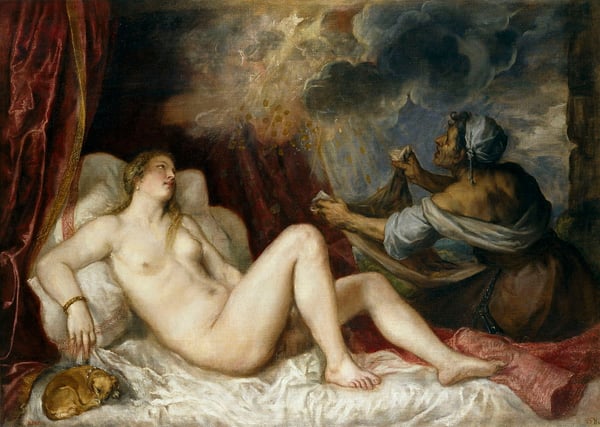
Expert analysis of Titian’s Danae
Style: Mannerism (Late Renaissance) · Genre: mythological painting
As an expert art historian, I can provide an analysis of Titian's "Danae" based solely on the provided facts: its style as Mannerism (Late Renaissance) and its genre as a mythological painting. The significance of this work lies in how it exemplifies the key shifts of Mannerism while remaining deeply rooted in the mythological tradition.
Significance within Mannerism (Late Renaissance):
The painting is a prime example of Mannerist departures from the High Renaissance ideals of balance, harmony, and naturalism. Titian introduces a distinct sense of artificiality and elegance that is typical of Mannerism. The composition is deliberately asymmetrical, with the figure of Danae reclining diagonally across the canvas, creating a dynamic, serpentine (figura serpentinata) line that draws the eye. This poses tension and movement, rather than the stable, pyramidal compositions of earlier Renaissance works. The perspective is slightly distorted; the bed and setting push the figure forward, while the floating golden rain (Zeus’s form) is rendered with a soft, dissolving brushwork that emphasizes the unreal, dreamlike quality of the moment. The color palette is rich but dissonant—veering towards vivid, almost artificial tones (the deep crimson drapery, the gleaming gold, the pale flesh) that prioritize emotional and sensuous impact over naturalistic accuracy.
Significance within the mythological genre:
As a mythological painting, "Danae" reinterprets the classical story of Jupiter’s seduction of Danae (as gold) through a distinctly Mannerist lens. Instead of a heroic or narrative depiction, Titian focuses on sensuality and psychological complexity. The intimate, eroticized treatment of the nude—with her relaxed, inviting pose and direct gaze—subverts the traditional, distant portrayal of mythological heroines. This foregrounding of flesh and emotion was controversial and innovative, marking a shift from mythological allegory to a more personal, almost voyeuristic experience. The inclusion of a maidservant in the background collecting the gold coins adds a layer of moral ambiguity and contrast, typical of Mannerism's love for complex, ambiguous storytelling over straightforward morality.
In conclusion, the work's significance is that it uses the mythological genre as a vehicle for Mannerist experimentation—sacrificing classical balance for elegant tension, artificial beauty, and heightened sensuality—making it a seminal bridge between the High Renaissance and the more mannered, theatrical art of the 16th century.
Museum / Gallery
Visually similar
20 works with related composition and palette
Danae
Titian
Lying nude with jug
Achille Devéria
The Sleepers
Gustave Courbet

Liggie Venus
Titian
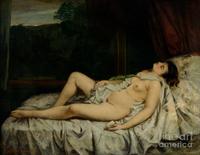
Sleeping Nude
Gustave Courbet
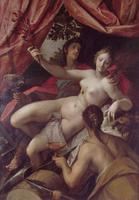
Allegory of Peace, Art, and Abundance
Hans von Aachen
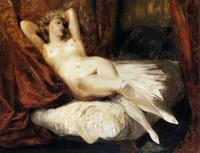
Female Nude Reclining on a Divan
Eugene Delacroix
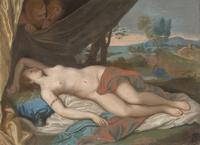
Sleeping nymph spied by satyrs (after a painting based on a print by Anthony van Dyck)
Jean-Étienne Liotard
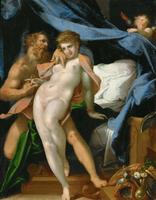
Vulcan and Maia
Bartholomeus Spranger
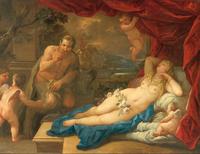
Jupiter and Antiope
Luca Giordano
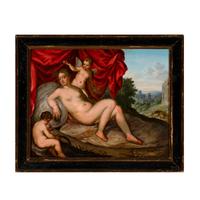
Venere e Amore
Hans Rottenhammer I
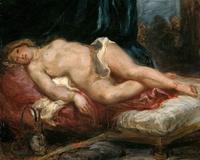
Odalisque
Eugene Delacroix
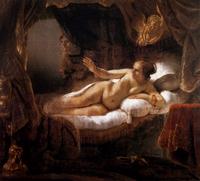
Danae
Rembrandt
The Death of Dido
Peter Paul Rubens

Danae
Alexandre-Jacques Chantron
Sleeping Venus
Artemisia Gentileschi
Venus and the Lute Player
Titian
Shepherd and Nymph
Titian

Sleeping Venus and Cupid
Nicolas Poussin
The Toilette
Antoine Watteau