
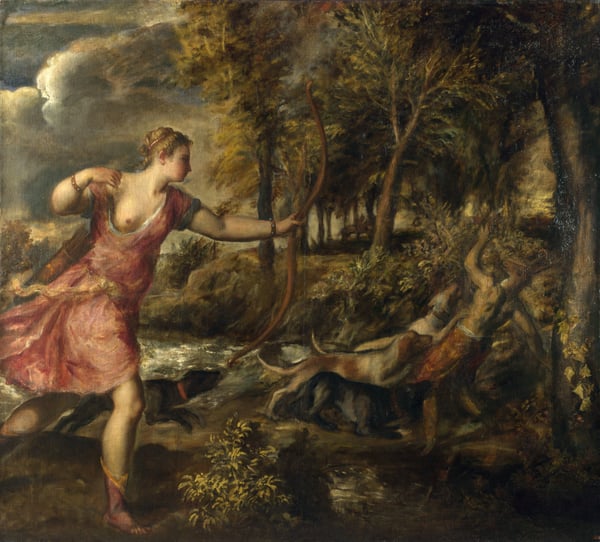
Expert analysis of Titian’s Death of Actaeon
Style: Mannerism (Late Renaissance) · Genre: mythological painting
Expert Analysis: Death of Actaeon by Titian
Titian’s Death of Actaeon stands as a masterful and harrowing example of Late Renaissance Mannerism, signaling the artist’s radical departure from the balanced naturalism of the High Renaissance. Painted in the final years of his life (c. 1559–1576), the work is both unfinished and profoundly expressive—a quality that marks its significance within the Mannerist canon.
1. Mannerist Dynamism and Emotional Intensity
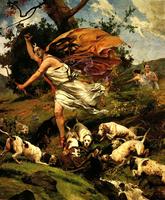
Unlike the static, idealized compositions of earlier Renaissance painting, Titian here unleashes a swirling, diagonal energy. Actaeon, partially transformed into a stag, is mauled by his own hounds in a dense, chaotic forest. The figures are elongated and twisted—hallmarks of Mannerist figura serpentinata—while the goddess Diana presides from a shadowy cloud, her cold detachment amplifying the scene’s psychological brutality. This deliberate distortion and emotional charge reject classical harmony in favor of subjective, even violent expression.
2. The “Unfinished” Sublime
Titian left the canvas incomplete, yet that incompleteness is central to its power. Broad, slashing brushstrokes in the background and the hounds’ fur create a sense of raw, tactile motion—a technique that anticipates Baroque bravura and even Impressionist facture. The lack of finish does not diminish the drama; instead, it emphasizes the fleeting, disintegrating moment of death. This daring approach challenges the Renaissance ideal of polished perfection and elevates process as meaning.
3. Inventive Color and Luminosity
Titian’s late colorism is on full display: a molten palette of deep greens, ochres, and flesh tones trembles with reflected light. The red of Diana’s robe and the searing white of Actaeon’s highlighted flank create a jaring, almost non-naturalistic intensity—a Mannerist taste for colore espressivo over mere description. The painting’s sfumato and broken tonalities dissolve outlines, merging figures with their environment in a way that feels both modern and mythic.
4. Narrative Subversion
The myth of Actaeon—punished for accidentally glimpsing Diana bathing—is here stripped of any moral clarity. Titian focuses on the moment of annihilation, not the prior transgression. Diana’s indifference and the savagery of the dogs (some of which are named in Ovid’s Metamorphoses) render the gods cruel and the cosmos arbitrary, a deeply Mannerist pessimism that contrasts with the earlier Renaissance faith in divine order.
Significance:
Death of Actaeon is a culmination of Titian’s lifelong exploration of violence, beauty, and mortality. It bridges the Mannerist obsession with artifice and tension and the raw, unmediated emotionalism that would define the Baroque. In its audacious brushwork, chromatic daring, and psychological rawness, it stands as one of the most compelling mythological works of the late 16th century—a testament to an aging master breaking every rule he once perfected.
Museum / Gallery
Visually similar
20 works with related composition and palette
Apollo and the Python
Cornelis de Vos
Diana and Cupid
Pompeo Batoni
Pan Et Syrinx
Adam Elsheimer
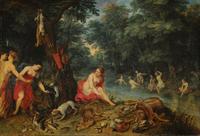
Nymphs bathing
Jan Brueghel the Elder
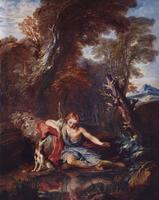
Narziss
François Lemoyne
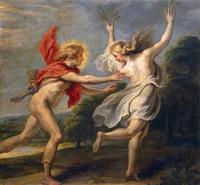
Apollo Chasing Daphne
Cornelis de Vos
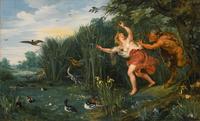
Landscape with Pan and Syrinx
Peter Paul Rubens
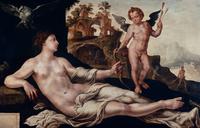
Venus and Amor
Maerten van Heemskerck
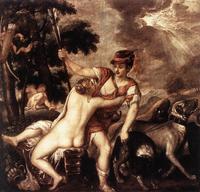
Venus and Adonis
Titian
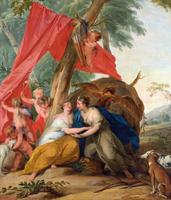
Jupiter, Disguised As Diana, Seducing The Nymph Callisto
Jacob de Wit
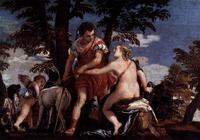
Venus and Adonis
Paolo Veronese
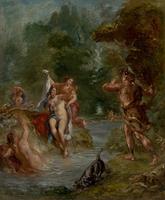
The Summer Diana Surprised by Actaeon
Eugene Delacroix
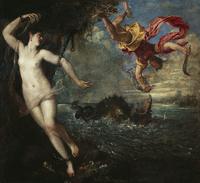
Perseus and Andromeda
Titian
Venus Presenting Arms to Aeneas
Nicolas Poussin
Venus Directing Aeneas and Achates to Carthage
Angelica Kauffman
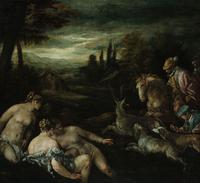
Diana and Actaeon
Jacopo Bassano
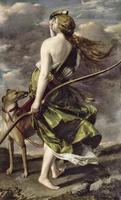
Diana the Huntress
Orazio Gentileschi
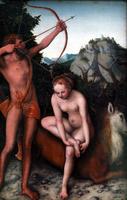
Apollo and Diana
Lucas Cranach the Elder
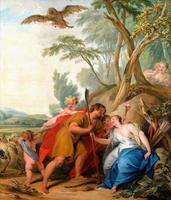
Jupiter, Disguised As a Shepherd, Seducing Mnemosyne, The Goddess of Memory
Jacob de Wit
Diana cazadora
Arturo Michelena