
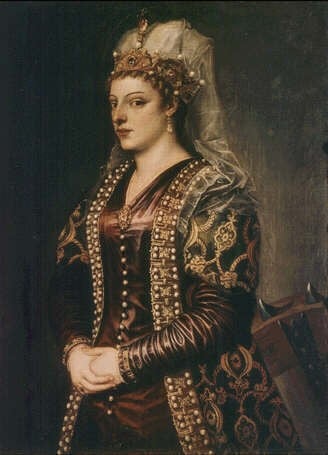
Expert analysis of Titian’s Portrait of Caterina Cornaro (1454-1510) wife of King James II of Cyprus, dressed as St. Catherine
Style: Mannerism (Late Renaissance) · Genre: portrait
This portrait by Titian—a master typically associated with the High Renaissance—is a striking example of how the artist adapted to the Mannerist sensibilities of the late 16th century. The work’s significance lies in its sophisticated fusion of courtly portraiture with saintly allegory, a hallmark of Mannerist artifice and intellectual play.
Historical and Symbolic Layering:
Caterina Cornaro, the former Queen of Cyprus, is depicted not merely as a noblewoman but as St. Catherine of Alexandria. By dressing her in the saint’s attributes—the crown, the wheel (often seen as a broken wheel in traditional iconography), and the palm of martyrdom—Titian elevates her political identity into a spiritual and virtuous ideal. This conflation of a living historical figure with a sacred martyr was a Mannerist strategy to imbue the portrait with moral authority and timeless grandeur. Cornaro’s own life—her forced abdication and return to Venice—mirrors the saint’s steadfastness, making the allegory particularly poignant.
Mannerist Stylization:
While Titian’s earlier works are known for their naturalistic color and atmospheric softness, here the composition shows Mannerist tendencies: a slightly elongated elegance in Caterina’s figure, a cool, refined palette, and a deliberate, almost theatrical arrangement of drapery and props. The sitter’s gaze is direct but distant, creating a psychological tension that reflects the Mannerist interest in intellectual distance and courtly poise. The broken wheel and the landscape backdrop (perhaps alluding to Cyprus or to the idyllic world of the saint) are not strictly realistic but serve as symbolic props in a sophisticated visual riddle.
Significance within Period:
As a work labeled Mannerism (Late Renaissance), this portrait demonstrates the transition from the balanced, harmonious ideals of the High Renaissance to a more stylized, self-conscious art. Titian, working in his later years, shows that even the most acclaimed Venetian colorist could engage with the courtly, artificial language of Mannerism—especially in a portrait meant to immortalize a queen as a saint. The painting thus stands as a bridge between Titian’s own naturalistic legacy and the more intellectual, elongated forms of artists like Bronzino or Parmigianino.
In sum, the portrait’s significance lies in its seamless blending of historical reality and sacred allegory, its refined Mannerist elegance, and its demonstration of Titian’s versatility within the changing currents of late Renaissance art.
Visually similar
20 works with related composition and palette

Cameria, daughter of Suleiman the Magnificent
Titian
Portrait of Bianca Cappello
Alessandro Allori
Portrait of a Lady
Titian
Portrait of a Woman
Cornelis de Vos
Portrait of a Lady
Paolo Veronese
La Reina Isabel I De Castilla
Luis de Madrazo y Kuntz
Portrait of a lady, possibly Margaret Cecil, Countess of Ranelagh, seated three-quarter length, in Coronation robes
Godfrey Kneller
Portrait of Isabella of Portugal, wife of Holy Roman Emperor Charles V
Titian
Unknown Lady
Agnolo Bronzino
Eleonora da Toledo
Agnolo Bronzino
The Beauty
Titian
Portrait of Eleonora Di Toledo
Alessandro Allori
Eleonora da Toledo
Agnolo Bronzino
Portrait of a Noble Genoese Lady
Anthony van Dyck
Portrait d`Isabella d`Este
Titian
Margaret Graham (d.c.1626), Lady Napier, Sister of 1st Marquess of Montrose and Wife of 1st Lord Napier
Adam de Colone
Lady Ponsonby, née Caroline Cavendish in Costume Veneziano
Jean-Étienne Liotard
Kaiserin Maria Theresia Von Neapel-Sizilien
Joseph Kreutzinger
Helena Fourment
Peter Paul Rubens

Queen Isabel, Standing
Diego Velazquez