
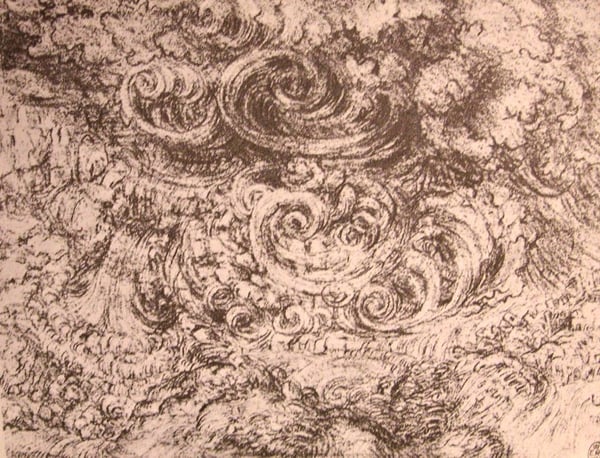
Analisi esperta di Drawing of an flood di Leonardo da Vinci
Stile: High Renaissance · Genere: religious painting
Expert Analysis of Drawing of a Flood by Leonardo da Vinci
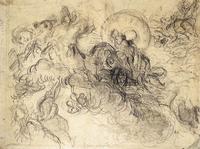
Artwork: Drawing of a Flood (often grouped among Leonardo’s Deluge series)
Artist: Leonardo da Vinci (1452–1519)
Style: High Renaissance
Genre: Religious painting (though executed as a drawing, it depicts the biblical Deluge from Genesis)
Significance within the High Renaissance
Leonardo’s Drawing of a Flood stands as one of the most extraordinary examples of how High Renaissance artists merged scientific observation with spiritual narrative. Although technically a drawing—likely in red chalk or ink on paper—it was conceived as a study for a monumental religious painting, reflecting the period’s ambition to elevate natural phenomena into divine drama.
1. Synthesis of Science and Spirituality
Leonardo, a polymath, applied his rigorous study of hydrodynamics, meteorology, and geology to this biblical subject. The swirling torrents, cascading waterfalls, and spiraling winds are not mere fantasy; they are grounded in his detailed observations of water flow, erosion, and atmospheric turbulence. This fusion of empirical knowledge with a religious theme exemplifies the High Renaissance ideal that nature itself reveals God’s power.
2. Dynamic Composition and Emotional Impact
Unlike earlier, static depictions of the Flood, Leonardo’s drawing is a maelstrom of movement. Figures cling to shattered trees, rocks tumble through churning waves, and the sky is torn by violent gusts. The composition spirals outward from a central vortex, drawing the viewer into the cataclysm. This dynamism—achieved through rapid, expressive linework—anticipates the Baroque, yet remains rooted in the High Renaissance’s pursuit of terribilità (awe-inspiring power).
3. Technical Virtuosity
Leonardo’s use of sfumato (soft, smoky transitions) and chiaroscuro (strong contrasts of light and dark) in a drawing medium was revolutionary. He built form through hatching and cross-hatching, creating a sense of billowing clouds and frothy waves that seem almost tangible. The unfinished, sketch-like quality preserves the artist’s thought process, making this a rare window into his creative genius.
4. Unfinished Ambition
The Drawing of a Flood was never developed into a finished painting, yet it remains a masterpiece of conceptual art. It demonstrates Leonardo’s lifelong fascination with apocalypse and renewal—themes that recur in his later Storm over a Landscape and notes on the “deluge of the world.” This work thus embodies both the High Renaissance’s faith in human reason and its recognition of nature’s uncontrollable force.
Conclusion
Leonardo’s Drawing of a Flood is significant because it transforms a religious subject into a universal meditation on chaos, mortality, and the sublime power of nature. It pushes the boundaries of drawing as a finished art form, marrying scientific precision with spiritual awe—a hallmark of the High Renaissance at its most daring.
Visivamente simili
20 opere con composizione e palette affini
Natural disaster
Leonardo da Vinci
Deluge over a city
Leonardo da Vinci
Sketch of Clouds with Colour Annotations
Vincent van Gogh
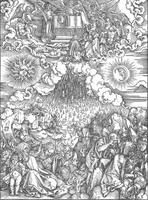
The Opening of the Fifth and Sixth Seals
Albrecht Durer
Ancient land
Konstantin Bogaevsky
Landscape with the Oise
Vincent van Gogh
Untitled (Variations around La Poupée)
Hans Bellmer
Cloud
Nicholas Roerich
Tobias and the Angel Raphael
Adam Elsheimer
The Whore of Baylon
Albrecht Durer
Consciousness
Rose O'Neill
Caprice decorative frames in the middle of a wall with a oval in the upper left a barrel and a hand pours a drink, the lower a syringe, a club, a caduceus, a censer smoke, an hourglass, skulls and bones
Giovanni Battista Piranesi
So be light
Konstantin Yuon
Risveglio
FELICECOSI
Jacob Finds Rest in a Rugged Landscape and Dreams of a Ladder
Salvator Rosa
Elijah Destroys the Messengers of Ahaziah
Gustave Dore
Ride
Boris Kustodiev
The Creation of Light
Gustave Dore
Untitled
Nicholas Roerich
Apollo Slays Python
Eugene Delacroix