Analisi esperta di Book of doves di Nicholas Roerich
Stile: Symbolism · Genere: religious painting
Expert Analysis: "Book of Doves" by Nicholas Roerich
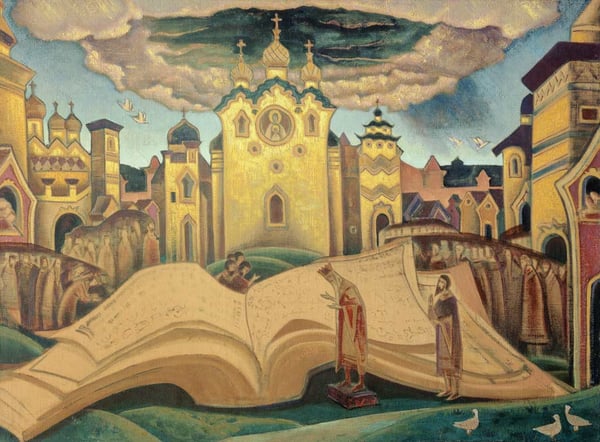
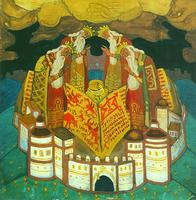
Nicholas Roerich’s Book of Doves exemplifies the profound spiritual synthesis that defines his mature Symbolist period. Executed in the early 20th century, the painting fuses Eastern religious iconography with a Western Symbolist sensibility, creating a work that transcends mere illustration to become a meditation on peace, wisdom, and cosmic harmony.
Composition and Symbolism
True to Roerich’s hallmark style, the composition is stark yet luminous. A central figure—perhaps a sage or a bodhisattva—holds an open book from which white doves ascend. The doves, traditional symbols of peace and the Holy Spirit, are recontextualized within a Buddhist or Himalayan setting, suggesting a universal spiritual message. The background typically features Roerich’s signature layered mountains and an ethereal sky, painted in crystalline blues, mauves, and golds. The palette is deliberately non-naturalistic, using color to evoke transcendence rather than physical reality.
Significance within Symbolism
Roerich was a leading figure in Russian Symbolism, a movement that sought to express inner truths through metaphor and myth. Book of Doves is significant because it embodies Symbolism’s turn toward the East as a source of esoteric wisdom. At a time when many Western artists borrowed exotic motifs superficially, Roerich—inspired by his extensive travels and his founding of the Agni Yoga Society—integrated genuine Buddhist and Hindu concepts into his iconography. The “book” here may refer to the Dhammapada or a universal text of compassion, while the doves recall the Buddhist teaching of non-violence (ahimsa).
Religious Genre and the Roerich Pact
As a religious painting, Book of Doves avoids depicting a specific biblical or mythological narrative. Instead, it creates an archetypal sacred scene, open to multiple faiths. This ecumenical approach was groundbreaking for its time. Roerich later became famous for the Roerich Pact (1935), an international treaty protecting cultural heritage in wartime, and the painting’s message of peace directly prefigures that activism. The doves, thus, are not just symbols but a call to action—an artistic counterpart to his humanitarian work.
Legacy
Book of Doves remains a key work for understanding how Symbolism evolved into a global spiritual art. Roerich’s ability to blend the ethereal beauty of the Himalayas with the quiet gravity of a sacred text makes this painting a touchstone for those exploring art as a vehicle for universal brotherhood. Its significance lies in its quiet confidence: it does not preach, but invites the viewer into a state of silent reverence, where the boundary between the earthly and the divine dissolves.
Visivamente simili
20 opere con composizione e palette affini
The saints have gone - leave Gleb as keeper
Nicholas Roerich
Sketch for the opera "Boris Godunov" by Modest Mussorgsky
Ivan Bilibin
Design for final backcloth
Natalia Goncharova
Boyan
Nicholas Roerich

Zvenigorod
Nicholas Roerich
Book of Doves
Nicholas Roerich
Sketch for the opera "Legend of the Invisible City of Kitezh and Maiden Fevronia" by Nikolai Rimsky-Korsakov
Ivan Bilibin
And we see
Nicholas Roerich
Monks Anthony and Theodosius of the Caves
Orthodox Icons
Saint Sergius
Nicholas Roerich
Arrival of Prince Michael Glanda Kambila to Russia, Veliky Novgorod
Nicholas Roerich
Sergius of Radonezh
Nicholas Roerich

Russian Easter
Nicholas Roerich
Icon The Descent of the Holy Spirit
Petro Kholodny (Elder)

Yaroslav the Wise
Nicholas Roerich
Procopius the Righteous
Nicholas Roerich
Saint Nicholas (Nicola Mozhaisky)
Nicholas Roerich
Intercession of the Theotokos
Nicholas Roerich
Towns
Nicholas Roerich
Saint guests
Nicholas Roerich