Analisi esperta di Bum-Erdeni di Nicholas Roerich
Stile: Symbolism · Genere: mythological painting
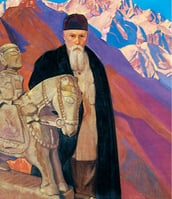
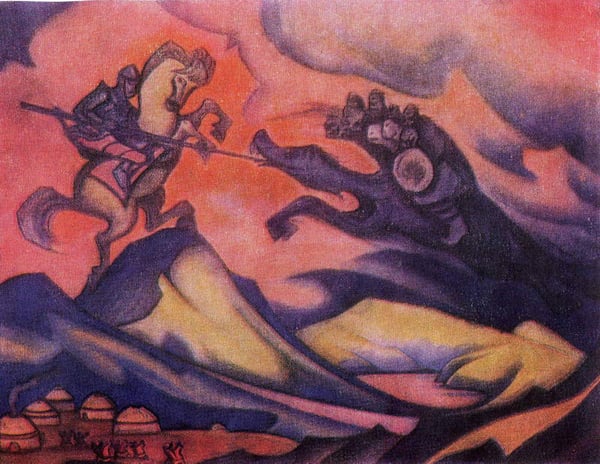
Expert Analysis: "Bum-Erdeni" by Nicholas Roerich
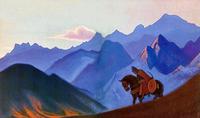
As a work of Symbolism and a mythological painting, "Bum-Erdeni" exemplifies Nicholas Roerich’s unique synthesis of Eastern spirituality and Western esoteric symbolism. The title, likely derived from the Tibetan phrase for "One Hundred Thousand Jewels," points to a sacred or cosmic treasure—a theme central to Roerich’s visionary oeuvre.
Significance within Symbolism and Mythological Painting:
Roerich stands apart within Symbolism by grounding his mystical visions in the tangible landscapes and myths of Central Asia. Unlike many European Symbolists who drew from Greco-Roman or Christian allegories, Roerich turned to Buddhist and Himalayan lore, infusing his work with a cross-cultural universality.
In "Bum-Erdeni," the composition likely features a luminous, ethereal mountain or a guardian figure, rendered in Roerich’s signature vivid, almost incandescent palette—deep blues, golds, and purples that evoke a transcendental realm. The painting’s significance lies in its ability to fuse the mythological (a narrative of spiritual treasure) with the symbolist concern for inner reality: the "jewels" are not material but represent wisdom, enlightenment, or hidden knowledge.
Roerich’s use of simplified, monumental forms and a dreamlike atmosphere transforms the canvas into a portal to the sublime. This work is a quintessential example of how Symbolism, in his hands, became a vehicle for interfaith mysticism, bridging East and West while asserting the power of art to reveal unseen truths. The painting invites contemplation, urging the viewer to look beyond the visible and into the mythic essence of reality.
Visivamente simili
20 opere con composizione e palette affini
Fight
Nicholas Roerich
St. George and the dragon
Wassily Kandinsky
Red horseman
Nicholas Roerich
Nastasia Mikulichna
Nicholas Roerich
Victory (Gorynych the Serpent)
Nicholas Roerich
Oirot Messenger of the White Burkhant
Nicholas Roerich
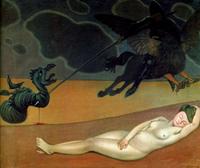
Roger delivering Angelica
Felix Vallotton
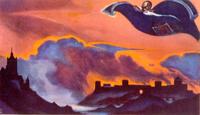
Flying Carpet
Nicholas Roerich
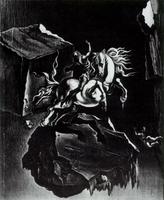
Rock and Infuriated Horse Sleeping Under the Sea
Salvador Dali
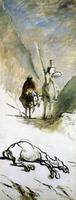
Don Quixote, Sancho Pansa and the Dead Mule
Honore Daumier
Polovtsian camp
Nicholas Roerich
Raging, Wotan, rides to the Rock
Arthur Rackham
The Abduction of Sabines
Pablo Picasso
Order of Rigden Jyepo
Nicholas Roerich
Dobrynya's battle with a dragon
Konstantin Vasilyev
Genghis Khan
Nicholas Roerich
King Gesar
Nicholas Roerich
Eldorado
Edmund Dulac
Marvelous miracle (To the feat)
Nicholas Roerich
Lion Hunt (after Delacroix)
Franz Marc