Analisi esperta di Genghis Khan di Nicholas Roerich
Stile: Symbolism · Genere: history painting
Expert Analysis of “Genghis Khan” (c. 1930s) by Nicholas Roerich
Style & Genre
Executed in the Symbolist tradition and classified as a history painting, Roerich’s “Genghis Khan” transcends mere historical record. Symbolism, with its emphasis on inner vision, myth, and metaphysical resonance, allowed Roerich to treat the Mongol conqueror not as a literal figure but as an archetype of primal will, cultural fusion, and spiritual dynamism. The work belongs to Roerich’s celebrated “Heroic” and “Asiatic” series, where history becomes a vessel for eternal truths.
Composition & Imagery
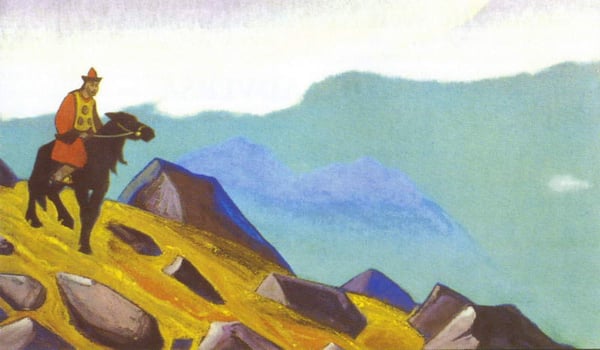
Though no image is provided, Roerich’s style is consistent: vast, uncluttered horizons; a monumental, often silhouetted central figure; and a dramatic interplay of deep blues, ochres, and fiery oranges. Genghis Khan is likely depicted on horseback against a sweeping Central Asian landscape—perhaps the Gobi steppe or the Altai Mountains—with the sky charged with symbolic light. Roerich’s figures are simplified, almost hieratic, evoking ancient frescoes or thangka painting. The atmosphere would be one of austere majesty, with the horizon line placed low to emphasize the figure’s dominance and the vastness of the land he united.
Significance within Symbolism
Roerich’s Genghis Khan is significant for several reasons:
-
Spiritualizing Historical Subject Matter – In Symbolist practice, history is not documentary but emblematic. Roerich presents Genghis Khan as a shamanic force—a unifier of East and West, and a precursor to the “New Era” of spiritual synthesis championed by the Theosophical movement (with which Roerich was deeply involved). The conqueror becomes a symbol of the creative, destructive energy necessary for cultural renewal.
-
East-West Bridge – Roerich’s lifelong mission was to reunite Asian and European spiritual traditions. “Genghis Khan” embodies this: the Mongol Empire, often demonized in Western history, is recast as a vessel of cross-fertilization. The painting’s symbolic language blends Russian icon painting, Buddhist mandala geometry, and the chromatic intensity of the Blue Rider group (with whom Roerich exhibited).
-
Monumental Simplicity – Unlike academic history painting’s cluttered battle scenes, Roerich reduces the narrative to a single, potent image. This minimalism—a hallmark of Symbolist abstraction—forces viewers to encounter the idea of Genghis Khan rather than a literal episode. The result is a timeless icon, akin to a saint’s image or a tarot card.
-
Roerich’s Unique Vision – As both a painter and a philosopher, Roerich used history painting to propose a “Pan-Human” culture. “Genghis Khan” anticipates his later banner “Peace through Culture” and his famous “Roerich Pact” for the protection of cultural heritage. The painting is thus not merely a historical portrait but a manifesto: the conqueror’s power is ultimately subordinated to the artist’s vision of unity.
Conclusion
In “Genghis Khan,” Nicholas Roerich crystallizes Symbolism’s core ambition: to make the past speak in universal, spiritual terms. The work stands as a masterful fusion of history painting and symbolic abstraction, affirming Roerich’s role as a visionary who saw in the Mongol leader a timeless symbol of the creative, unifying force that transcends boundaries—geographic, cultural, and temporal.
Visivamente simili
20 opere con composizione e palette affini
Mongolian horseman
Nicholas Roerich
Mother of Genghis Khan
Nicholas Roerich

Voice of Mongolia
Nicholas Roerich
Oirot Messenger of the White Burkhant
Nicholas Roerich
He who hastens
Nicholas Roerich

Marvelous miracle (To the feat)
Nicholas Roerich
Mother of Genghis Khan
Nicholas Roerich
Compassion
Nicholas Roerich
Remember
Nicholas Roerich
Mongolia. Yurtas.
Nicholas Roerich
Charaka
Nicholas Roerich
Mongolia (Campaign of Genghis Khan)
Nicholas Roerich
Chenrezig
Nicholas Roerich
Order of Rigden Jyepo
Nicholas Roerich

King Gesar
Nicholas Roerich
A depiction of the Cintamani being carried by the Lung Ta (Wind Horse)
Nicholas Roerich
Fires of victory (Sentinel lights on the towers in Gobi)
Nicholas Roerich
Nastasia Mikulichna
Nicholas Roerich
She who leads
Nicholas Roerich
Soria Moria Slott
Theodor Severin Kittelsen