
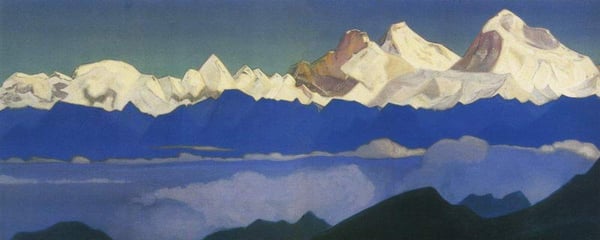
Análisis experto de Everest de Nicholas Roerich
Estilo: Symbolism · Género: landscape
Expert Analysis of "Everest" by Nicholas Roerich
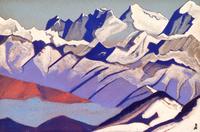
Nicholas Roerich’s "Everest" stands as a quintessential example of Symbolist landscape painting, where the natural world becomes a vessel for spiritual and metaphysical meaning. Within the Symbolist movement, artists rejected mere visual realism in favor of evoking inner states, and Roerich brings this to its zenith by transforming the iconic Himalayan peak into a luminous, almost otherworldly icon.
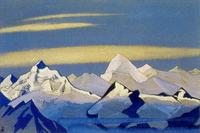
Composition and Color as Symbol The painting typically features the stark, soaring silhouette of Mount Everest against a vast, ethereal sky. Roerich’s signature palette—high-keyed blues, purples, and cool whites—imbues the scene with a sense of stillness and transcendence. The mountain is not rendered with geological precision but as a monumental, archetypal form, its snowy ridges glowing as if lit from within. This use of color and simplified geometry aligns with Symbolism’s goal to express the ineffable; the mountain becomes a threshold between the earthly and the divine.
Significance within Symbolism and Landscape Roerich’s "Everest" is significant for how it merges the landscape genre with Theosophical and Eastern spiritual ideas. The artist was a devoted explorer and mystic who saw the Himalayas as a living symbol of humanity’s spiritual ascent. In this work, the mountain is not a passive backdrop but an active protagonist—a beacon of purity, challenge, and enlightenment. The absence of human figures or dramatic action forces the viewer to confront the sublime scale of nature and their own inner contemplation, a hallmark of Symbolist landscape.
Cultural and Historical Context Painted during Roerich’s Central Asian expeditions (1920s–1930s), "Everest" also reflects his role as a cultural bridge. It anticipates the later fascination with Tibet and the Himalayas in Western consciousness, yet avoids Orientalism by treating the landscape with genuine reverence. Roerich’s technique—thin, luminous washes of color—evokes the atmospheric effects of the high altitude, making the viewer feel both the physical cold and the spiritual warmth of the scene.
Legacy "Everest" endures as a masterwork because it transcends its genre: it is at once a landscape, a meditation, and a manifesto. Roerich proves that Symbolism’s power lies in making the visible world speak for the invisible, and here, Everest becomes the eternal, silent teacher. Its significance lies in its ability to transform a geographical fact into a universal symbol of aspiration—a goal Roerich pursued throughout his artistic life.
Visualmente similares
20 obras con composición y paleta relacionadas
Everest
Nicholas Roerich
Treasure of snows (Kangchenjunga)
Nicholas Roerich

Sacred Himalayas
Nicholas Roerich

Himalayas
Nicholas Roerich

Himalayas
Nicholas Roerich

Himalayas
Nicholas Roerich

Kangchenjunga
Nicholas Roerich
Kangchenjunga
Nicholas Roerich
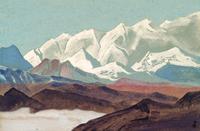
Himalayas. Chain of Kanchenjunga.
Nicholas Roerich
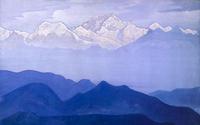
Himalayas
Nicholas Roerich
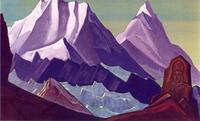
Maitreya
Nicholas Roerich

Nanda Devi
Nicholas Roerich
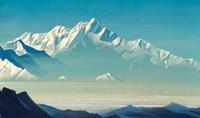
Mount of five treasures (Two worlds)
Nicholas Roerich
Everest
Nicholas Roerich
Himalayas
Nicholas Roerich
Land of snow people
Nicholas Roerich
Kangchenjunga
Nicholas Roerich
Himalayas. Everest.
Nicholas Roerich
Himalayas
Nicholas Roerich
Kangchenjunga
Nicholas Roerich