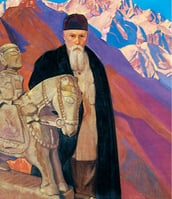
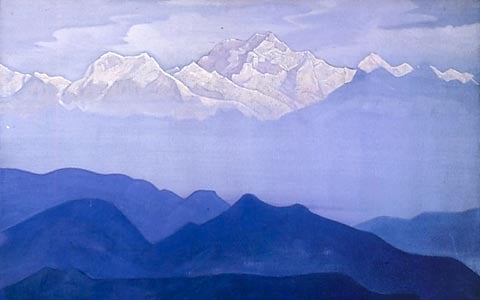
Nicholas Roerich の Himalayas の専門的な分析
スタイル:Symbolism · ジャンル:landscape
Expert Analysis: "Himalayas" by Nicholas Roerich
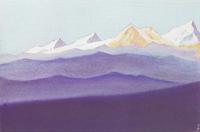
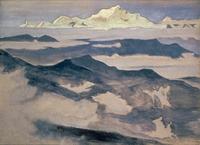
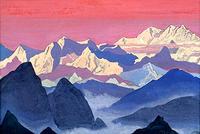
Nicholas Roerich’s "Himalayas" stands as a masterful synthesis of Symbolist ideals and landscape painting, elevating a physical mountain range into a transcendent spiritual vision. Within the Symbolist movement, which sought to express inner truths and mystical experiences through visual metaphor, Roerich’s work is significant for its ability to transform a specific geographical location into a universal symbol of enlightenment, purity, and cosmic harmony.
Key aspects of its significance:
-
Symbolist transcendence of the natural world: Unlike conventional landscapes that aim for topographical accuracy, Roerich treats the Himalayan peaks as archetypal forms. The mountains are not merely geological features but gateways to higher consciousness—a core Symbolist pursuit of evoking the ineffable. The composition often strips away anecdotal detail, focusing on sweeping, simplified silhouettes that suggest the eternal and the sacred.
-
Chromatic spirituality: Roerich’s distinctive palette—dominated by luminous blues, purples, and whites—is not naturalistic but symbolic. Cool, ethereal tones evoke the thin air of high altitudes and, more importantly, a meditative, otherworldly atmosphere. Light itself becomes a character, often emanating from behind the peaks to suggest an inner radiance or divine presence. This aligns with Symbolism’s interest in color as a vehicle for emotion and metaphysical meaning.
-
Cultural and philosophical fusion: Roerich was deeply influenced by Eastern philosophy, Theosophy, and the idea of Shambhala—a hidden spiritual kingdom in the Himalayas. "Himalayas" thus bridges Western Symbolist aesthetics with Asian spiritual concepts, making it a landmark in cross-cultural artistic dialogue. The landscape becomes a meditation on the unity of all existence, a theme central to Roerich’s broader oeuvre.
-
Contribution to the "mountain landscape" within Symbolism: While many Symbolists focused on mythological or dreamlike scenes, Roerich rooted his symbolism in the actual, majestic terrain of Central Asia. This gives his work a unique grounding: the sublime power of nature is not rejected in favor of fantasy but is itself the source of symbolic power. The Himalayas are both real and ideal, concrete and transcendent.
In summary, "Himalayas" is significant because it perfectly embodies Symbolism’s goal of using visual art to suggest hidden realities—here, the spiritual majesty of the mountains becomes a mirror for the soul’s ascent. Roerich’s serene, hieratic style and his integration of Eastern mysticism mark the work as a distinctive and influential contribution to early 20th-century Symbolist landscape painting.
視覚的に類似
構図やパレットが近い作品 20 件

Himalayas
Nicholas Roerich

Himalayas
Nicholas Roerich

Kangchenjunga
Nicholas Roerich

Sacred Himalayas
Nicholas Roerich

Treasure of snows (Kangchenjunga)
Nicholas Roerich

Kangchenjunga
Nicholas Roerich

Everest
Nicholas Roerich

Kangchenjunga
Nicholas Roerich

The glory of Himalayas
Nicholas Roerich

Border of Tibet
Nicholas Roerich
Kangchenjunga
Nicholas Roerich

Himalayas. Blue mountains.
Nicholas Roerich
Himalayas
Nicholas Roerich
Himalayas
Nicholas Roerich

Mountains Soshing
Nicholas Roerich

Himalayas
Nicholas Roerich

Himalayas
Nicholas Roerich
Evening
Nicholas Roerich

Mount of five treasures (Two worlds)
Nicholas Roerich
Kangchenjunga
Nicholas Roerich