
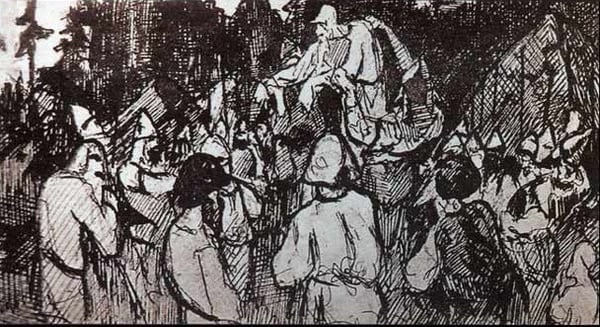
Expert analysis of Nicholas Roerich’s Figures of elders
Style: Realism · Genre: sketch and study
Expert Analysis: "Figures of Elders" by Nicholas Roerich
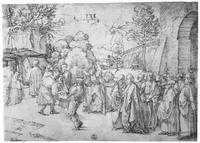
Nicholas Roerich (1874–1947) is widely celebrated for his luminous landscapes and spiritually charged compositions that blend Symbolism, Theosophy, and a profound reverence for ancient cultures. However, Figures of Elders—a work executed in the Realist style and categorized as a sketch and study—offers a rare, intimate glimpse into the artist’s foundational practice and his deep engagement with human character.
Significance within Roerich’s Oeuvre and the Realist Tradition
While Roerich is often associated with ethereal, visionary scenes, his early academic training at the Imperial Academy of Arts in St. Petersburg instilled in him a rigorous command of Realist draftsmanship. Figures of Elders exemplifies this discipline. As a sketch—likely a preparatory study for a larger composition—the work prioritizes anatomical accuracy, gesture, and the psychological weight of age. The elders are not generic stereotypes; each face and posture suggests a distinct life experience, wisdom, and cultural identity. This aligns with Roerich’s lifelong interest in representing the dignity of sages, shamans, and spiritual guides across civilizations.
In the context of the Realist movement, which sought to depict everyday subjects with unidealized truth, this study stands out for its focus on the essence of elderhood. Roerich captures the physical markers of age—wrinkles, sagging flesh, stooped shoulders—not as signs of decay, but as maps of inner strength and accumulated knowledge. The sketch medium itself is significant: Roerich’s confident, economical lines and subtle tonal modeling reveal his mastery of form without the distraction of color. This rawness allows viewers to witness the artist’s thought process—the search for the essential character beneath the surface.
Historical and Thematic Context
Roerich created numerous studies of elders, monks, and holy men while traveling through Russia, Central Asia, and the Himalayas. Figures of Elders likely dates from his pre-expatriation period (c. 1900–1910s) or from his expeditions. In either case, it reflects his belief that the elderly, as keepers of tradition, embody the spiritual continuity of a people. The work’s significance lies in its dual role: as a technical exercise that demonstrates Roerich’s Realist foundation, and as a thematic touchstone that prefigures his later symbolic depictions of ancient wisdom figures (e.g., The Treasure of the World, The Last of the Elders).
By preserving the immediacy of a sketch, Roerich invites us into his artistic laboratory. Figures of Elders reminds us that even the most transcendent visions are built upon a bedrock of careful observation—of humanity, of age, and of the quiet authority that time bestows.
Visually similar
20 works with related composition and palette
Dancing (Horovod)
Nicholas Roerich
Procession of Monks
Francisco Goya
Kondor Béla, Pihenés a Tábortűznél
Kondor Béla
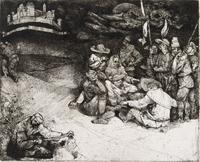
Kondor Béla, Pihenés a Tábortűznél
Kondor Béla
Elders Gathering
Nicholas Roerich
Campaign
Nicholas Roerich
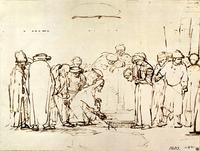
Jesus and the adulteress by Rembrandt
Rembrandt
Don Quixote
Gustave Dore
In a foreign bank
Nicholas Roerich
Study to "Boyarynya Morozova"
Vasily Surikov
Kondor Béla, Dózsa Halála 2
Kondor Béla
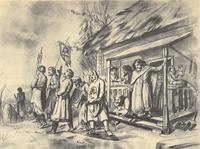
Procession on Easter. Sketch for the painting
Vasily Perov
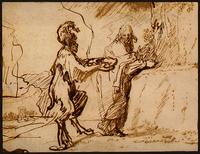
Satan Tempting Christ to Change Stones into Bread
Rembrandt
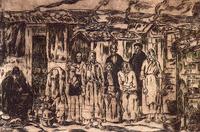
Alhóndiga Huts
Jose Gutierrez Solana
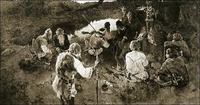
Elders Gathering
Nicholas Roerich
Moses and Aaron with Pharaoh
Marc Chagall
Study to "The Conquest of Siberia by Yermak"
Vasily Surikov
The Beekeepers and the Birdnester
Pieter Bruegel the Elder
Battle weary troops retreating - Battle of the Somme
Otto Dix
Christ
Albrecht Durer