Expert analysis of Nicholas Roerich’s Himalayas
Style: Symbolism · Genre: landscape
Expert Analysis: "Himalayas" by Nicholas Roerich
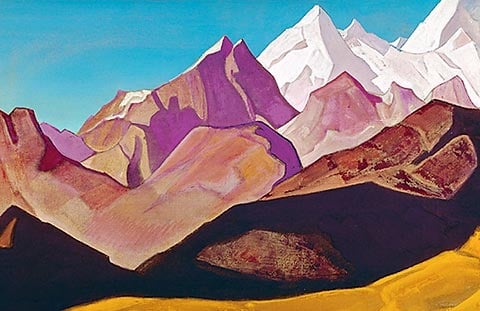
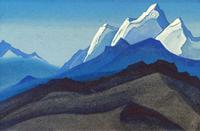
Nicholas Roerich’s "Himalayas" (likely one of his many Himalayan mountainscapes) is a quintessential work of Symbolist landscape painting, where the natural world is transfigured into a vehicle for spiritual and metaphysical meaning. Within the Symbolist movement—which prioritized emotion, intuition, and the unseen over mere visual representation—Roerich’s depiction of the Himalayas stands as a profound meditation on the sublime and the eternal.
Significance within Style and Period:
- Symbolist Transformation of Landscape: Unlike a naturalistic or topographical view, Roerich treats the Himalayas not as a physical range but as a sacred, luminous threshold. The mountains become symbols of aspiration, divinity, and the cosmic order. The crisp, luminous blues and whites—often applied in layered, almost enamel-like tones—evoke a sense of pure, unearthly light, aligning with Symbolism's goal to “clothe the idea in sensuous form” (Mallarmé).
- Spiritual and Theosophical Resonance: Roerich was deeply influenced by Theosophy and Eastern mysticism. "Himalayas" functions as a visual mantra, suggesting the mountains are the abode of higher consciousness. The sparse, geometric simplification (sharp peaks, rhythmic ridgelines) strips the scene of anecdotal detail, focusing the viewer’s gaze on the vertical climb toward a transcendent, silent peak—a classic Symbolist move from the material to the ideal.
- Color as Emotion and Idea: The bold, pure colors (pale lavender, cobalt, snow-white) are not atmospheric but symbolic. They evoke purity, distance, and the icy stillness of the absolute. Roerich’s palette anticipates later abstract spiritualism (e.g., Kandinsky) while firmly rooted in Symbolist color theory, where hues carry emotional and spiritual weight.
- Monumental Stillness: The composition is stark, uncluttered, and symmetrical—often with a central peak or a sweeping diagonal. This stillness creates a contemplative, almost icon-like presence. The work thus becomes a threshold for meditation, aligning with the Symbolist fascination with the ineffable and the quiet drama of the soul.
Why This Matters: "Himalayas" is significant because it moves landscape beyond description into the realm of the sacred. It encapsulates Roerich’s lifelong quest to fuse art with spiritual philosophy, embodying the Symbolist ideal of art as a bridge between the visible world and the invisible. In the broader history of 20th-century painting, it stands as a precursor to the abstract spiritual landscapes of modernism, while remaining a masterful example of Symbolism’s power to transform nature into a symbol of the divine.
Visually similar
20 works with related composition and palette
Sacred Himalayas
Nicholas Roerich

Pass
Nicholas Roerich

Himalayas. Chain of Kanchenjunga.
Nicholas Roerich
Milarepa's cave
Nicholas Roerich

Himalayas
Nicholas Roerich

Himalayas
Nicholas Roerich

Everest
Nicholas Roerich

Himalayas. Blue mountains.
Nicholas Roerich
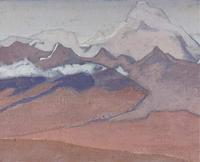
On the way to Shekar Dzong
Nicholas Roerich

Everest
Nicholas Roerich
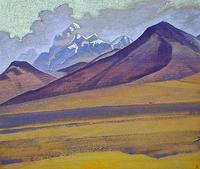
Karakoram ridge
Nicholas Roerich

Maitreya
Nicholas Roerich
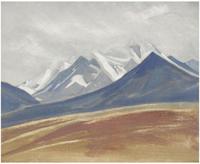
Jyagong
Nicholas Roerich
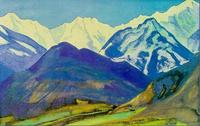
Kuluta. Dobi Nulla.
Nicholas Roerich

Himalayas. Sunset.
Nicholas Roerich

Mount of five treasures (Two worlds)
Nicholas Roerich
Himalayas
Nicholas Roerich

Himalayas
Nicholas Roerich
Himalayas
Nicholas Roerich
Mount "M"
Nicholas Roerich