
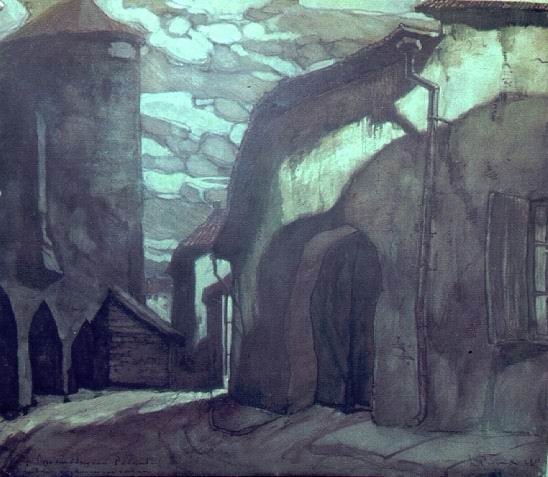
Analisi esperta di Medieval Revel di Nicholas Roerich
Stile: Art Nouveau (Modern) · Genere: capriccio
Expert Analysis of "Medieval Revel" by Nicholas Roerich
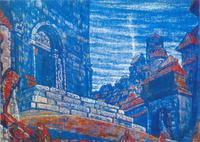
Nicholas Roerich’s Medieval Revel (c. 1900s) is a striking capriccio—a fantastical architectural composition—that exemplifies the artist’s unique synthesis of Art Nouveau aesthetics with a deep, mystical engagement with the medieval past. While the term “capriccio” traditionally suggests whimsy or architectural fancy, Roerich elevates the genre into a solemn, almost ritualistic vision, characteristic of his later symbolist and spiritual leanings.
Significance within Art Nouveau (Modern):
-
Decorative Wholeness: Roerich’s composition aligns with Art Nouveau’s core principle of unifying all artistic elements into a harmonious, organic whole. In Medieval Revel, the sinuous lines typical of the style—often seen in the flowing drapery of figures or the curling ornamentation of architectural details—are tempered by a distinctly medieval, almost Byzantine rigidity. This tension between natural, flowing rhythms and hieratic, icon-like symmetry marks Roerich’s departure from purely decorative Art Nouveau toward a more profound cultural symbolism.
-
Mystical Nationalism: Unlike many Art Nouveau artists who drew inspiration from floral or feminine motifs, Roerich rooted his modernism in the primordial folk heritage of ancient Russia and Scandinavia. Medieval Revel likely depicts a feast or ritual within a fortified hall, its crenellations and arched windows rendered with the flattened perspective and jewel-toned palette (deep blues, crimson, gold) that evoke stained glass or enamel work. This choice reflects the period’s interest in national romanticism within the Modern style, but Roerich’s treatment of light—a diffuse, almost spiritual glow—lifts the scene beyond mere historical reconstruction into a timeless, mythic realm.
-
Genre Transformation: As a capriccio, the work blends real architectural elements (reminiscent of Novgorod or Pskov churches) with imaginary structures, creating a dreamlike stage for human revelry. The figures, often shown in rhythmic procession, are not individuals but archetypes—a hallmark of Roerich’s later theosophical interests. This transformation of the capriccio from an exercise in architectural fancy into a vehicle for metaphysical storytelling is one of the work’s key contributions to modern art.
Overall Significance:
Medieval Revel stands at the crossroads of Art Nouveau’s decorative elegance and the emerging Symbolist movement’s quest for spiritual transcendence. Roerich here demonstrates that the modern artist can reclaim the medieval not as a period of quaint revivalism, but as a living, visionary language. The work anticipates his later, monumental series such as The Great Serpent and his stage designs for The Rite of Spring, solidifying his role as a visionary who used the forms of his time to articulate a timeless, universal mythos. For scholars, it remains a key example of how Art Nouveau in Russia diverged from Western models, embracing a more epic, introspective, and historically resonant mode.
Museum / Gallery
Visivamente simili
20 opere con composizione e palette affini
Street with church
Arthur Segal
Ketshin, Poland
Petros Malayan
Courtyard in Venice
August von Pettenkofen
La Grand Rue, Normande
Dorrit Black
Via Toscanella
Ottone Rosai
Purbeck Courtyard, Morning
Frances Hodgkins
Riga
Mstislav Dobuzhinsky
Street from Bretania
Stefan Popescu
The blacksmith's courtyard
Mstislav Dobuzhinsky
Zigeunerkind Im Dorf
Otto Mueller
Dramatic scene
Michele Cammarano
Street Scene
Walter Osborne
Dorfgasse
Paul Unbereit
The Hypochondriac
Carl Spitzweg
Laundress in a Sunlit Archway
Cesare Biseo
Vilno. Old wall.
Mstislav Dobuzhinsky
Narrow Street
Petros Malayan
A Farm House in France
Burhan Dogancay
Study of scene design for "Fuente Ovehuna"
Nicholas Roerich
City
Nicholas Roerich