Expertenanalyse zu Nicholas Roerichs City
Stil: Art Nouveau (Modern) · Genre: cityscape
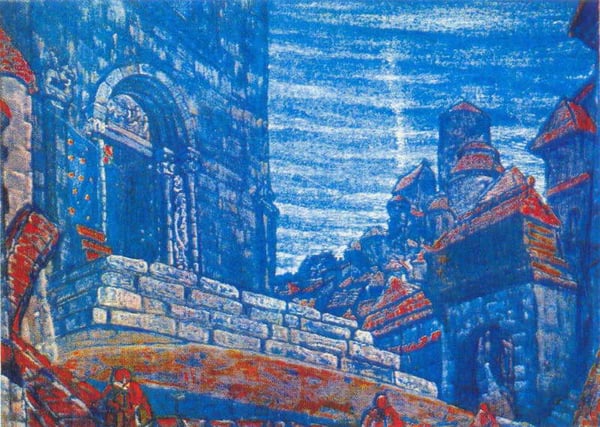
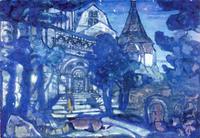
Nicholas Roerich’s City (c. 1900s) stands as a compelling intersection of Art Nouveau decorative sensibility and the cityscape genre, yet it transcends mere urban record. Painted during Roerich’s early Symbolist phase, the work reimagines the city not as a bustling modern hub but as a luminous, almost mythical vision—a hallmark of his spiritual and theosophical interests.
Significance within Art Nouveau:
While Art Nouveau typically celebrated organic, flowery forms and sinuous lines, Roerich adapts that aesthetic to architecture. In City, buildings rise with simplified, rhythmic silhouettes and flattened planes, their surfaces often glowing with jewel-tone colors (blues, golds, pinks) that echo the movement’s love of decorative harmony. But unlike many Art Nouveau artists who focused on interior design or poster art, Roerich applies the style’s ideal of total unity to the urban landscape: the city becomes a unified, spiritual organism rather than a collection of separate structures.
Significance within the Cityscape Genre:
Roerich breaks from 19th-century realist cityscapes (e.g., Pissarro’s boulevards) by stripping away anecdotal detail. His City is archetypal, not topographical—a “City on the Hill” or a sacred settlement. The perspective is often elevated, looking down or across a panorama; the human figure, if present, is minute, underscoring the city’s cosmic scale. This approach anticipates later Modernist utopian visions (e.g., Soviet constructivist “city of the future”) but rooted in Roerich’s own mystical philosophy: the city as a nexus of higher consciousness.
Why It Matters:
City exemplifies Roerich’s unique synthesis of East and West: Art Nouveau’s Western decorative elegance meets the timeless, hieratic stillness of Asian and Russian icon painting. The work is significant because it pushes the cityscape beyond documentation into a symbolic, meditative realm—a key step toward the visionary modernism that would define early 20th-century art. In Roerich’s hands, the modern city becomes a temple, and Art Nouveau becomes a vessel for transcendence.
Museum / Gallery
Visuell ähnlich
20 Werke mit ähnlicher Komposition und Farbpalette
City wall
Nicholas Roerich
City
Nicholas Roerich
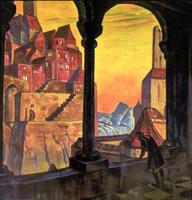
Cor Ardens
Nicholas Roerich
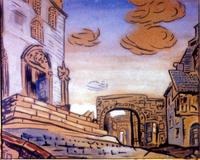
City
Nicholas Roerich
Scenery sketch for Mussorgsky's opera "Khovanshchina"
Nicholas Roerich
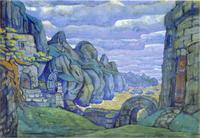
Tristan's castle in Brittany
Nicholas Roerich
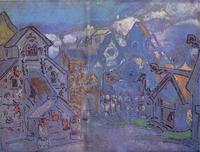
Terem
Nicholas Roerich
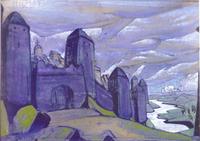
Yaroslavna's Lament
Nicholas Roerich
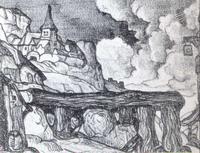
Study of decoration
Nicholas Roerich
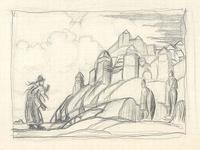
Sketch with woman in front of city walls
Nicholas Roerich
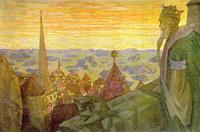
Old king
Nicholas Roerich
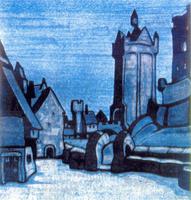
Street in front of castle
Nicholas Roerich
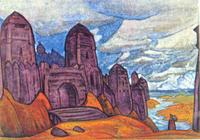
Yaroslavna's Lament
Nicholas Roerich
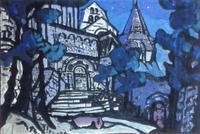
Castle of King Mark
Nicholas Roerich
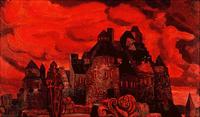
Glow
Nicholas Roerich
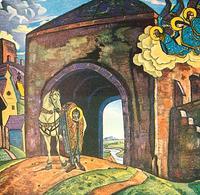
St. Mercurius of Smolensk
Nicholas Roerich
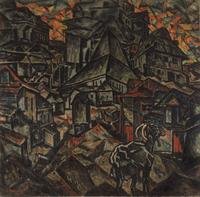
Destruction of the Ghetto, Kyiv
Abraham Manievich
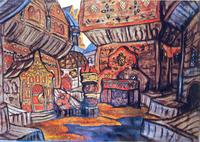
The court of Prince Vladimir Galitsky (Study of scene design for "Prince Igor")
Nicholas Roerich
Castle of King Mark
Nicholas Roerich
Der Karneval
Georg von Rosen