Analisi esperta di Order of Rigden Jyepo di Nicholas Roerich
Stile: Symbolism · Genere: religious painting
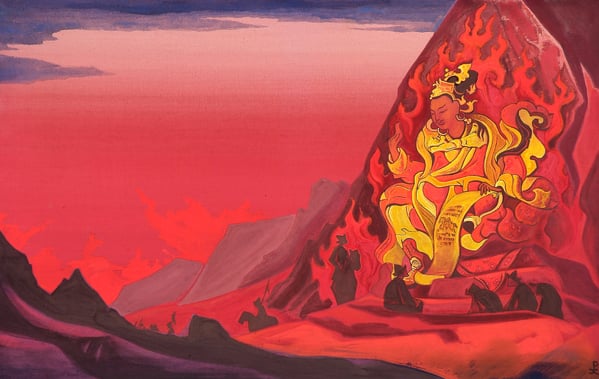
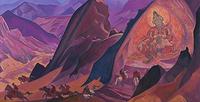
Nicholas Roerich’s Order of Rigden Jyepo is a quintessential work of Symbolist religious painting, one that bridges the mystical aspirations of early 20th-century European esotericism with the iconographic traditions of Tibetan Buddhism. Within the Symbolist movement—which prized intuition, dreamlike imagery, and spiritual transcendence over naturalistic depiction—Roerich’s painting stands out for its disciplined, almost hieratic composition. The image likely depicts Rigden Jyepo, the legendary king of Shambhala, whose figure in Buddhist prophecy heralds an age of peace and enlightenment.
What makes this work significant within its style and period is Roerich’s radical synthesis of East and West. While many Symbolists drew on Christian or Greco-Roman myth, Roerich turned to Himalayan and Central Asian lore, filtered through his own theosophical worldview. The painting’s formal language—simplified forms, a limited but luminous palette of blues, golds, and deep reds, and a frieze-like arrangement—evokes the timeless quality of a religious icon or a mandala. The figure of Rigden Jyepo is static, frontal, and commanding, surrounded by a halo of light that suggests both divine authority and the inner radiance of enlightenment. This is not a narrative scene but a vision: the king’s ordered presence embodies the cosmic order (dharma) that Roerich believed was a hidden truth behind all religions.
Moreover, Order of Rigden Jyepo exemplifies Roerich’s mature style, in which Symbolism merges with a deliberate archaism—a return to the spare, iconic power of medieval Russian icons and Buddhist thangkas. The painting’s significance lies in how it uses Symbolist ideals (the primacy of the spiritual, the use of symbol to transcend the material) to create a universal, cross-cultural sacred image. For Roerich, Rigden Jyepo was not merely a foreign deity but a symbol of humanity’s potential for harmony—a theme that resonated deeply in the turbulent early 1900s. Thus, the work stands as a key example of Symbolism’s reach beyond European boundaries, redefining religious painting as a visionary, syncretic act.
Museum / Gallery
Visivamente simili
20 opere con composizione e palette affini
Arhat
Nicholas Roerich
Guardian of the Entrance
Nicholas Roerich
Dorje the Daring One
Nicholas Roerich
Order of Rigden Jyepo
Nicholas Roerich
Shambala is going
Nicholas Roerich
Order of Rigden Jyepo (study)
Nicholas Roerich
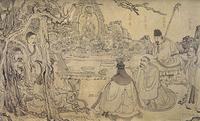
An Elegant Gathering
Chen Hongshou

Kannon Crossing the Sea
Fujishima Takeji

Padmasambhava
Nicholas Roerich
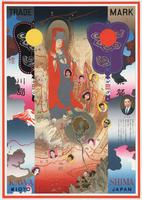
Kawashima Orimono
Tadanori Yokoo
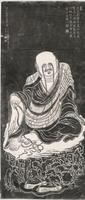
The 7th - Kalika Arhat
Guanxiu
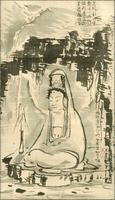
Untitled
Sengai
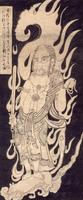
Akiba Sajakubo
Hakuin Ekaku
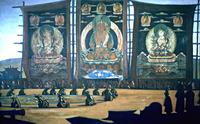
Mongolian tsam
Nicholas Roerich
Flying Demon
Wu Daozi
The Famous Unrivalled Hidari Jingoro
Utagawa Kuniyoshi
Agni Yoga
Nicholas Roerich
Daoist deity of heaven
Wu Daozi
The 1st - Pindolabharadraja Arhat
Guanxiu
Chenrezig
Nicholas Roerich