
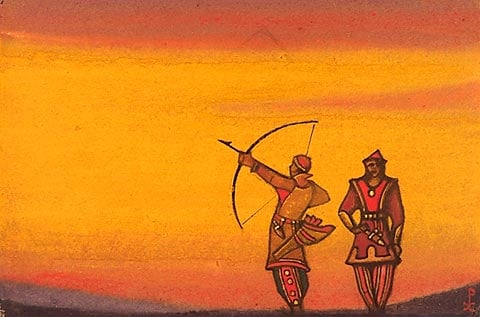
Analisi esperta di Polovets with bow di Nicholas Roerich
Stile: Art Nouveau (Modern) · Genere: design
Expert Analysis: "Polovets with bow" by Nicholas Roerich
Nicholas Roerich’s Polovets with bow is a masterful example of Art Nouveau applied to theatrical and decorative design, reflecting the movement’s fascination with organic forms, historical revivalism, and symbolic abstraction. Created as part of Roerich’s renowned costume and set designs for the Ballets Russes production of Alexander Borodin’s opera Prince Igor (premiered 1909, with costumes finalized around 1914), this work epitomizes how Art Nouveau could synthesize ethnographic authenticity with modernist stylization.
Stylistic significance within Art Nouveau (Modern):
Roerich’s depiction of a Polovtsian (Cuman) warrior exemplifies the Art Nouveau interest in the flowing line and the “whiplash” curve, here translated into the taut arc of the bow and the dynamic silhouette of the figure. The composition is reduced to essential, rhythmic forms—the elongated limbs, the sweeping headdress, and the decorative patterning on the garment—that echo the sinuous, nature-inspired motifs typical of the style. Yet Roerich avoids the purely ornamental: the figure’s poised tension and grounded stance convey the raw energy of the steppe nomad, marrying the era’s decorative elegance with a primal, almost Symbolist intensity.
Genre and function (Design):
As a design for the stage, this work highlights Art Nouveau’s role in Gesamtkunstwerk—the total work of art. Roerich’s costume designs were revolutionary in their archaeological fidelity: he researched Polovtsian artifacts, textiles, and weaponry to create a believable, yet artistically heightened, representation of 12th-century Eurasian steppe culture. The figure’s bow, quiver, and layered garments are not merely decorative but functional, supporting the choreography of the Polovtsian Dances. The flattened perspective and bold outlines, while rooted in Art Nouveau graphic design, also anticipate the primitivism that would define early 20th-century modernism.
What makes this artwork significant:
Polovets with bow is significant as a convergence of Roerich’s dual interests: his scholarly passion for ancient Slavic and Asian cultures, and his avant-garde sensibility for linear abstraction. Within the Art Nouveau movement, it stands out for its refusal to romanticize the exotic; instead, it presents the Polovtsian warrior as a dignified, architectonic presence—part decorative pattern, part ethnographic document. This work not only influenced stage design for generations but also demonstrated how Art Nouveau could transcend mere ornamentation to become a vehicle for cultural storytelling, capturing the spirit of a vanished people through the lens of a modern visual language.
Visivamente simili
20 opere con composizione e palette affini
Young men
Nicholas Roerich
Bukhara soldiers (Sarbaz)
Vasily Vereshchagin
Archers
Ernst Ludwig Kirchner
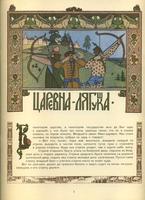
Illustration for the Russian Fairy Story "The Frog Princess"
Ivan Bilibin
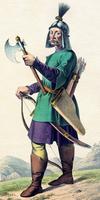
Bulcs
Josef Kriehuber
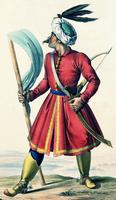
Kadicha, legendary Hungarian military leader
Josef Kriehuber
Man ke (من که)
Ali Akbar Sadeghi
Polovets and girls
Nicholas Roerich
Polovets with scimitar
Nicholas Roerich
Tartar Soldiers
Sigismund Bacstrom
Chinese Soldier
Vasily Vereshchagin
Ares - God of War
Nina Tokhtaman Valetova
L'Arciere
Mario Tozzi
Mihajlo Potyk
Ivan Bilibin
Illustration To "Zahar Berkut"
Georgyi Yakutovytch
Ivan Tsarevich and the Swan
Viktor Vasnetsov
Archer
Ernst Ludwig Kirchner
The Firebird, Michel Fokine as tsarevitch
Leon Bakst
Illustration to Odyssey
John Flaxman
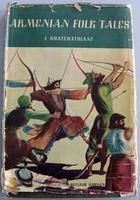
Cover of 'Armenian Folk Tales' by I. Khatchatryantz
Martiros Sarian