Analisi esperta di Sacred caves di Nicholas Roerich
Stile: Symbolism · Genere: landscape
Expert Analysis: Sacred Caves by Nicholas Roerich
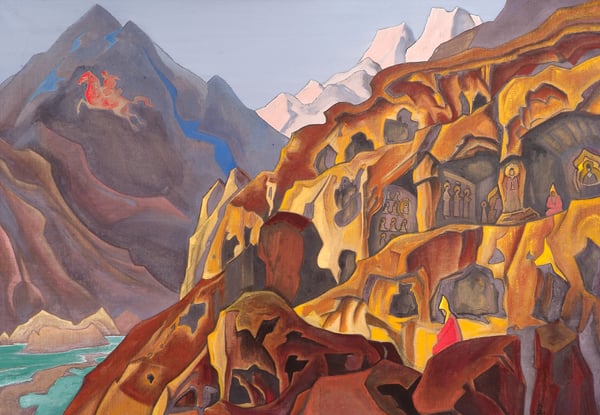
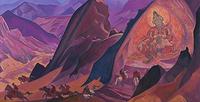
Nicholas Roerich’s Sacred Caves stands as a quintessential example of Symbolist landscape painting, where the natural world becomes a vessel for metaphysical inquiry. While the genre is landscape, Roerich transcends mere topographical representation, using the scene to evoke an inner, spiritual dimension—a core tenet of Symbolism.
Stylistic and Symbolist Significance:
The painting likely employs Roerich’s signature luminous, almost mineral palette, with deep blues, violet shadows, and stark whites that suggest a realm beyond the physical. The caves—a recurring motif in his work—are not depicted as geological features but as thresholds: portals to hidden knowledge, ancient wisdom, or sacred initiation. In Symbolist theory, caves often represent the subconscious, the womb, or the sanctuary of esoteric traditions. Roerich amplifies this by situating them within an austere, mountainous landscape reminiscent of the Himalayas, a region he revered as the spiritual heart of Asia.
Cultural and Philosophical Context:
Roerich’s work is deeply informed by his study of Eastern philosophy, Buddhism, and the spiritual heritage of Central Asia. Sacred Caves likely reflects his belief in the unity of all religions and the existence of hidden “sacred places” where cosmic energy concentrates. The painting’s stillness and hushed atmosphere invite contemplation, aligning with the Symbolist goal of art as a catalyst for inner vision rather than a record of external reality.
Legacy and Distinction:
Within Roerich’s oeuvre, Sacred Caves exemplifies how he merged Symbolist aesthetics with a profound sense of place—turning landscape into a visionary experience. Its significance lies in its ability to make the invisible tangible: the caves become archetypes of the eternal, the sacred dwelling in the natural world. This work also anticipates Roerich’s later role as a cultural ambassador and the architect of the Roerich Pact (the first international treaty protecting cultural heritage during war), as it embodies his belief that art and spirituality are intertwined guardians of human civilization.
In summary, Sacred Caves is not merely a landscape; it is a symbolic portal, a silent hymn to the mystical union of earth and spirit, and a testament to Roerich’s singular ability to fuse Symbolist ambition with a reverence for the natural and the transcendent.
Museum / Gallery
Visivamente simili
20 opere con composizione e palette affini
Holy cave
Nicholas Roerich

Lotus
Nicholas Roerich
Maitreya the Conqueror
Nicholas Roerich
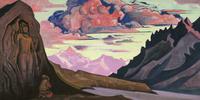
Maitreya the Conqueror
Nicholas Roerich
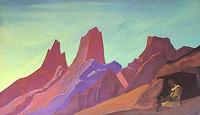
Three Jewels
Nicholas Roerich
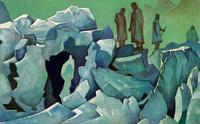
Patrol of Himalayas
Nicholas Roerich
The Amselfluh
Ernst Ludwig Kirchner
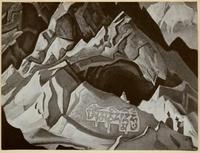
Path to Kailas
Nicholas Roerich
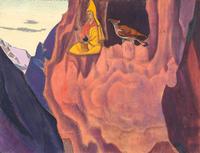
Tidings of the Eagle
Nicholas Roerich
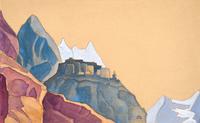
Kardang
Nicholas Roerich
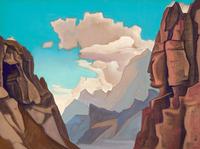
Great spirit of Himalayas
Nicholas Roerich
Scene design for "Peer Gynt"
Nicholas Roerich
Fire paternoster
Nicholas Roerich
Santana
Nicholas Roerich
Maitreya
Nicholas Roerich
Captors of fire
Nicholas Roerich
The treasure diviner
Nicholas Roerich
Great spirit of Himalayas
Nicholas Roerich
Order of Rigden Jyepo
Nicholas Roerich
Order of Rigden Jyepo
Nicholas Roerich