Analisi esperta di Throne of the invisible God di Nicholas Roerich
Stile: Art Nouveau (Modern) · Genere: religious painting
Expert Analysis: "Throne of the invisible God" by Nicholas Roerich
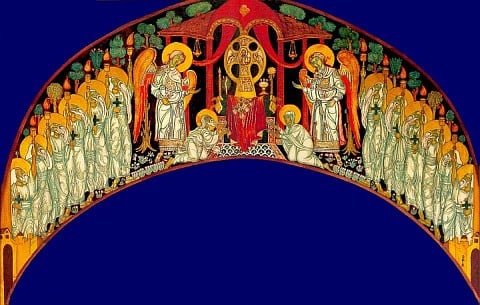
Nicholas Roerich’s Throne of the invisible God exemplifies a pivotal moment in early modern religious painting, where the fluid, decorative language of Art Nouveau is channeled into a transcendent spiritual vision. The work’s significance lies in its ability to fuse the period’s ornamental elegance with aniconic mysticism—a deliberate departure from figurative religious tradition.
Stylistic Significance (Art Nouveau/Modern):
Art Nouveau’s hallmark—sinuous, organic lines and a rejection of historicism—is repurposed here not for mere decoration but to evoke the formless presence of the divine. The “throne” itself likely becomes a nexus of rhythmic, undulating forms (perhaps stylized foliage, light rays, or architectural motifs), echoing the movement’s obsession with nature as a source of spiritual energy. By rendering the deity as invisible, Roerich pushes Art Nouveau beyond its typical decorative role into pure metaphysical suggestion: the painting’s structure, color harmonies, and linear flow become the sole carriers of sacred meaning.
Genre Significance (Religious Painting):
In a period when religious art often gravitated toward either Symbolist allegory or academic narrative, Roerich’s work is radical in its abstraction. The absence of a visible god challenges viewers to experience divinity through absence—a concept resonant with Roerich’s theosophical and Eastern influences. The “throne” functions as an energetic vacancy, a portal to the unseen, aligning with Art Nouveau’s fascination with the unseen forces of nature (e.g., electricity, growth, cosmic rhythms). This makes the painting a bridge between 19th-century Symbolist longing and 20th-century abstraction, anticipating later non-objective spiritual art (e.g., Kandinsky).
Conclusion:
Throne of the invisible God is significant as a rare synthesis of Art Nouveau’s aesthetic philosophy with a devoutly non-representational religious subject. It demonstrates how modern style can serve ancient spiritual inquiry, transforming a decorative idiom into a tool for theological contemplation. Roerich’s work here stands as a testament to the early modern search for a universal, invisible sacred—one articulated through line, color, and empty throne.
Visivamente simili
20 opere con composizione e palette affini
Resurrection of Christ. The sketch for the fresco of the church of the Assumption in Olshany
Ivan Bilibin
Judgement. Sketch of murals for of the church of the Assumption in Olshany
Ivan Bilibin
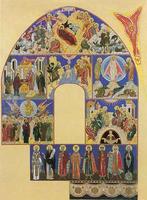
Christmas and other holy scene of the life of Jesus Christ and Virgin Mary. Sketch of murals for the south wall of the church of the Assumption in Olshany
Ivan Bilibin
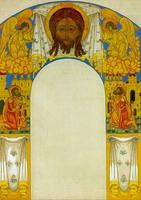
The saviour over the door
Nicholas Roerich
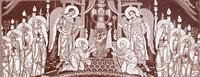
Throne of the invisible God
Nicholas Roerich
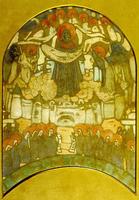
Intercession of the Theotokos
Nicholas Roerich
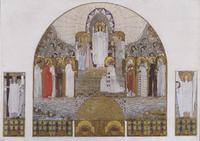
Am Steinhof Church, mosaic design for the main altar
Koloman Moser
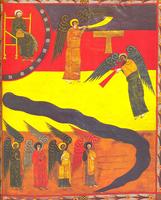
La sixième Trompette. Les Anges prisonniers au bord de l'Euphrate. Apoc. IX
Facundus
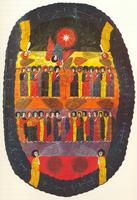
Les 144 000 Élus et les Anges retenant les Vents. Apoc. VII
Facundus
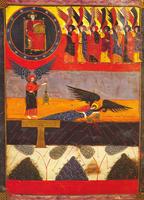
L'Ange et l'Encensoir d'or. Apoc. VIII
Facundus
Les trois Anges. La chute de Babylone. Apoc. XIV
Facundus
L'Evangéliste Marc
Facundus
Head of Saviour
Nicholas Roerich
Beato de Gerona
Ende
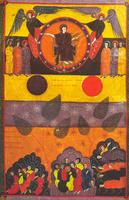
Beatus de Facundus
Facundus
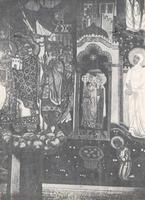
Kneeling warriors (Study of murals for the chapel in Pskov)
Nicholas Roerich
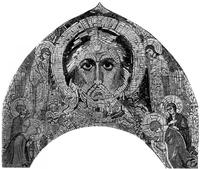
Saviour Almighty and saints
Nicholas Roerich
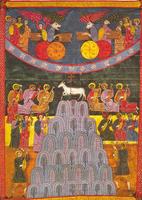
Adoration de l'Agneau mystique sur le Mont Sion.. Apoc. XIV
Facundus
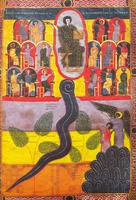
La Jérusalem nouvelle. Le Fleuve de Vie. L'Arbre de Vie. Apoc. XXII
Facundus
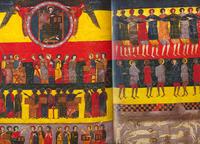
Le jugement dernier (détail de la double page). Apoc. XX
Facundus