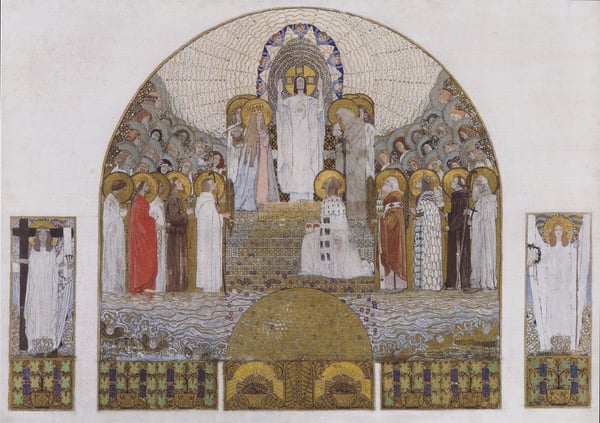
Am Steinhof Church, mosaic design for the main altar
Details
Expert analysis of Koloman Moser’s Am Steinhof Church, mosaic design for the main altar
Style: Art Nouveau (Modern) · Genre: design
Expert Analysis: "Am Steinhof Church, mosaic design for the main altar" by Koloman Moser
This work is a seminal example of how the Art Nouveau (Modern) style bridged religious tradition with avant-garde aesthetics. As part of the Kirche am Steinhof in Vienna—often called the “Jugendstil church” and designed by Otto Wagner—Moser’s main altar mosaic stands as a pinnacle of the Gesamtkunstwerk (total work of art) ideal that defined the Vienna Secession and the Wiener Werkstätte.
Significance within Art Nouveau / Modern style:
-
Integration of Sacred and Decorative: Moser transforms a traditional altar into a radiant, flat-patterned composition. The mosaic employs gold leaf tesserae and stylized, symmetrical floral motifs (often associated with Byzantine and early Christian art) but reinterprets them through a geometric, disciplined Art Nouveau lens. This fusion elevates decorative art to the level of fine art, a core tenet of the modernist movement.
-
Color and Material Innovation: The mosaic’s lavish use of gold, combined with jewel-toned enamels, creates a luminous, anti-naturalistic effect. This breaks from historicist religious painting and aligns with the Secessionist belief in “the beauty of the surface” and the primacy of ornament. The work is not merely illustrative but an ambient, spiritual field of color and form.
-
Hieratic Yet Modern Composition: The central figure (often identified as Christ or a saint) is rendered in a flat, frontal, almost iconic manner, yet the surrounding geometric and floral borders are distinctly fin-de-siècle. This balance between the sacred hieratic and the modern decorative makes the mosaic a bridge between medieval mosaic traditions and 20th-century abstraction.
-
Context of the Steinhof Church: The church itself is a masterpiece of modern religious architecture, and Moser’s altar mosaic is its visual anchor. It demonstrates how Art Nouveau’s rejection of historicism could revitalize church art, making it both spiritually transcendent and contemporary. The design is significant as a rare example of sacred modernism where ornament does not detract from devotion but enhances it through pure, stylized beauty.
In sum, this mosaic is not just a design; it is a manifesto of the Wiener Werkstätte’s ambition to unite all arts under a modern, harmonious vocabulary, and it remains one of the most successful integrations of Art Nouveau aesthetics into a sacred space.
Visually similar
20 works with related composition and palette
Throne of the invisible God
Nicholas Roerich
Holy Spirit Church in Düsseldorf, design for the choir wall
Koloman Moser
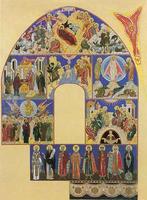
Christmas and other holy scene of the life of Jesus Christ and Virgin Mary. Sketch of murals for the south wall of the church of the Assumption in Olshany
Ivan Bilibin
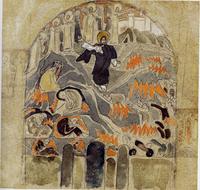
Harrowing of Hell
Nicholas Roerich
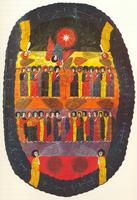
Les 144 000 Élus et les Anges retenant les Vents. Apoc. VII
Facundus
Kneeling warriors (Study of murals for the chapel in Pskov)
Nicholas Roerich
Kneeling warriors (Study of murals for the chapel in Pskov)
Nicholas Roerich
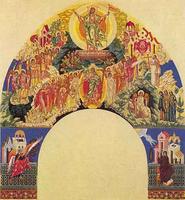
Resurrection of Christ. The sketch for the fresco of the church of the Assumption in Olshany
Ivan Bilibin
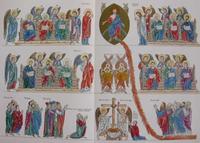
Hortus deliciarum
Herrad of Landsberg
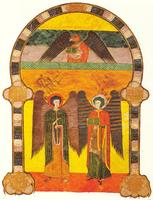
L'Evangéliste Marc
Facundus
Intercession of the Theotokos
Nicholas Roerich
Fatti Della Vita Di Gesù Cristo, Varii Profeti, Porto E Città Di Classe
Giuseppe Barberis
Les âmes des martyrs persécutés. Autel mozarabe en T. Apoc. VI
Facundus
Judgement. Sketch of murals for of the church of the Assumption in Olshany
Ivan Bilibin
La Jérusalem nouvelle. Apoc. XXI
Facundus
Beatus of Facundus
Facundus
Our Lady of Burning Bush
Orthodox Icons
Les trois Anges. La chute de Babylone. Apoc. XIV
Facundus
Throne of the invisible God
Nicholas Roerich
La Jérusalem nouvelle. Le Fleuve de Vie. L'Arbre de Vie. Apoc. XXII
Facundus