
Analisi esperta di Toghrak-dong di Nicholas Roerich
Stile: Symbolism · Genere: landscape
Expert Analysis of "Toghrak-dong" by Nicholas Roerich
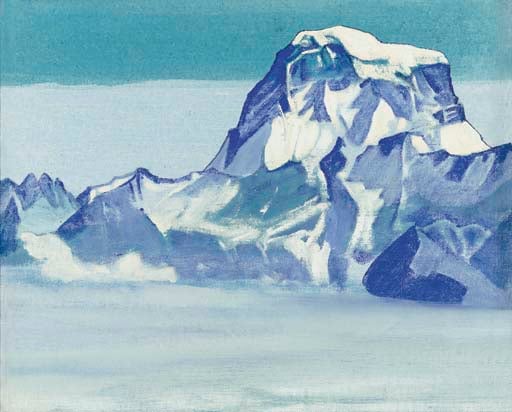
Nicholas Roerich’s “Toghrak-dong” stands as a quintessential example of Symbolist landscape painting, where the natural world becomes a vessel for spiritual and metaphysical meaning. Executed within the Symbolist tradition, this work transcends mere topographical representation to evoke a sense of the sublime and the eternal.
Significance within the Symbolist Movement
Roerich, deeply influenced by theosophy and Eastern philosophy, used landscape as a conduit for inner vision. In “Toghrak-dong,” the rugged, monolithic forms of the mountains are not merely geological features but symbols of ancient wisdom, endurance, and the sacred. The stark, almost hieratic composition, with its sharp ridges and muted, layered palette of blues, purples, and ochres, reflects the Symbolist preoccupation with the ineffable. The absence of human figures emphasizes the overwhelming power of nature as a spiritual force, a hallmark of Roerich’s mature period.
The title itself—“Toghrak-dong”—refers to a specific site in Central Asia (likely a valley or mountain pass in the Altai or Himalayan region), yet Roerich transforms this locale into a timeless, mythic landscape. The interplay of light and shadow, with a diffused, ethereal glow, suggests a moment of cosmic revelation, aligning with the Symbolist goal of evoking mood and mystery over literal description.
Genre and Stylistic Innovation
As a landscape, “Toghrak-dong” subverts the Western tradition of picturesque or picturesque views. Instead, Roerich adopts a deliberately simplified, almost primitivist form—broad planes of color, rhythmic outlines, and a flattened perspective—reminiscent of Russian icon painting and Tibetan thangkas. This synthesis of East and West makes the work significant as a bridge between Symbolist spirituality and modern abstraction. The painting’s dramatic, silent vastness invites contemplation, positioning Roerich as a visionary who imbued landscape with philosophical depth, influencing later movements in metaphysical and visionary art.
Visivamente simili
20 opere con composizione e palette affini
Everest
Nicholas Roerich
Kangchenjunga
Nicholas Roerich
Kangchenjunga
Nicholas Roerich
All ridge
Nicholas Roerich
Himalayas
Nicholas Roerich
Everest
Nicholas Roerich
Himalayas
Nicholas Roerich
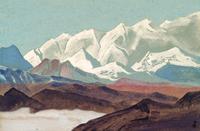
Himalayas. Chain of Kanchenjunga.
Nicholas Roerich

Tibet
Nicholas Roerich
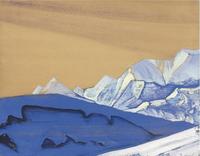
Tibet
Nicholas Roerich
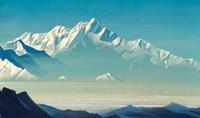
Mount of five treasures (Two worlds)
Nicholas Roerich

Sacred Himalayas
Nicholas Roerich
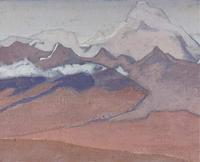
On the way to Shekar Dzong
Nicholas Roerich
Ridge of Everest
Nicholas Roerich
Himalayas. Everest.
Nicholas Roerich
Snowy peaks at sunset
Nicholas Roerich
Himalayas. Sunset.
Nicholas Roerich
Himalayas. Evening.
Nicholas Roerich
Abode of King Gesar
Nicholas Roerich
Land of snow people
Nicholas Roerich