
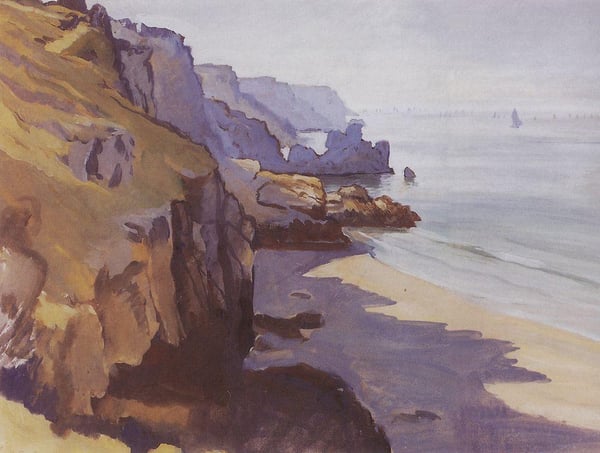
Analisi esperta di Brittany. Camaret. di Zinaida Serebriakova
Stile: Symbolism · Genere: landscape
Expert Analysis of "Brittany. Camaret." by Zinaida Serebriakova
The painting Brittany. Camaret. by Zinaida Serebriakova is a landscape executed in the Symbolist style. Its significance lies in how Serebriakova, primarily known for her luminous portraits and intimate domestic scenes, adapts the Symbolist idiom to an outdoor setting, transforming a specific geographic location into a vessel of inner mood and timeless spiritual resonance.
Within the Symbolist Tradition:
Unlike Impressionist landscapes, which prioritize fleeting light and atmospheric effects, Symbolist landscapes treat nature as an echo of the soul. In Brittany. Camaret., Serebriakova emphasizes structure and stillness. The composition likely emphasizes simplified forms—the dark mass of a rocky shore, the pale expanse of sky, the muted palette of sea and stone—to evoke a sense of quiet contemplation or melancholy. The coastal town of Camaret, on Brittany’s Crozon Peninsula, was a magnet for artists seeking a rugged, mythic landscape. For a Symbolist, Brittany’s ancient megaliths, Celtic legends, and stark coastlines offered a ready-made repository of mystery and the archaic. Serebriakova taps into this by stripping the scene of anecdotal detail, letting the elemental geometry of land, water, and sky speak to universal solitude or the sublime.
Significance as a Landscape:
What makes this work especially notable within Serebriakova’s oeuvre and Symbolist landscape painting is its fusion of specificity and abstraction. She does not abandon the recognizable features of Camaret—the calm harbor, the low tidal flats, the distinctive light of the Atlantic—but she subordinates them to an internal emotional logic. The painting’s significance lies in its ability to hold a dual identity: it is both a topographical record of a Breton village and a symbolic meditation on transience, belonging, or the boundary between sea and sky as a metaphor for the liminal. In this, Serebriakova aligns herself with Symbolist contemporaries who saw in landscape a language for what cannot be directly said—the ineffable, the nostalgic, the sacred.
Conclusion:
Brittany. Camaret. demonstrates how Symbolism could extend beyond mythological or allegorical figuration into a pure landscape vocabulary. Serebriakova’s contribution is her refinement of this vocabulary: she applies her characteristic clarity of line and restrained, pearlescent color to a subject that demands both meticulous observation and poetic abstraction. The result is a work that stands as a quiet but powerful example of how a seemingly conventional view can become a symbol—of place, of memory, of the artist’s own search for a transcendent resonance in the natural world.
Visivamente simili
20 opere con composizione e palette affini
Brittany. Beach at Camaret.
Zinaida Serebriakova
The Beach at Morgat, Finistere
Maxime Maufra
Sea Landscape in Brittany
Charles Cottet
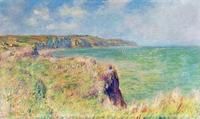
Edge of the Cliff at Pourville
Claude Monet
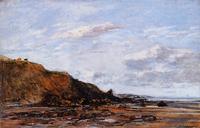
The Sea at Douarnenez
Eugene Boudin
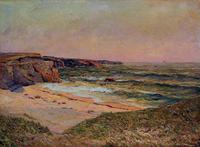
The Dunes of Port Blanc near Ile de Quiberon
Maxime Maufra
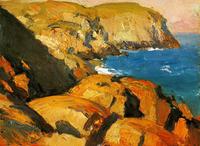
Blackhead, Monhegan
Edward Hopper
Rocks on the breton coast
Paul Gauguin
On the Oregon Coast
T. C. Steele
Cliff by the sea
Mikalojus Konstantinas Ciurlionis
Cliff at Grainval
Claude Monet
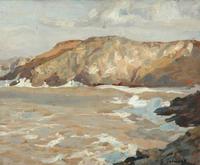
Coast Scene with Cliffs
Algernon Talmage
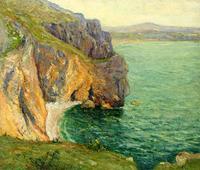
The Cliffs at Polhor
Maxime Maufra
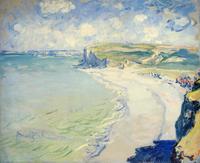
The Beach at Pourville
Claude Monet
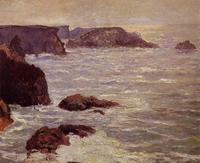
Coast Goulphar
Maxime Maufra

Camaret, Le Toulinguet
Eugene Boudin
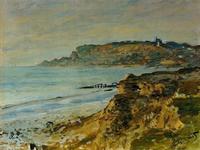
Cliff at Sainte-Adresse
Claude Monet
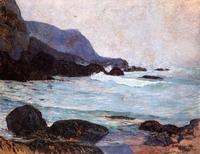
The Coast of Bellangenay
Paul Gauguin
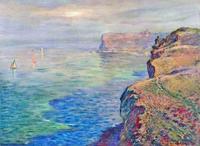
Cliff at Grainval near Fecamp
Claude Monet
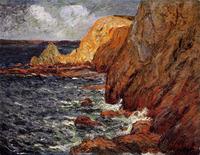
Cliffs
Maxime Maufra