
Zinaida Serebriakova sanatçısının India eseri hakkında uzman analizi
Tarz: Art Nouveau (Modern) · Tür: nude painting (nu)
Expert Analysis: India by Zinaida Serebriakova
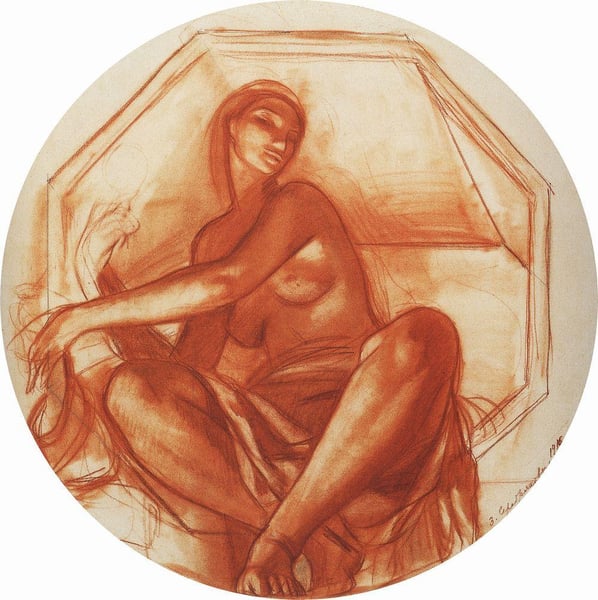
Zinaida Serebriakova’s India stands as a remarkable intersection of Russian émigré experience, Orientalist fascination, and the sinuous elegance of Art Nouveau. Although the painter is best known for her earlier, more naturalistic portraits and nudes, this work marks a significant shift: it applies the decorative, linear grace of Art Nouveau to an ethnographic subject, while also asserting a distinctly female perspective within the traditionally male-dominated genre of the nude.
Stylistic Significance within Art Nouveau
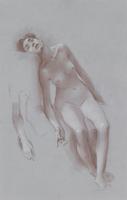
Art Nouveau (c. 1890–1910) prized organic, flowing lines, flattened planes, and stylized ornament drawn from nature. In India, Serebriakova channels these qualities not through the typical floral or mythical motifs of European Art Nouveau, but through the rhythmic drapery, the graceful contour of the figure, and the subtle patterning that echoes Indian textile traditions. The nude body is rendered with a soft, continuous line—almost like a whiplash curve—that glides from the model’s shoulder to her hip, emphasizing a languid, sculptural poise. The background, likely a muted wash of warm earth tones, functions as a decorative field rather than a deep space, allowing the figure to float as an idealized, almost symbolist form.
Genre and Gender: The Nude Reimagined
As a nude painting, India departs from the academic tradition of the odalisque. Serebriakova, one of the few prominent female painters of her generation to engage with the nude, brings a gaze that is neither voyeuristic nor idealizing in the conventional sense. Instead, she situates the Indian woman as a subject of quiet dignity—her pose relaxed yet composed, her eyes meeting the viewer with a sense of self-possession. This aligns with Art Nouveau’s broader interest in the “New Woman” and the exotic, but Serebriakova avoids the clichéd sensuality typical of male Orientalists. The body is rendered with honest, unexaggerated curves, and the skin tones are warm, not idealized white marble.
Modernity and Cross-Cultural Fusion
Painted during Serebriakova’s exile in France (she had fled revolutionary Russia), India reflects her travels and her immersion in non-Western aesthetics. The title itself is a geographic signifier, yet the work resists pure documentary—it is a modern synthesis. The figure’s pose recalls both classical contrapposto and Indian temple sculpture, filtered through the decorative flatness of Art Nouveau. This fusion makes the painting significant as an early example of how modernist artists repurposed historical and global forms to create a new visual language, one that privileges surface beauty and emotional resonance over narrative.
Conclusion
India is significant because it embodies Serebriakova’s adaptive genius: a female artist working in a declining academic tradition, embracing the decorative innovations of Art Nouveau while asserting her own voice in the genre of the nude. It bridges the personal (her displacement) with the universal (the timeless grace of the female form), and stands as a testament to the cross-cultural dialogues that defined early 20th-century modernism.
Görsel olarak benzer
İlişkili kompozisyon ve renk paletine sahip 20 eser
Turkey (Two odalisques)
Zinaida Serebriakova
Japan (odalisque)
Zinaida Serebriakova
Siam
Zinaida Serebriakova
The Model
Kuzma Petrov-Vodkin
Nu au Soleil (Nude in the Sun)
Jean Metzinger
Turkey
Zinaida Serebriakova
Reclining Nude Woman
Robert Brackman
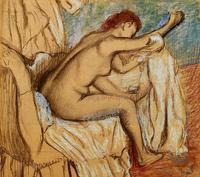
Woman Drying Herself
Edgar Degas
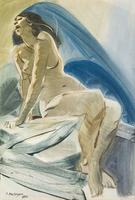
Passion
Petros Malayan
Czobel Bela Visage
Bela Czobel
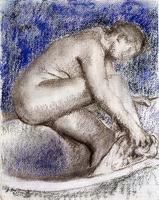
The Bath
Edgar Degas
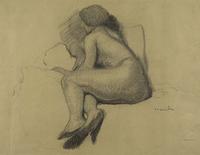
Nu de Dos
Theophile Steinlen
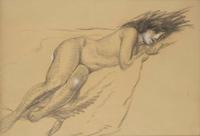
Nu Aux Cheveux Epars
Theophile Steinlen
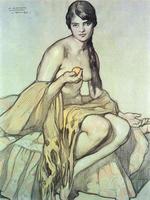
El rebozo
Saturnino Herran
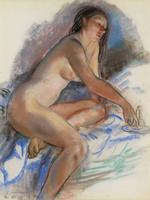
Nude with a candle. France
Zinaida Serebriakova
La Rousse
Constant Permeke
Funerary Composition III
Yiannis Moralis
Study for a female portrait
Zinaida Serebriakova
Nude Study of a Dancer
Edgar Degas
Solitudine
Adolf Hirémy-Hirschl