
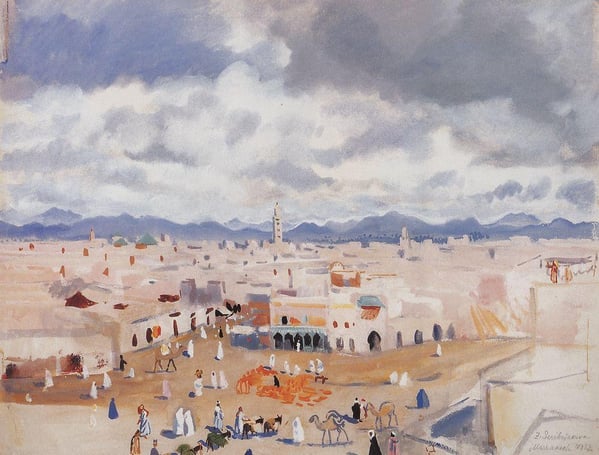
Analisi esperta di Morocco. Marrakesh di Zinaida Serebriakova
Stile: Expressionism · Genere: cityscape
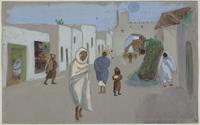
Expert Analysis: "Morocco. Marrakesh" by Zinaida Serebriakova
Artist & Context: Zinaida Serebriakova (1884–1967) was a Russian-born painter who, after fleeing the Russian Revolution, settled in Paris and embarked on a transformative journey to Morocco in the late 1920s and again in the 1930s. These North African sojourns produced some of her most vibrant, emotionally charged works, marking a pivotal shift from her earlier, more restrained neo-classical and realist style toward a bolder, more color-driven expressionism.
Stylistic Significance: As an Expressionist cityscape, "Morocco. Marrakesh" transcends mere topographical record. Serebriakova does not aim for photographic accuracy; instead, she distills the essence of the city through intensified hues, rhythmic brushstrokes, and a deliberate flattening of space. The work captures the dazzling North African light—a key challenge for many European painters—by using high-key, almost Fauve-like color contrasts (saturated ochres, deep blues, vermilion accents) that convey the heat, dust, and sensory overload of Marrakesh. Her handling of architectural forms (red city walls, minarets, a maze of flat roofs) is both structural and atmospheric, balancing solid geometry with the shimmer of heat haze.
Thematic Significance: Serebriakova’s Moroccan works are significant for their departure from the orientalist clichés often employed by male European painters. Rather than exoticizing or romanticizing local figures, she focuses on the cityscape itself—its alleys, markets, and skyline—presenting Marrakesh as a living, dynamic organism. The composition typically leads the eye through layered planes: from the intimate, shadowed foreground (perhaps a courtyard or souk) to the luminous, distant minaret. This vertical and spatial compression creates a sense of being enveloped by the city, not merely observing it from a safe, colonial distance.
Contribution to Expressionism: While Serebriakova is often associated with the Russian Mir iskusstva (World of Art) movement and later with Post-Impressionism, her Moroccan series firmly aligns with Expressionism’s emphasis on subjective emotional experience. Here, the artist’s personal response—a mixture of wonder, displacement, and creative liberation—animates every brushmark. The painting’s significance lies in how it melds a feminine, introspective gaze with the raw vitality of a foreign landscape, expanding Expressionist vocabulary beyond the angst-ridden urban scenes of Northern Europe into a sun-drenched, celebratory yet deeply personal vision.
Legacy: "Morocco. Marrakesh" stands as a testament to Serebriakova’s resilience and artistic reinvention. It demonstrates her mastery of color as a carrier of mood and place, and her ability to infuse the familiar genre of the cityscape with a sense of immediacy and emotional truth that remains remarkably fresh today.
Visivamente simili
20 opere con composizione e palette affini
A Market Square in Tunis, Evening
Tom Scott
Gabès Cityscape
Samuel Mutzner
Moroccan Market
Theo van Rysselberghe
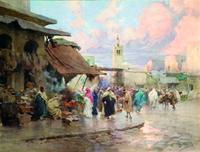
Marché À Tunis
Achille Beltrame
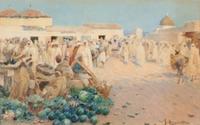
A busy market, North Africa
Gustavo Simoni
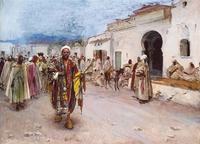
Street vendor
Gustavo Simoni
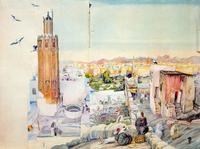
Visit of Tetuan from the terrace of Khalifa
Carlos Saenz de Tejada
Moroccan street scene (study for The Moroccan storyteller)
Alfred Dehodencq
Encampment near a Moroccan Village
Theo van Rysselberghe
The carpet seller
Gustavo Simoni
In Constantine
Henry Ossawa Tanner
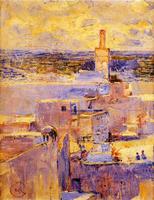
View of Meknes, Morocco
Theo van Rysselberghe
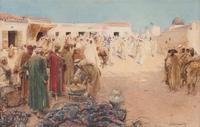
The arms merchant
Gustavo Simoni
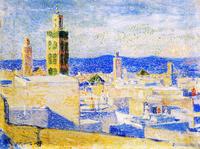
View of Meknes
Theo van Rysselberghe
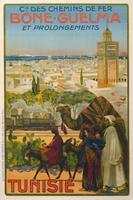
Poster of ''Bône-Guelma railway and extensions'' (Tunisia)
Louis Abel-Truchet
Rabat, Morocco
Lucien Levy-Dhurmer
Market Day
Louis Comfort Tiffany
Market in Algiers
August Macke
Thes. Morocco
Zinaida Serebriakova
Street Scene in an African City
Gabriele Munter