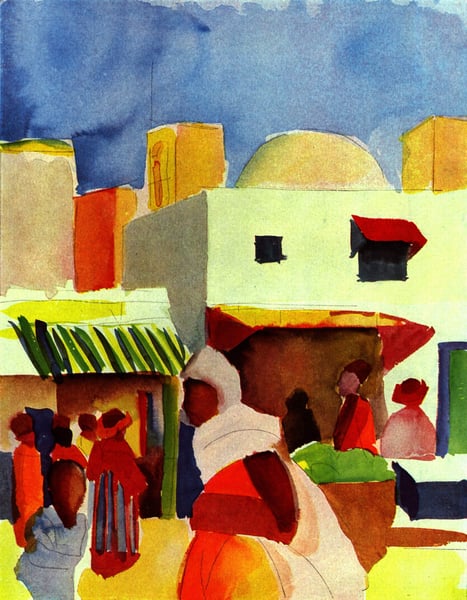
Expert analysis of August Macke’s Market in Algiers
Style: Expressionism · Genre: genre painting
Expert Analysis: "Market in Algiers" by August Macke
August Macke’s “Market in Algiers” (1914) stands as a luminous testament to the brief but brilliant flowering of German Expressionism just before the First World War. Painted during his transformative journey to Tunisia earlier that year, this work exemplifies Macke’s unique ability to synthesize the intense color harmonies of French Fauvism with the structural clarity of Cubist composition—all while infusing everyday genre scenes with a spirit of modern, rhythmic joy.
Significance within Expressionism and Macke’s Oeuvre
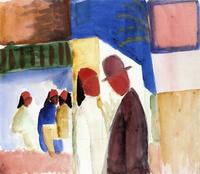
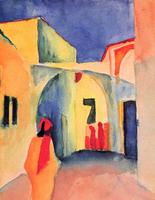
What makes this painting significant is its role in the Der Blaue Reiter movement’s broader ambition: to express spiritual and emotional truths through color and form. Unlike the more jagged, psychologically fraught works of fellow Expressionists, Macke’s vision is one of harmonious radiance. In “Market in Algiers,” he captures the bustling life of the North African souk not through mimetic detail, but through vibrant, prismatic patches of color—citron yellows, cerulean blues, rose pinks, and verdant greens. Light itself becomes a tangible, almost musical force, dissolving architectural forms and figures into a fragmented yet cohesive mosaic.
Macke’s technique here is crucial: he applies paint in broad, flat planes with visible brushwork, rejecting modeling in favor of pure color contrasts that generate a sense of shimmering heat and movement. The market scene—figures under awnings, laden stalls, and the interplay of sun and shadow—is deceptively simple. Yet Macke elevates a quotidian genre subject into an abstract symphony of hue and geometry, anticipating the lyrical abstraction that would emerge later in the century.
The painting is also historically significant as a product of Macke’s 1914 Tunisian trip with Paul Klee and Louis Moilliet. This journey catalyzed a final, astonishingly productive year for Macke (he was killed in action later in 1914 at age 27). “Market in Algiers” embodies the cross-cultural dialogue between European Modernism and North African visual culture. Macke was drawn to the bright, unmodulated colors of local textiles, the dappled light of market squares, and the rhythmic patterns of daily life—elements he translates into a universal, optimistic language of form.
In summary, this artwork is significant because it captures Expressionism at its most serene and lyrical, merging avant-garde formal inventions with a deep, empathetic observation of human activity. It represents the apex of Macke’s career: a moment when color, light, and everyday life coalesce into a transcendent, modern vision.
Visually similar
20 works with related composition and palette
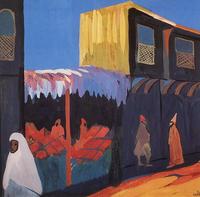
A street. Constantinople.
Martiros Sarian
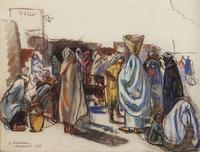
Market. Marrakesh
Zinaida Serebriakova
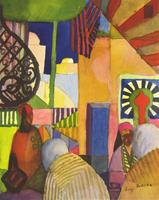
In the bazaar
August Macke
Street Scene in an African City
Gabriele Munter
To the spring
Martiros Sarian
Baianas
Emiliano Di Cavalcanti
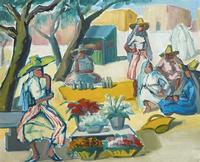
Le Marche Aux Fleurs
Hélène de Beauvoir
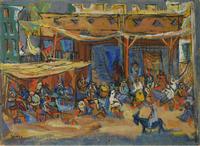
Arab Café in Ramallah
Marcel Janco
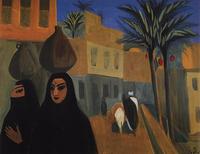
Street in Cairo
Martiros Sarian
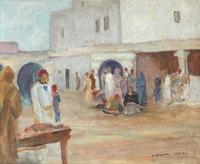
Gabès Cityscape
Samuel Mutzner
Moroccan Market
Theo van Rysselberghe
Yerevan
Martiros Sarian
Morocco. Marrakesh
Zinaida Serebriakova
A busy market, North Africa
Gustavo Simoni
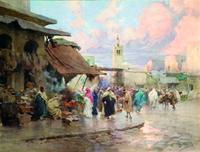
Marché À Tunis
Achille Beltrame
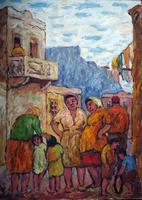
Bo Kaap- DinksFãStan Private Collection
Kenneth Baker
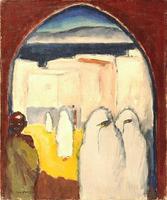
Tangier, Morocco
Kees van Dongen
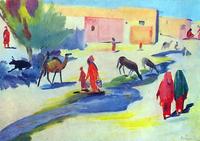
Street and the ditch in Ashgabat
Martiros Sarian
On the Street
August Macke
A Glance Down an Alley
August Macke