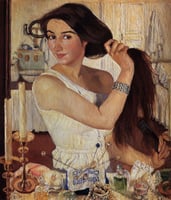
Analisi esperta di Nude Girl di Zinaida Serebriakova
Stile: Art Nouveau (Modern) · Genere: nude painting (nu)
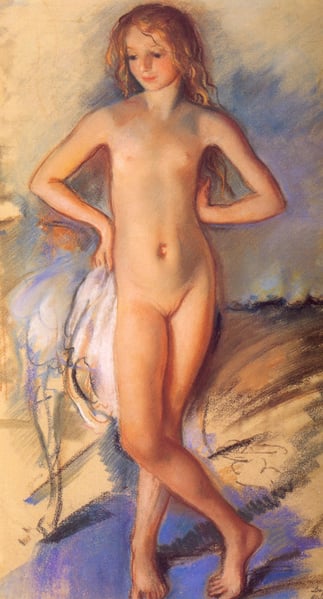
Expert Analysis of "Nude Girl" by Zinaida Serebriakova
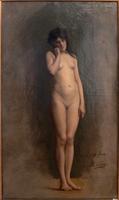
Zinaida Serebriakova’s “Nude Girl” is a compelling example of the Art Nouveau movement’s reinterpretation of the classical nude, filtered through a distinctly modern, early‑20th‑century sensibility. While Art Nouveau is often celebrated for its decorative, sinuous lines and organic motifs, Serebriakova’s treatment of the female form brings a fresh psychological intimacy and naturalism to the style, elevating the genre beyond mere ornament.
Significance within Art Nouveau and the Modern Nude
-
Organic Line and Sensuous Form
The painting’s composition likely echoes Art Nouveau’s characteristic emphasis on flowing, continuous contours. The model’s posture—whether reclining or standing—would be rendered with a gentle, rhythmic curve that mirrors the vine‑like tendrils and floral whiplash lines typical of the period. Yet Serebriakova avoids the stylized, almost abstract elongation seen in much Art Nouveau figuration (e.g., Mucha or Klimt). Instead, she anchors the body in a solid, believable anatomy, creating a dialogue between decorative elegance and human truth. -
A Bold, Female‑Centered Modernity
As a female artist working in a male‑dominated field, Serebriakova’s nude studies challenge voyeuristic conventions. “Nude Girl” is not a passive, idealized object but a self‑possessed, fleshed‑out individual. The model’s gaze—if directed outward—invites a reciprocal, respectful viewership, while an averted glance suggests introspection rather than submission. This aligns with the modern shift toward psychological realism, making the work significant as a feminist reclamation of the nude genre. -
The Russian Context of Art Nouveau
Serebriakova was a key figure in the Russian “Mir iskusstva” (World of Art) group, which blended European Art Nouveau with national Slavic themes. In “Nude Girl,” the influence of French impressionism and Russian realism merges: the handling of light and skin tone is naturalistic, yet the overall design retains a decorative, planar quality. This synthesis makes the work a bridge between the late‑19th‑century academic tradition and the emerging avant‑garde, marking a moment when the nude could be both a formal exercise and a vehicle for personal expression.
Conclusion
Serebriakova’s “Nude Girl” stands out within Art Nouveau for its humanizing approach to the female nude. By combining the movement’s hallmark grace with a modern, unidealized directness, it asserts the power of the individual sitter over stylistic formula. It is a testament to how the genre of the nude—so often bound by convention—could be revitalized through a female artist’s gaze, making it a significant milestone in both Art Nouveau and the broader history of Modernist portraiture.
Visivamente simili
20 opere con composizione e palette affini
Standing Nude
Zinaida Serebriakova
Nude Woman Standing
Thomas Eakins
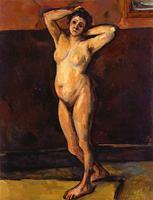
Nude Woman Standing
Paul Cezanne
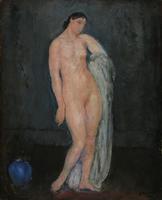
Nude with Blue Vase
Michel Simonidy
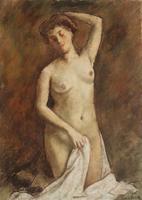
After Bath
Stefan Luchian
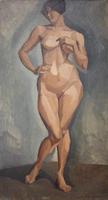
Standing nude from the front
Roger de La Fresnaye
Self Portrait
Émilie Charmy
Nude
Raoul Dufy
Nu Au Drape
Henri Matisse
Drawing of Female Nude with charcoal and chalk
Pierre-Paul Prud'hon
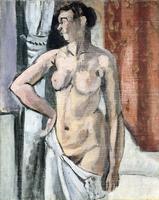
Standing Nude
Henri Matisse
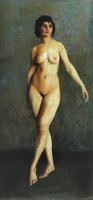
Figure in Motion
Robert Henri
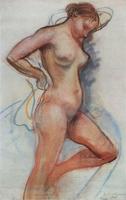
Emerging from the bath
Zinaida Serebriakova
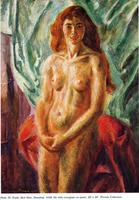
Nude, Red Hair, Standing
John French Sloan
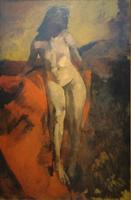
A nude
G H Breitner
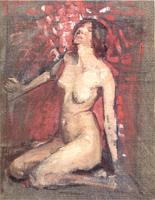
Seated Nude with Her Head Thrown Back (Kathleen Kearney)
Sarah Purser
Standing Figure
Henry Tonks
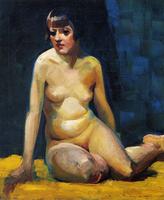
Seated Nude with Bobbed Hair
George Luks
Nude Girl
Jean-Leon Gerome
Nude on the Chair
Iosif Iser