
Analisi esperta di On the beach di Zinaida Serebriakova
Stile: Art Deco · Genere: genre painting
Expert Analysis of On the Beach by Zinaida Serebriakova
Style & Context:
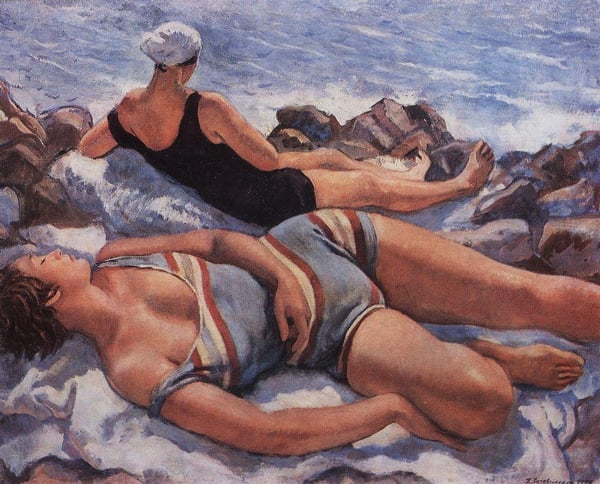
Zinaida Serebriakova, though rooted in the Russian Realist and Impressionist traditions, created works that resonate with the elegance and decorative clarity of the Art Deco movement. Painted during the 1920s–1930s—the heyday of Art Deco—On the Beach exemplifies how the style’s emphasis on streamlined forms, rhythmic lines, and sophisticated leisure could be adapted to intimate genre scenes. While Art Deco is often associated with glamorous urban interiors and luxury travel, Serebriakova translates its sensibility to a natural, sunlit setting, merging the movement’s modern aesthetic with timeless themes.
Composition & Formal Qualities:
The artwork employs a balanced, almost frieze-like arrangement of figures along the shore, typical of Art Deco’s love for orderly, decorative patterning. The horizon line is low and uncluttered, drawing the eye to the human activity. Figures are simplified into elegant silhouettes—a hallmark of Art Deco’s preference for clean, geometric shapes. Light and shadow are rendered with a soft, prismatic clarity, not unlike the stained-glass or lacquer surfaces found in Art Deco objets d’art. The palette likely features warm sands, cool blues of the sea, and deliberate touches of white or bright accent colors, reinforcing a mood of refined relaxation.
Significance within the Genre & Movement:
On the Beach is significant because it expands the scope of Art Deco beyond its typical urban and interior motifs, applying its principles to genre painting—the depiction of everyday life. Serebriakova’s work captures a moment of modern leisure (a popular subject in the 1920s) while avoiding the exaggerated dynamism or mechanization of other Deco works. Instead, she infuses the scene with a quiet, lyrical dignity: women and children enjoy the seaside, their poses both natural and stylized. This balance between realism and decorative grace marks the painting as a bridge between traditional Russian painting and the international Art Deco language. It demonstrates that Art Deco could be intimate and human, not merely opulent or industrial.
Artistic Legacy:
For Serebriakova, who often painted women and family life with tender observation, On the Beach shows her ability to adapt to the aesthetic currents of her time without sacrificing her personal vision. The artwork stands as a testament to the versatility of Art Deco, proving the style could elevate a simple beach scene into a sophisticated, timeless composition—one that celebrates both modernity and the enduring pleasures of nature and human connection.
Visivamente simili
20 opere con composizione e palette affini
Quappi in blue in a boat
Max Beckmann
Ladies at Beach
Ibrahim Calli
Gurzuf. Women's beach
Ilya Mashkov
Games in the Sand (also known as Beach with Fighters)
Maurice Denis
Blonde and Brunette
Edward Henry Potthast

Bathings in the Sun
Konstantin Somov

À La Plage
Alexandre-Jacques Chantron

Nude in Dappled Sunlight
Frederick Carl Frieseke
Silver Morning, Aldeburgh Beach
Algernon Talmage
Bathers
Pablo Picasso
South Beach Bathers
John French Sloan
On the beach. Gurzuf
Ilya Mashkov

On the Sand, Valencia Beach
Joaquín Sorolla
High Summer II
Edvard Munch

A Holiday
Henry Scott Tuke
Bathers
Theo van Rysselberghe

The Bather
Christopher Wood

Lovers of the Sun
Henry Scott Tuke
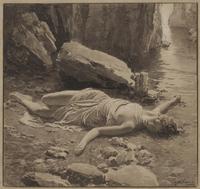
Death of Sappho
Fortunino Matania

Are You Jealous?
Paul Gauguin