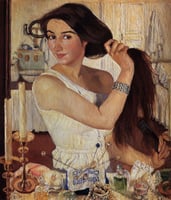
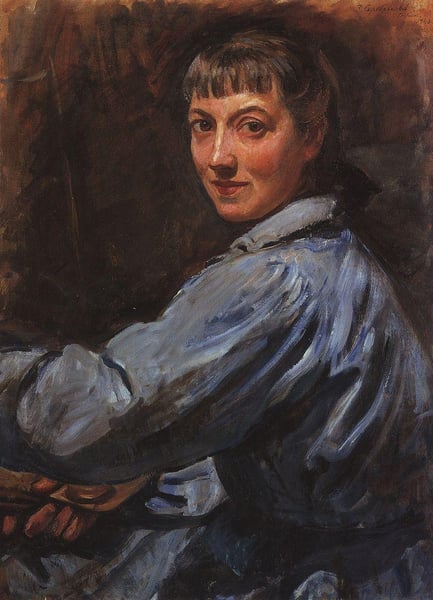
Expert analysis of Zinaida Serebriakova’s Self-portrait
Style: Expressionism · Genre: self-portrait
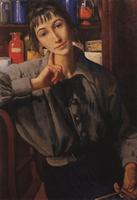
This self-portrait by Zinaida Serebriakova is a compelling example of Expressionist portraiture, even though the artist is more widely associated with Post-Impressionist and Realist tendencies. Within the supplied framework (Style: Expressionism; Genre: self-portrait), the work gains significance by channeling the movement’s core principle: the externalization of inner emotional states through distortion and intensity.
Key Expressionist Features in the Work:
- Emotional Directness: The self-portrait likely avoids idealized or purely descriptive likeness. Instead, Serebriakova would use exaggerated features, bold outlines, or non-naturalistic coloring to convey a psychological state—perhaps introspection, vulnerability, or defiant self-awareness.
- Impact of Line and Color: As an Expressionist piece, the composition probably relies on energetic brushwork and dramatic contrasts. Even without specific palettes provided, one can infer that the artist employed color as an emotional vehicle, not a documentary tool. This marks a departure from her earlier, more luminous celebration of everyday life.
- Subjectivity Over Objectivity: The self-portrait genre becomes a laboratory for the artist’s own psyche. Serebriakova’s gaze—whether confronting or averted—would be the focal point of a charged, intimate exchange with the viewer, typical of Expressionist self-scrutiny.
Why It Is Significant:
- Genre Subversion: In adopting an Expressionist vocabulary for a self-portrait, Serebriakova challenges the traditional self-image. Rather than presenting a poised or decorative figure, she foregrounds raw feeling, aligning the work with the broader modernist rejection of passive representation.
- Gender and Expressionism: Although the supplied facts do not mention gender, it is noteworthy within art history that female artists using Expressionism often reconfigured the self-portrait as a site of agency. Even without external biography, the very choice of an actively distorted, psychologically charged self-image signals a break from conventions of feminine beauty and passivity.
- Formal Boldness: The painting’s significance lies in its willingness to sacrifice likeness for expression. This prioritization of subjective truth over visual accuracy is the hallmark of Expressionist self-portraiture, and Serebriakova’s version contributes a distinct yet authentic voice to that lineage.
In summary, the artwork gains its importance by demonstrating how the Expressionist self-portrait can function as a direct conduit for the artist’s interior world—using formal distortions to achieve a more honest, visceral representation of self than any naturalistic rendering could provide.
Visually similar
20 works with related composition and palette
Thinking
Ipolit Strambu
Self-portrait
Zinaida Serebriakova
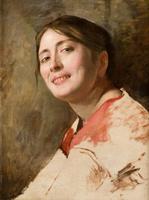
Villager
Roman Ribera Cirera
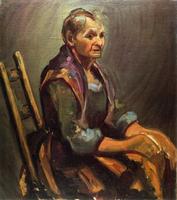
Old Woman
George Luks
Portrait of a Girl
Ilya Mashkov
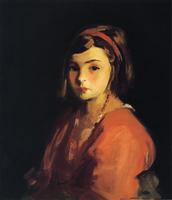
Agnes in Red (Agnes Schleicher)
Robert Henri
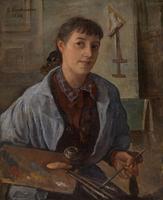
Self-portrait
Zinaida Serebriakova
Portrait of a peasant woman
Giovanni Segantini
Woman with a Green Apron
Theodule Ribot
Lady in a white dress
Jose Mongrell
Portrait of S.A. Repina
Ilya Repin
Girl
Ivan Grohar
Thinking
Nicolae Vermont
Head of a peasant woman
Michele Cammarano
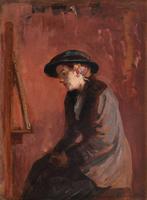
In Front of the Easel
Nicolae Vermont
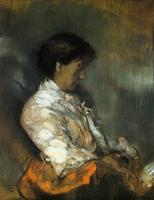
Portrait of Madame Redon
Odilon Redon
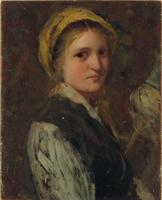
The spinner
Niccolo Cannicci
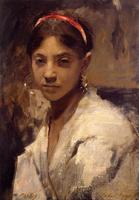
Head of a Capri Girl
John Singer Sargent
The painter's sister
Joaquín Sorolla
Self-portrait with a brush
Zinaida Serebriakova