Expert analysis of Zinaida Serebriakova’s Self-portrait
Style: Expressionism · Genre: self-portrait
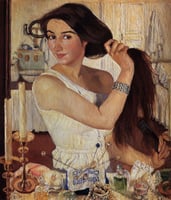
Expert Analysis: Self-Portrait by Zinaida Serebriakova (c. 1911–1914)
Executed in the Expressionist mode, Serebriakova’s self-portrait is a startlingly intimate declaration of artistic identity from one of the few celebrated female painters of early 20th-century Russia. While her contemporaries in the Russian avant‑garde often pushed toward abstraction, Serebriakova rooted her expressionist vocabulary in a profound psychological realism.
Significance within Expressionism and the Self‑Portrait Genre
-
Emotional Depth through Formal Distortion – True to Expressionist principles, Serebriakova distorts features—slightly enlarged eyes, an elongated neck, and a stark, angular positioning of the figure—to project a sense of vulnerable self‑scrutiny. The compressed space and muted, earthy palette (olives, ochres, deep browns) create an atmosphere of introspective tension rather than naturalistic calm.
-
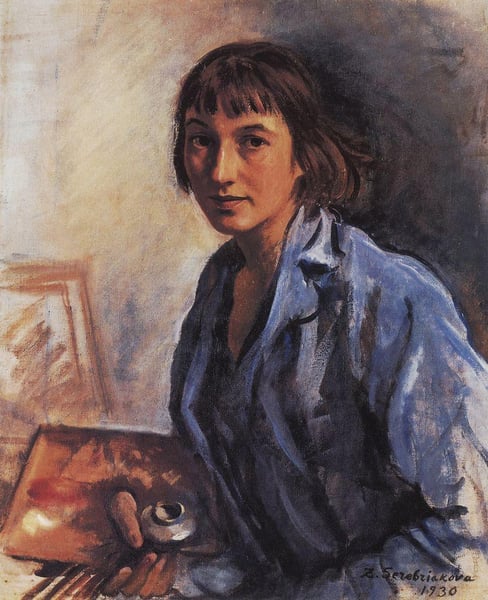
Defying Gendered Conventions – In an era when female artists were often expected to produce decorative or sentimental works, Serebriakova presents herself not as an object of the male gaze, but as a sovereign creator. The direct, unflinching stare and the inclusion of her palette and brushes (in related versions) assert her role as a professional artist—a radical statement for a woman in Tsarist Russia.
-
Bridge Between Traditions – The work fuses the rigorous draftsmanship of the Russian “World of Art” movement (her Neoclassical training) with the bold emotionalism of Expressionism. Her loose, energetic brushstrokes and selective exaggeration of features recall both Edvard Munch’s anxious self-portraits and the raw expressiveness of the German Brücke artists, yet remain distinctly personal.
-
Autobiographical Resonance – Painted during a period of personal hardship (her husband’s death and the Russian Revolution), the self‑portrait becomes a survival act—a defiant affirmation of selfhood. The angular, almost awkward posture conveys a profound sense of isolation, prefiguring the psychological intensity that would later define mid‑century portraiture.
Legacy
Serebriakova’s Self-Portrait stands as a foundational expressionist statement that repositions the female self-portrait from passive reflection to active psychological inquiry. Its blend of formal boldness, emotional honesty, and gender‑consciousness makes it a crucial work—both within Russian Expressionism and as a precursor to later feminist reclamations of the self‑portrait genre.
Visually similar
20 works with related composition and palette
Self-portrait
Zinaida Serebriakova
Miss Anne Popham
Graham Bell
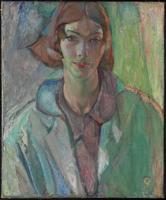
Vera
Frederick Varley
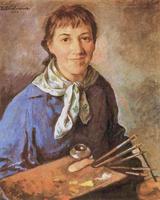
Self-portrait
Zinaida Serebriakova
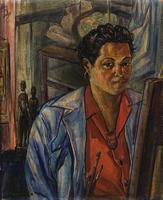
Self Portrait
Lois Mailou Jones
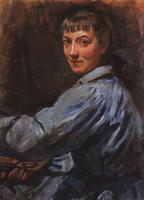
Self-portrait
Zinaida Serebriakova
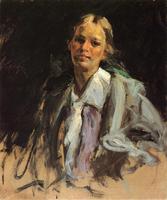
Young Girl
William Merritt Chase
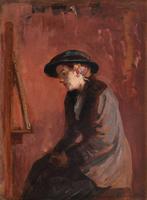
In Front of the Easel
Nicolae Vermont
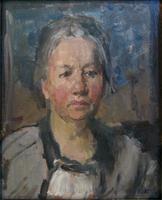
Portret Van Johanna Van Gogh-Bonger
Isaac Israels
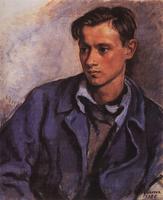
Portrait of a son, Alexander
Zinaida Serebriakova
Portrait of Mary Patten
Robert Henri
Svetlana
Igor Grabar
Letecia
Robert Henri
Girl Reading
Francisc Sirato
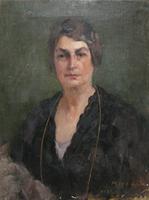
Portrait of a Lady
George Demetrescu Mirea
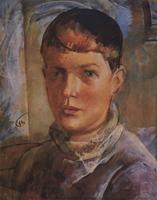
The daughter of an artist
Kuzma Petrov-Vodkin
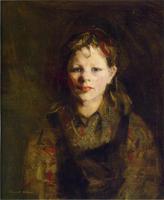
Little Dutch Girl
Robert Henri
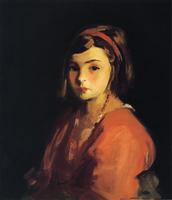
Agnes in Red (Agnes Schleicher)
Robert Henri
The young painter
Vincenzo Irolli
Portrait of Elizabeth van Rysselberghe
Theo van Rysselberghe