Analisi esperta di Woman and Bird in the Night di Joan Miro
Stile: Abstract Expressionism, Surrealism · Genere: abstract
Expert Analysis of Joan Miró’s "Woman and Bird in the Night"
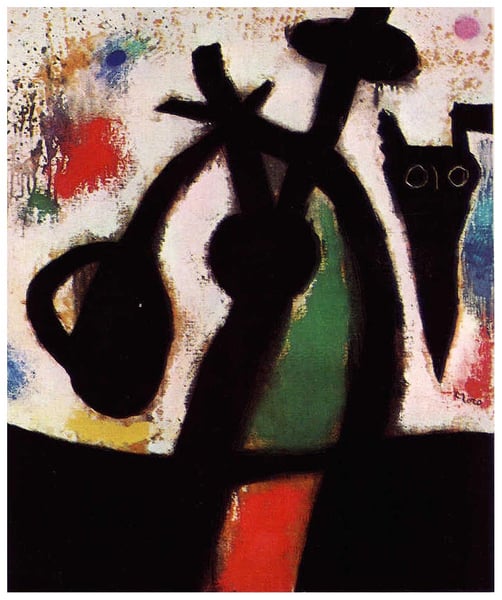
Joan Miró’s Woman and Bird in the Night stands as a quintessential example of his mature visual language, bridging Surrealism’s psychological depth with the gestural freedom that would later define Abstract Expressionism. Painted in a period when Miró was synthesizing his Catalan heritage with avant-garde experimentation, this work demonstrates his signature use of biomorphic abstraction—floating, organic forms that hover between figuration and pure shape.
Significance within Surrealism:
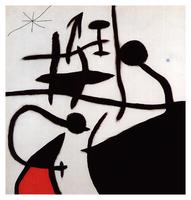
Miró was not a literal Surrealist; he described his method as “the destruction of painting” to liberate the subconscious. Here, the “woman” is reduced to a curved, egg-like torso and a single eye-like circle, while the “bird” dissolves into a swooping arc and a star-shaped dot. The nocturnal setting is evoked through a deep, velvety black ground punctuated by bursts of red, yellow, and blue. This color contrast—dramatic and raw—creates a dreamscape where earthly constraints dissolve. Miró’s refusal to render the human or avian forms realistically allows the viewer to project their own unconscious associations, a core Surrealist goal.
Connections to Abstract Expressionism:
While Miró predated the New York School, his works like Woman and Bird in the Night directly influenced Abstract Expressionists such as Arshile Gorky and Jackson Pollock. The painting’s spontaneous yet controlled linework—erratic black strokes that seem to dance across the canvas—anticipates the “all-over” compositions of Pollock. Miró’s technique of letting the paint dribble and smudge, combined with his use of unpainted white space (the “negative” ground of the canvas), creates a tension between deliberate gesture and accidental effect.
Why It Matters:
This artwork is a pivotal moment in modernism because it synthesizes two seemingly opposing movements: the Surrealist reliance on subconscious imagery and the Abstract Expressionist emphasis on process and materiality. Miró proves that abstraction need not abandon symbolic meaning; the woman and bird are both recognizable archetypes (femininity, freedom) and purely plastic elements (curves, lines, fields of color). The painting’s intimate scale (typical of Miró’s works of the 1940s) invites close viewing, rewarding the eye with hidden jokes—the “bird” might also read as a crescent moon, the “woman” as a biomorphic hourglass.
Ultimately, Woman and Bird in the Night demonstrates Miró’s lasting contribution: the notion that a painting can be simultaneously poetic, primitive, and profoundly abstract—a language that spoke both to the subconscious and to the tactile realities of paint on canvas.
Genere
Visivamente simili
20 opere con composizione e palette affini
Women and Birds
Joan Miro
The Skiing Lesson
Joan Miro
Women and Birds in the Night
Joan Miro
Character and Bird in the Night
Joan Miro
Orient
Jean-Michel Atlan
Femme, oiseaux devant le soleil
Joan Miro
Characters in the Night
Joan Miro
Africa I
Willi Baumeister
Woman and Birds in the Night
Joan Miro
Composition
Valerii Lamakh
1951
Karel Appel
Cosmic Characters
George Stefanescu
The Escape Ladder
Joan Miro
White Line
Wassily Kandinsky
Ladders Cross the Blue Sky in a Wheel of Fire
Joan Miro
Moon Woman
Jackson Pollock
Corne a Licou
Maurice Esteve
Calypso II
Jean-Michel Atlan
Femme III
Joan Miro
The Barber (Composition No. 5)
Arshile Gorky