Analisi esperta di The White Glove di Joan Miro
Stile: Surrealism, Automatic Painting · Genere: figurative
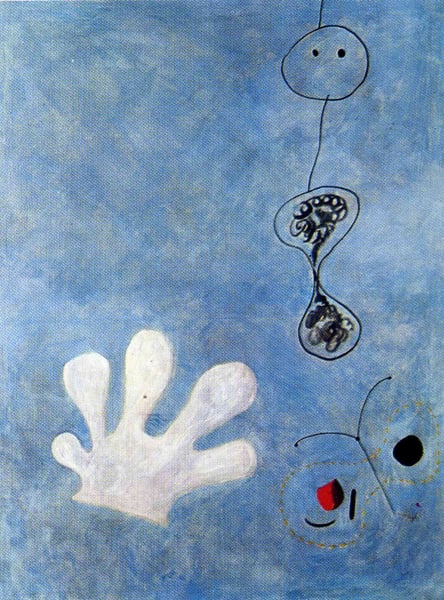
Joan Miró’s The White Glove stands as a compelling example of his mature Surrealist practice, where the tension between automatic, unpremeditated mark-making and recognizable figurative form becomes the very engine of meaning. Painted in the spirit of Automatic Painting—a technique championed by the Surrealists to bypass rational control and access the subconscious—the work nonetheless retains a figurative anchor in the form of a single white glove.
Significance within Surrealism and Automatic Painting:
-
The Paradox of Controlled Accident
While automatic painting often yields entirely abstract, biomorphic fields, Miró deliberately reintroduces a concrete object—the glove—as a kind of “found sign” from the unconscious. The glove is not rendered realistically but floats in a dreamlike, indeterminate space, its crisp whiteness contrasting with surrounding fluid lines and washes. This interplay between spontaneous gesture (the drips, the erratic contours) and a recognizable symbol demonstrates Surrealism’s core ambition: to fuse the irrational with the everyday, making the familiar strange and the strange familiar. -
The Glove as Surrealist Object
In Miró’s iconography, isolated body parts (hands, eyes, feet) often act as conduits for psychological states. The white glove here is both a fragment of the human form and a kind of empty, waiting hand—suggesting absence, touch, or even a theatrical prop. By isolating it against an ambiguous ground, Miró transforms a mundane article into a totem of desire, mystery, or memory. This approach aligns with the broader Surrealist fascination with the “marvelous” hidden in ordinary things. -
Figuration Born from Automation
The work’s figuration is not pre-planned but emerges from the automatic process itself. Miró would often begin with random stains, blots, or scribbles, then “discover” latent images within them—a method he called “the painting’s own life.” In The White Glove, the glove may have appeared as a spontaneous crystallization of line and color, later emphasized and fixed. This method proves that figuration and automation are not opposing forces; rather, the subconscious can produce recognizable symbols as naturally as it produces abstract forms. -
Significance within Miró’s Oeuvre
Miró’s so-called “peinture poésie” (painting-poetry) often walks the line between abstraction and figuration. The White Glove exemplifies his ability to distill complex psychological content into a deceptively simple image. The glove becomes a silent protagonist in a visual poem, its whiteness evoking purity, absence, or the blank page of the unconscious. It is a work that invites narrative speculation while resisting fixed interpretation—a hallmark of Surrealist achievement.
In essence, The White Glove is significant because it demonstrates how automatic painting can yield not chaos but a disciplined, evocative figuration—one that lets the subconscious speak through a single, powerful image. Here, Miró proves that Surrealism’s most radical innovation is not the destruction of form, but the discovery of new meanings within forms we thought we already knew.
Visivamente simili
20 opere con composizione e palette affini
Untitled
Joan Miro
Person Throwing a Stone at a Bird
Joan Miro
Untitled
Eileen Agar
Abstract figures
Eileen Agar
Painting (Man with a Pipe)
Joan Miro
Flight of the Spectre
Theodoros Stamos
The Flesh Eaters
William Baziotes
Dux et Comes IV
Edward Wadsworth
Dragonfly with Red-Tipped Wing in Pursuit of a Serpent Spiralling Toward a Comet
Joan Miro
Message from a Friend
Joan Miro
The Smile of the Flamboyant Wings
Joan Miro
Still Life with Lamp
Joan Miro
Fiction no. 1
Koshiro Onchi
Alma Ausente
Erol Akyavaş
Untitled
Serge Brignoni
Untitled
Vilen Barsky
The Obsessional
Desmond Morris
Tennis
Willi Baumeister
Smoker Head
Joan Miro
Bird's Flight in Moonlight
Joan Miro