Analisi esperta di Still Life with Rose di Joan Miro
Stile: Cubism, Fauvism · Genere: still life
Expert Analysis: "Still Life with Rose" by Joan Miró
While Joan Miró is best known as a pioneering Surrealist, Still Life with Rose represents a critical transitional moment in his early career, where he synthesizes the bold chromatic intensity of Fauvism with the geometric fragmentation of Cubism—two movements that directly shaped his pre-Surrealist vocabulary.
Formal Significance
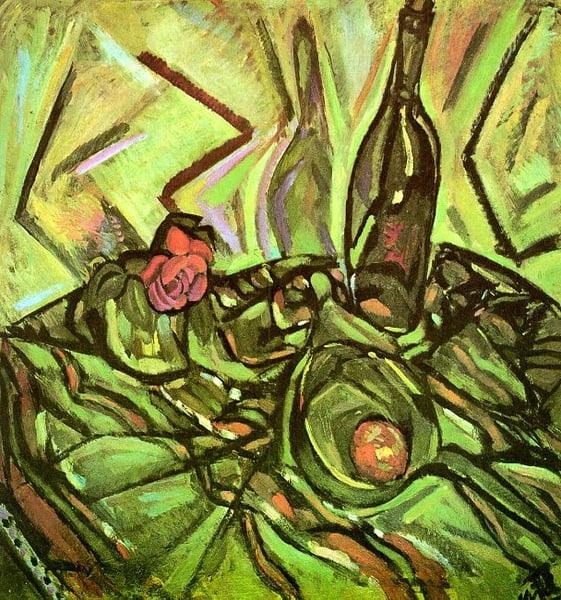
The still life genre, traditionally a vehicle for illusionistic depiction, here becomes a laboratory for radical formal experimentation. Miró flattens the pictorial space into a shallow, almost tapestry-like plane, typical of late Synthetic Cubism, yet infuses it with Fauvism’s non-naturalistic, emotionally charged color. The rose—traditionally a symbol of beauty or transience—is not rendered with delicate naturalism but as a geometricized, almost abstract cluster of sharp facets, its “redness” exaggerated to a fiery, almost violent hue. This dual influence creates a tension between structure and sensation: the Cubist grid anchors the composition, while Fauvist patches of pure color (intense blues, yellows, greens) threaten to break free of those lines.
Historical Context
Painted during Miró’s formative period in Barcelona and Paris (circa 1917–1920), Still Life with Rose demonstrates his rejection of academic naturalism in favor of a more expressive, subjective reality. The work is significant because it shows Miró absorbing and then pushing beyond the dominant avant-garde idioms of his time. While Picasso and Braque had largely drained Cubism of color, and Matisse had subordinated form to color, Miró here seeks to unite both principles—a fusion that would later inform his Surrealist biomorphic abstractions.
Stylistic Integrity
The painting’s significance also lies in its bold handling of the still-life motif. Objects are reduced to their essential geometric cores: a table, a bottle, the rose itself are simplified into angular, overlapping planes. Yet Miró retains a sense of whimsy and organic life through the irregular, almost playful outlines and the abrupt, unblended brushstrokes. This restless energy anticipates the “automatic” mark-making of his mature Surrealist works.
In summary, Still Life with Rose is not merely a student exercise in two movements—it is a vital, original synthesis that records the moment Miró began to free color from description and line from contour, laying the groundwork for his unique visual language.
Museum / Gallery
Visivamente simili
20 opere con composizione e palette affini
Still Life with Fruit
Samuel Peploe
Untitled
Dilek Demirci
Czobel Bela Dinnyés Csendélet
Bela Czobel
Still Life
Margit Selska
Still Life
Samuel Peploe
Still LIfe with Fruit and Bottles
Henri Matisse
Still Life with Glass
Abraham Manievich
Still Life with Fruit
Henri Matisse
Bela Adalbert Czobel Still Life Wit Flowers and
Bela Czobel
Portugese Still Life
Sonia Delaunay
Still Life on Table
Kmetty János
Still Life
Fernando García Ponce
Bereny Robert, Still Life 1911
Berény Róbert
Still life with blue cup
Mario Sironi
Still life
Marc Chagall
Still Life
Samuel Peploe
Still Life with Bowl of Fruit, Jug, Cup and Saucer
Samuel Peploe
Czobel Still Life Gyümölcsökkel
Bela Czobel
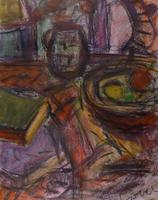
Czóbel Béla Csendélet Vegyes Technika,70x59cm
Bela Czobel
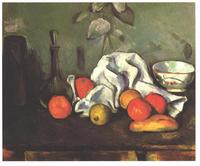
Still life with fruits
Paul Cezanne