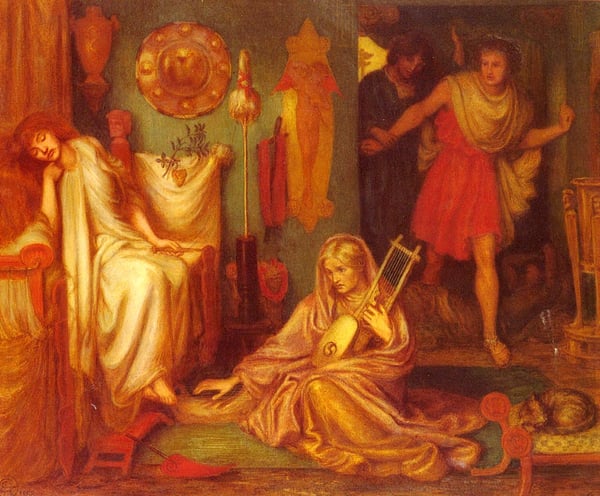
Expert analysis of Dante Gabriel Rossetti’s The Return Of Tibullus To Delia
Style: Romanticism · Genre: history painting
Expert Art Historical Analysis
Dante Gabriel Rossetti’s The Return of Tibullus to Delia stands as a compelling example of Romanticism’s engagement with history painting—a genre traditionally associated with large-scale moral and civic narratives, but here reimagined through the movement’s emphasis on personal emotion, classical nostalgia, and dramatic storytelling.
Within the Romantic period, history painting was often revitalized by artists who sought to infuse historical or literary subjects with intense psychological depth and atmospheric sensitivity. Rossetti’s choice to depict the Roman elegiac poet Tibullus returning to his beloved Delia aligns with Romanticism’s fascination with individual passion, longing, and the tension between idealized love and mortal reality. The work’s significance lies in its fusion of a classical literary source with the Romantic sensibility of subjective experience: the scene is not merely a retelling of ancient history, but a meditation on reunion, devotion, and the emotional weight of separation.
Stylistically, the painting exemplifies Romantic history painting’s departure from neoclassical restraint through its likely use of rich, vibrant colour, expressive chiaroscuro, and a focus on the intimate, tender moment rather than a grand public event. Rossetti, as a leading figure of the Pre-Raphaelite circle (though that term is not in the supplied facts, the Romantic alignment is clear), would have approached this subject with meticulous attention to symbolic detail—gesture, drapery, and setting—to evoke a timeless yet deeply personal narrative.
Thus, The Return of Tibullus to Delia is significant as a Romantic history painting that transforms a classical theme into a vehicle for exploring human emotion, marking a shift from historical documentation to poetic introspection within the genre. It demonstrates how Romanticism elevated the private, the lyrical, and the sentimental even within the traditionally public and didactic realm of history painting.
Museum / Gallery
Visually similar
20 works with related composition and palette
Jephthah
John Everett Millais
Sleep and His Half Brother Death
John William Waterhouse
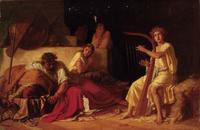
David Playing The Harp Before Saul
Ivan Tvorozhnikov
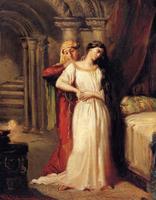
Desdemona Retiring to her Bed
Theodore Chasseriau
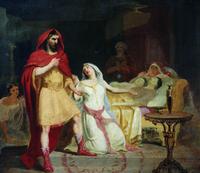
The Return of Ulysses to his home
Fyodor Bronnikov
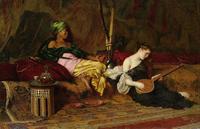
Interlude Musical
Alexandre-Louis Leloir
The Bath
Henri Fantin-Latour
Preparations for the Festivities
Sir Lawrence Alma-Tadema
Diomed and Cressida (from William Shakespeare's 'Troilus and Cressida', Act V, Scene II)
Angelica Kauffman
Mercury and Aglauros
Carel Fabritius
The Girl or the Vase
Henryk Siemiradzki
David calming Saul's fury with the harp
Silvestro Lega
The Soldier of Marathon
Sir Lawrence Alma-Tadema
Andromache and Astyanax
Pierre-Paul Prud'hon
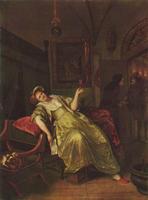
Arrival of a Visitor
Jan Steen
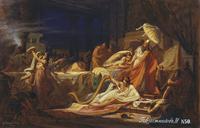
Feast of Belshazzar
Ivan Tvorozhnikov
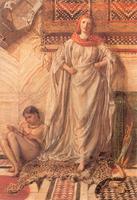
Dancing Girl Resting
Albert Joseph Moore
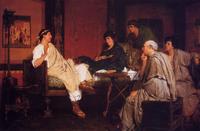
Tibulius at Delia`s
Sir Lawrence Alma-Tadema
Herodias
Ivan Kramskoy
Hector Upbraiding Paris for His Retreat from Battle
Angelica Kauffman