Harrowing of Hell
Ayrıntılar
Andrei Rublev sanatçısının Harrowing of Hell eseri hakkında uzman analizi
Tarz: Byzantine, Moscow school of icon painting · Tür: religious painting, icon
Expert Analysis: "Harrowing of Hell" by Andrei Rublev
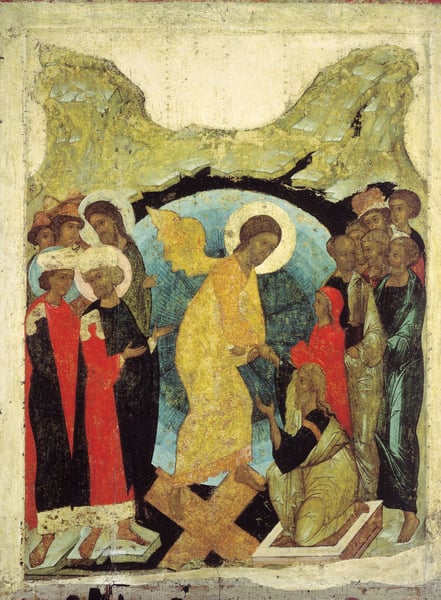
Andrei Rublev’s Harrowing of Hell stands as a masterwork of the Moscow school of icon painting, a school that refined and humanized the austere grandeur of the Byzantine tradition. Executed in the early 15th century—the golden age of Russian iconography—this icon depicts the pivotal moment of Christ’s descent into Hades after the Crucifixion, where he shatters the gates of death and raises Adam, Eve, and the Old Testament righteous to eternal life.
Significance within the Byzantine and Moscow School Tradition
While the subject is deeply rooted in Byzantine theology—the Anastasis (Resurrection) icon—Rublev’s treatment marks a distinct evolution. Where earlier Byzantine icons emphasize the rigid, hierarchical majesty of Christ trampling the broken gates, Rublev introduces a profound lyricism and psychological warmth. His Christ is not a distant, immovable emperor; he is a dynamic, stooping savior, reaching out with tenderness to grasp Adam’s wrist. This gesture of salvation is rendered with a flowing, sinuous line that softens the formal symmetry typical of the Constantinople style.
The Moscow school, under Rublev’s influence, shifted from the dark, gold-heavy palette of late Byzantine art to a luminous, delicate coloration. In Harrowing of Hell, note the subtle harmonies: Christ’s robes are a pale, translucent ocher and rose, while the abyss below is veiled in deep, veined blues and greens, suggesting both the darkness of hell and the dawn of grace. The figures are elongated but not ethereal—they carry a quiet, human gravity. The gold ground, rather than functioning as a flat, otherworldly backdrop, seems to radiate from within the forms, creating an inner light that signifies divine energy.
Iconographic Innovation
Rublev departs from the traditional layout by centering the action less on Christ’s triumphal march and more on the intimate dialogue between Savior and the saved. Adam and Eve are not merely passive recipients; their eyes meet Christ’s with a mix of awe and recognition. The broken locks and scattered nails at the bottom are rendered with careful, almost tactile precision, grounding the miracle in a palpable reality. This blend of the heavenly and the human—the theosis (divinization) of matter itself—is the hallmark of Rublev’s genius.
Legacy and Influence
This icon exemplifies the Moscow school’s peak: a synthesis of Byzantine theological depth, Slavic emotional sincerity, and a refined, harmonious composition that would influence generations of iconographers. Rublev’s Harrowing of Hell is not merely a ritual object; it is a visual homily on the victory of love over death, rendered with a grace that makes the sacred feel intimately near. It remains a touchstone for understanding how Russian iconography transcended its Byzantine origins to achieve a distinct, luminous spirituality.
Museum / Gallery
Görsel olarak benzer
İlişkili kompozisyon ve renk paletine sahip 20 eser
Ascension of Jesus
Andrei Rublev
Harrowing of Hell
Orthodox Icons
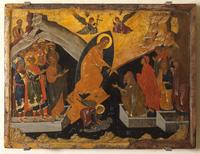
Harrowing of hell
Orthodox Icons
The Assumption of Our Lady
Simon Ushakov
Presentation of Jesus at the Temple
Andrei Rublev
The Deesis and the Twelve Great Feasts
Orthodox Icons
Only-Begotten Son and Immortal Word of God
Orthodox Icons
Transfiguration of Christ
Orthodox Icons
Transfiguration of Jesus
Andrei Rublev
Ascension
Orthodox Icons
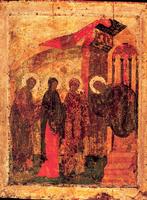
Presentation of Jesus at the Temple
Andrei Rublev
Synaxis of the Twelve Apostles
Orthodox Icons
The Raising of Lazarus
Orthodox Icons
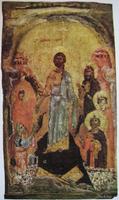
Harrowing to Hell
Orthodox Icons
Lazarus Miracle
Orthodox Icons
The Cloud Dormition
Orthodox Icons
Annunciation
Orthodox Icons
Lazarus Miracle
Orthodox Icons
Obadiah, Messenger of King Ahab, Meets Elijah (from Hagiographic cycle of detail of 'Prophet Elijah in the desert' )
Orthodox Icons
Dormition of Virgin Mary
Orthodox Icons