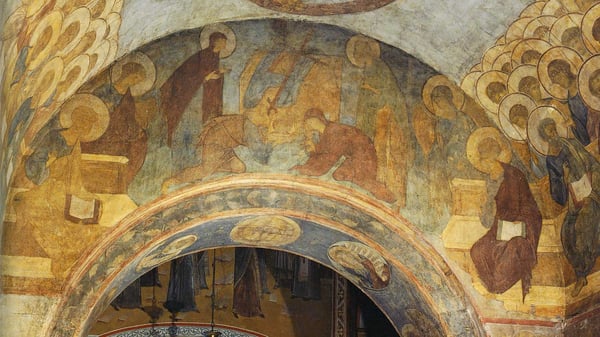
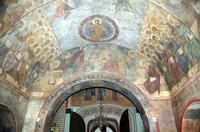
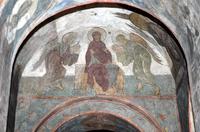
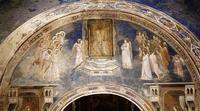
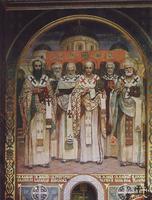
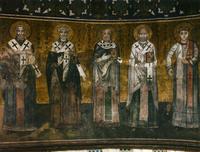
Expert Analysis of "The Last Judgement: Hetoimasia, Mother of God, John the Baptist, Adam and Eve, the angels, the apostles Peter and Paul" by Andrei Rublev
This work is a masterful synthesis of Byzantine iconographic tradition and the Moscow school’s distinct spiritual clarity, rooted in the theological drama of the Last Judgment. The structured facts reveal a complex, hierarchical composition:
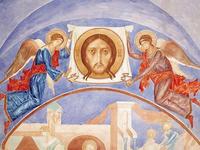
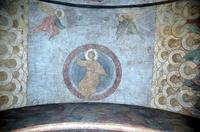
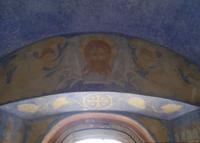
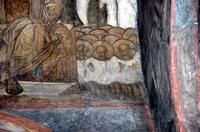
- Hetoimasia (the “Prepared Throne”) anchors the scene, symbolizing Christ’s imminent coming as Judge, while the absence of Christ himself emphasizes the eschatological expectation central to Byzantine liturgy.
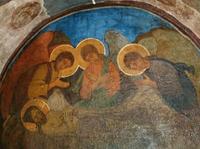
- The Mother of God and John the Baptist appear as intercessors, a standard Deësis grouping that underscores the role of prayer in the judgment narrative.
- Adam and Eve represent fallen humanity, their inclusion signaling the universal scope of judgment—from the first sinners to all souls.
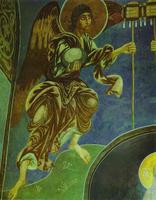
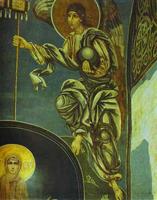
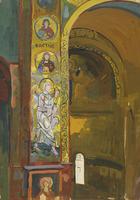
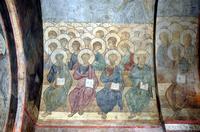
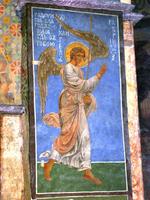
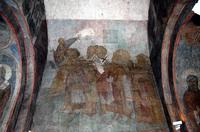
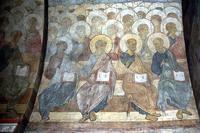
- The angels, apostles Peter and Paul embody the heavenly court and the founding witnesses of the Church, reinforcing the authoritative, apostolic foundation of the faith.
Within the Byzantine and Moscow school style, the icon’s significance lies in its rigorous adherence to canonical iconography while achieving a refined, ethereal harmony of line and color. Rublev, though working within fixed formulas, elevates the composition through a subtle balance: the solemn stillness of the figures conveys a transcendent calm, contrasting with the usual Byzantine emphasis on the terror of judgment. The Moscow school here softens the Byzantine austerity, replacing it with a luminous, introspective spirituality that invites contemplation rather than fear.
This icon is significant for its unified theological narrative—it condenses the entirety of salvation history (Creation, Incarnation, Intercession, and Final Judgment) into a single, ordered field. It functions not merely as illustration but as a liturgical object that makes the Last Judgment present to the worshiper, bridging earth and heaven through its stylized, timeless forms.