Trinity
Details
Deskundige analyse van Trinity van Andrei Rublev
Stijl: Byzantine, Moscow school of icon painting · Genre: religious painting, icon
Analysis of Andrei Rublev’s "Trinity"
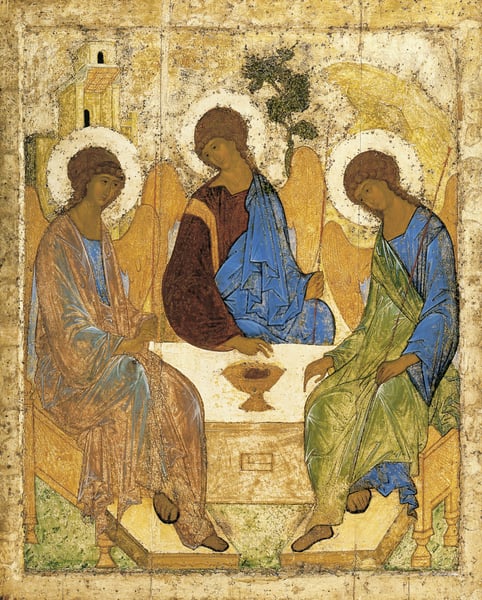
Andrei Rublev’s Trinity (c. 1411–1425) stands as the supreme achievement of the Moscow school of icon painting and a definitive masterpiece of Byzantine-inspired religious art. Painted as an icon for the Trinity Lavra of St. Sergius, the work departs from traditional narrative depictions of the Old Testament “Hospitality of Abraham” to create a purely theological vision of the Holy Trinity—an unprecedented focus that elevates it beyond mere illustration into profound spiritual meditation.
Stylistic and Theological Significance
Rublev’s composition strips the scene to its essential core: three angelic figures seated around a table, with Abraham and Sarah omitted. This distillation emphasizes the unity and co-equality of the Father, Son, and Holy Spirit. The angels form a perfect circle—a Byzantine device for eternity and divine harmony—while their poses echo one another in a silent, reciprocal dialogue. The central angel (traditionally identified as Christ) gestures toward the chalice on the table, prefiguring the Eucharist and Christ’s sacrifice. The left angel (the Father) gazes toward the Son, and the right angel (the Spirit) inclines in agreement, creating a dynamic of mutual love and consent.
Inverse Perspective and Spatial Innovation
True to Byzantine convention, Rublev employs inverse perspective: the table and footstools widen toward the viewer, drawing the icon’s space outward into the worshiper’s world. This technique, combined with the gold ground (symbolizing uncreated divine light), dissolves naturalistic depth and invites the beholder into the timeless realm of the Godhead. The colors—soaring lapis lazuli (the “Rublev blue”), soft green, and ochre—achieve a luminous transparency, evoking the radiant stillness of heaven.
Historical and Cultural Relevance
Created during a period of Mongol-Tatar domination and internal strife, the Trinity was commissioned as a prayer for unity and peace. Its serene, reconciling vision offered hope to a divided Russia. Today, it remains a theological icon par excellence—one that synthesizes Byzantine theological rigor (the essence of the Trinity as perichoresis, or interpenetration) with a lyrical, earthy tenderness unique to the Moscow school. Rublev’s work set the standard for Russian iconography for centuries, and its influence extends well into modern art, where its beauty and spiritual depth continue to be revered.
Museum / Gallery
Visueel vergelijkbaar
20 werken met verwante compositie en kleurenpalet
The Holy Trinity of Old Testament
Orthodox Icons
Trinity
Kuzma Petrov-Vodkin
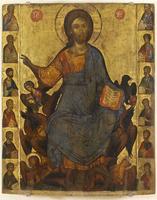
Christ in glory with apostles
Orthodox Icons
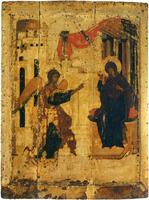
Annunciation
Andrei Rublev
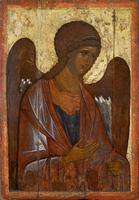
Vysotsky chin. Archangel Michael
Orthodox Icons
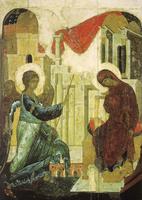
Annunciation
Andrei Rublev
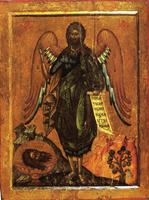
John the Baptist - Angel of the Desert
Orthodox Icons
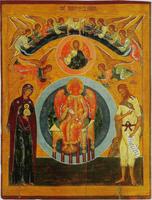
Holy Wisdom
Orthodox Icons
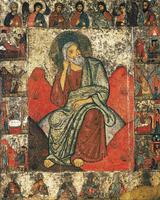
Prophet Elijah in the desert with Hagiographic cycle
Orthodox Icons
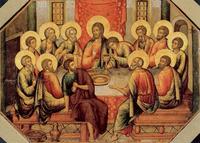
The Last Supper
Simon Ushakov
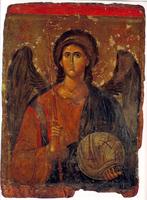
Saint Michael
Orthodox Icons
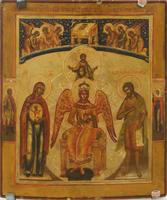
Holy Wisdom
Orthodox Icons
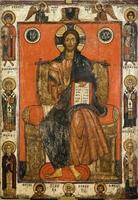
Christ enthroned
Orthodox Icons
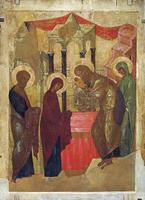
Presentation of Jesus at the Temple
Andrei Rublev
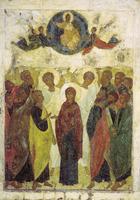
Ascension of Jesus
Andrei Rublev
Fiery Furnace, Mashtots, 1266
Toros Roslin
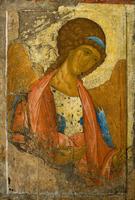
Archangel Michael
Andrei Rublev
The Cloud Dormition
Orthodox Icons
Elijah In The Widow's House Multiplies Bread (from Hagiographic cycle of detail of 'Prophet Elijah in the desert' )
Orthodox Icons
Annunciation of Ustyug
Orthodox Icons