Expertenanalyse zu Mikhail Vrubels Fallen Demon
Stil: Symbolism · Genre: literary painting
Expert Analysis of "Fallen Demon" (1902) by Mikhail Vrubel
Style: Symbolism | Genre: Literary Painting
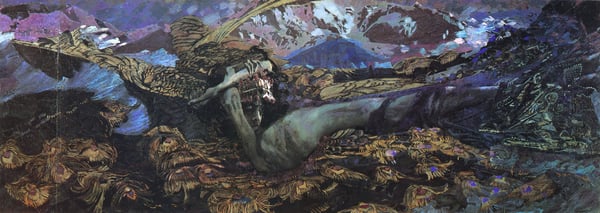
Mikhail Vrubel’s "Fallen Demon" stands as a defining masterpiece of Russian Symbolism, a movement that prioritized inner emotion, spiritual decay, and the sublime over naturalistic representation. As a literary painting, it directly adapts Mikhail Lermontov’s poem The Demon (1839–41), which tells the story of a proud, exiled angel who falls in love with a mortal woman—a narrative that resonated deeply with the Symbolist fascination with tragic isolation and metaphysical longing.
Significance within Symbolism: Vrubel’s work epitomizes the Symbolist rejection of empirical reality. The demon is not depicted as a monstrous villain but as a brooding, melancholic figure—massive, with an angular, almost cubist face and a body that seems to dissolve into the surrounding jewel-toned mosaic of flowers and sky. The brushwork is deliberately fragmentary, with thick, faceted strokes of blue, violet, and gold creating a shimmering, dreamlike surface. This technique—often described as “crystallization”—reflects the Symbolist belief that art should convey inner states rather than outward appearances.
Significance as a Literary Painting: By anchoring his composition in Lermontov’s poem, Vrubel transcends mere illustration. He visualizes the demon’s dual nature: his immense, winged body dominates the canvas, yet his expression is one of profound sorrow and defiance. The surrounding petals and rocks feel organic and decaying, mirroring the demon’s internal turmoil. This fusion of literary source with Symbolist visual language allows the painting to function as a psychological portrait of exile and yearning—a key theme not only in Russian literature but in the broader Symbolist ethos of the alienated artist.
What Makes It Iconic: “Fallen Demon” is Vrubel’s most ambitious exploration of a character he revisited obsessively (including The Demon Seated and The Demon Downcast). The painting’s significance lies in its radical synthesis of ornate decorative elements (drawn from Vrubel’s training in Byzantine and medieval art) with a modernist, almost proto-Expressionist emotional intensity. It influenced later Russian avant-garde artists by demonstrating that a literary subject could be a vehicle for pure formal experimentation and metaphysical depth.
In sum, “Fallen Demon” is a cornerstone of Symbolist painting, notable for its psychological complexity, its masterful integration of literary narrative, and its innovative, mosaic-like technique that captures the immaterial essence of a fallen soul.
Museum / Gallery
Visuell ähnlich
20 Werke mit ähnlicher Komposition und Farbpalette
Fallen Demon
Mikhail Vrubel
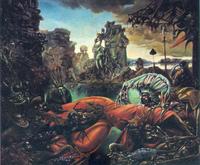
Temptation of St. Anthony
Max Ernst
The Temptation of St. Anthony
Ivan Albright
Orfeu nos Infernos
Guilherme de Santa-Rita
Orfeu nos Infernos (detail)
Guilherme de Santa-Rita
"Le dieu bleu" - set design
Leon Bakst
Disintegrating Trench
Otto Dix
Untitled
Zdzislaw Beksinski
Mock away! Mock! The Niblungs make for you Toy!
Arthur Rackham
The Symphony
Sabin Balasa
East of the Sun and West of the Moon
Kay Nielsen
Seize the despoiler
Arthur Rackham
The Temptation of Eve
James Lesesne Wells
Study "Cry of the serpent"
Nicholas Roerich
Prometheus Bound
David Alfaro Siqueiros
Warning
Ivan Marchuk
The Egyptians Drown in the Sea
Gustave Dore
The Cheerful Horse
Salvador Dali
Saint Surrounded by Three Pi-Mesons
Salvador Dali
Mothers
Nabil Kanso