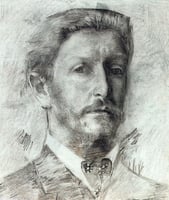
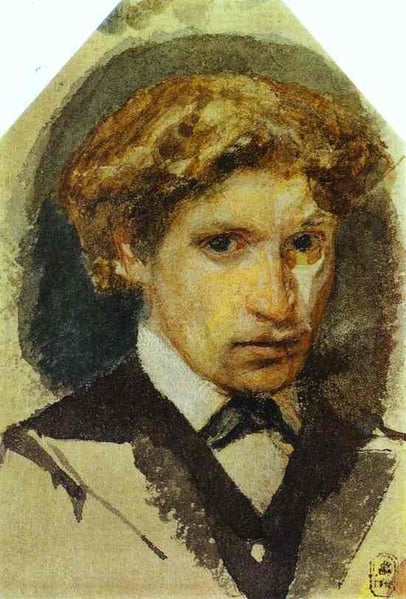
Self Portrait
Dettagli
Analisi esperta di Self Portrait di Mikhail Vrubel
Stile: Realism · Genere: self-portrait
Expert Analysis of Mikhail Vrubel's Self Portrait (Style: Realism; Genre: Self-Portrait)
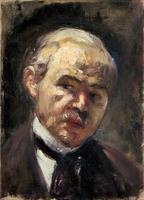
Mikhail Vrubel’s Self Portrait is a compelling example of how the Realist tradition can be harnessed not merely for objective likeness but for profound psychological introspection. Executed within the conventions of Realism—precise observation, naturalistic modeling, and a muted, earthy palette—the work transcends simple documentation to become a candid study of the artist’s inner state.
Significance within the Style of Realism
What makes this self-portrait significant is its focused, almost forensic attention to the sitter’s features and expression. Vrubel avoids idealization or dramatic staging, instead presenting himself with unflinching directness. The structure of the face is built through careful chiaroscuro, with subtle transitions of light and shadow that define bone structure and skin texture. The eyes, in particular, are rendered with remarkable clarity—dark, searching, and slightly weary—anchoring the viewer in a moment of quiet self-examination. This commitment to verisimilitude aligns with Realism’s core goal of depicting life without artifice, but Vrubel infuses it with an emotional gravity that elevates the work beyond mere imitation.
Genre: The Self-Portrait as Psychological Mirror
As a self-portrait, the work occupies a unique place in Vrubel’s oeuvre. Unlike his later, more famously brooding and symbolic works (e.g., The Demon Seated), this piece reveals the artist in a relatively unguarded moment. The composition is straightforward: a bust-length format, the head turned slightly to the side, a direct but contemplative gaze. The background is minimal, keeping all focus on the face. Here, Realism becomes a tool for self-revelation—the careful rendering of shadows under the eyes, the slight asymmetry of the mouth, and the tension in the jaw all suggest a mind at work, perhaps grappling with the very act of artistic creation. The significance lies in how Vrubel uses the conventions of Realism to make the internal visible, turning the self-portrait into a document of both physical presence and creative consciousness.
Conclusion
In this Self Portrait, Mikhail Vrubel demonstrates that Realism need not be cold or detached. By applying its principles to his own likeness, he produces an image that is at once meticulous and deeply human. The work stands as a testament to his technical mastery and his ability to find profound significance in the most direct form of artistic self-investigation. For viewers, it offers a rare, unadorned encounter with the artist’s own gaze—a moment of stillness and truth within the larger drama of his career.
Visivamente simili
20 opere con composizione e palette affini
Small Self-Portrait
Richard Gerstl
Portrait of the Artist Illarion Prianishnikov
Vasily Perov
Sixteen years old
Max Liebermann
Portrait of the Artist Mikhail Peskov
Alexei Korzukhin
Self-Portrait
Dante Gabriel Rossetti
Self-portrait
Jules Bastien-Lepage
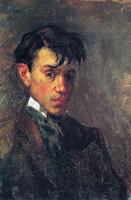
Self-Portrait
Pablo Picasso
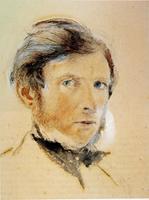
Self Portrait
John Ruskin
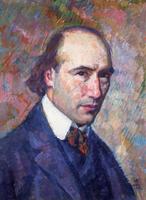
Portrait of Andre Gide
Theo van Rysselberghe
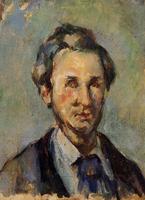
Victor Chocquet
Paul Cezanne
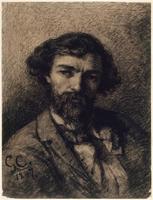
Portrait of Alphonse Promayet
Gustave Courbet
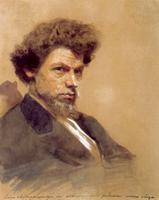
Portrait of the Artist V.M. Maksimov
Ivan Kramskoy
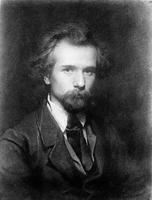
Portrait of the Artist Pavel Petrovich Chistyakova
Ivan Kramskoy
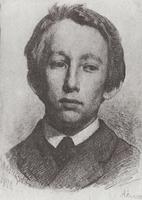
Portrait of Appolinary Vasnetsov
Viktor Vasnetsov
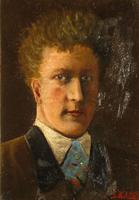
Portrait of a young man
Ludvig Kabell
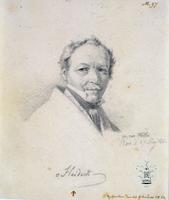
Portrait of Carl von Heideck (29 May 1842)
Theodor Leopold Weller
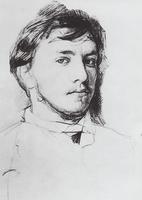
Self-Portrait
Valentin Serov
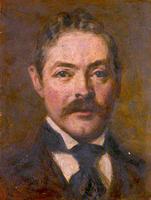
Sir David Murray, Artist
James Archer
Self-portrait
Lesser Ury
Portrait of Mr. Adorno
Giacomo Favretto