Sawn Tree
Expertenanalyse zu Ivan Shishkins Sawn Tree
Stil: Realism · Genre: sketch and study
Expert Analysis: "Sawn Tree" by Ivan Shishkin
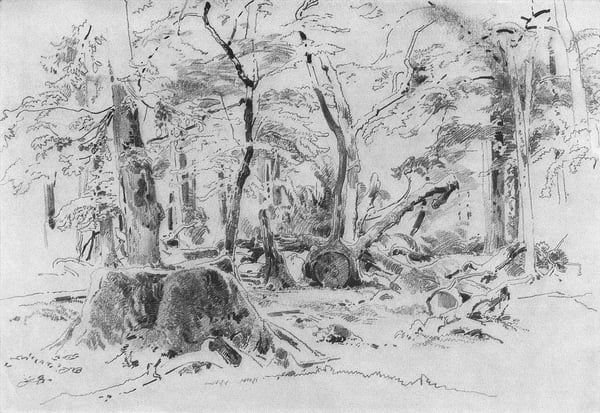
Ivan Shishkin (1832–1898) is celebrated as the foremost Russian landscape painter of the Realist tradition, and his Sawn Tree—a sketch and study—exemplifies the rigorous observational practice that underpinned his finished masterpieces. Within the context of 19th-century Realism, this work holds significance for its direct, unembellished focus on natural structure, revealing Shishkin’s profound commitment to truth in representation.
Stylistic and Technical Significance
As a sketch, Sawn Tree diverges from Shishkin’s grand, forest-laden canvases like Morning in a Pine Forest. Instead, it strips away composition and narrative, leaving only the raw anatomy of a tree. The genre of “study” places this work squarely in the artist’s working process—an intimate, immediate record of observation. Shishkin’s Realism here is not romanticized; the saw cut exposes the tree’s growth rings, bark texture, and the subtle play of light across the exposed wood. Every groove, crack, and mossy patch is rendered with a scientific eye, reflecting the influence of the Düsseldorf school’s precise naturalism, which Shishkin absorbed during his training.
Significance within Shishkin’s Oeuvre
For art historians, Sawn Tree is a key document of Shishkin’s methodology. He famously said, “Nature is the only teacher,” and these studies were his notebooks. This piece demonstrates how he built his iconic landscapes: starting from the micro (a single stump, a root, a sawn branch) to the macro (the vast, breathing forest). The choice of a sawn tree—a human intervention—subtly introduces a narrative of encroaching civilization, a theme that surfaces in his later works. Yet the focus remains on the tree’s material truth: the radial symmetry of rings, the rough bark, the splintered edge. This attention to detail elevates the work beyond mere preparatory notes; it becomes a meditation on time, growth, and decay.
Legacy and Influence
In the broader Realist movement, Sawn Tree epitomizes the belief that art should mirror nature’s specifics, not its ideals. Shishkin’s contemporaries, such as the Peredvizhniki (The Wanderers), championed this ethic. Today, this sketch is prized for revealing the artist’s hand—the swift pencil marks or thin washes of paint that capture a transient moment of light—while also offering a tangible link to the vast, silent forests that defined Russian national identity in art. It reminds us that Shishkin’s genius lay not only in the majestic panorama but in the humble, honest fragment.
Visuell ähnlich
20 Werke mit ähnlicher Komposition und Farbpalette
Carved wood
Ivan Shishkin
Wind Fallen Trees
Ivan Shishkin
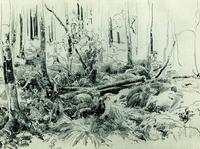
In the forest thicket
Ivan Shishkin
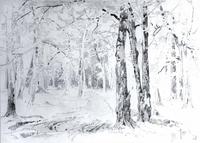
The road in forest
Ivan Shishkin
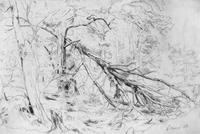
Broken Birch
Ivan Shishkin
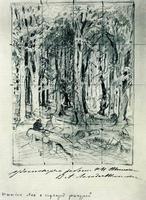
Forest with a seated figure
Ivan Shishkin
Forest
Ivan Shishkin
Weathered Tree Trunks in a Park
Carl Blechen
Fallen tree
Ivan Shishkin
Wind Fallen Trees
Ivan Shishkin
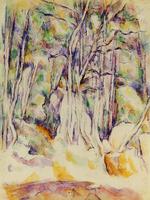
The Park of the Chateau Noir with Well
Paul Cezanne
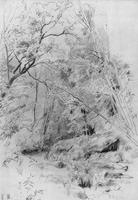
Over water
Ivan Shishkin
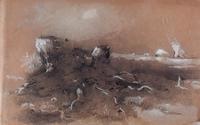
Stumps
Aleksey Savrasov
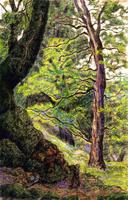
Untitled
Paul Ranson
Suuch Khan. Crimea
Ivan Shishkin
Tree roots
Ivan Shishkin
Boulogne Wood
Berthe Morisot
Cut down oak in the Bialowiezka Forest
Ivan Shishkin
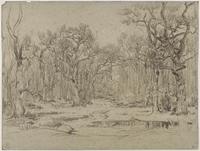
The Forest in Winter
Theodore Rousseau
The Forest in Winter
Theodore Rousseau