Expert analysis of Diego Velazquez’s Christ in the House of Mary and Martha
Style: Baroque · Genre: religious painting
Expert Analysis: Christ in the House of Mary and Martha by Diego Velázquez
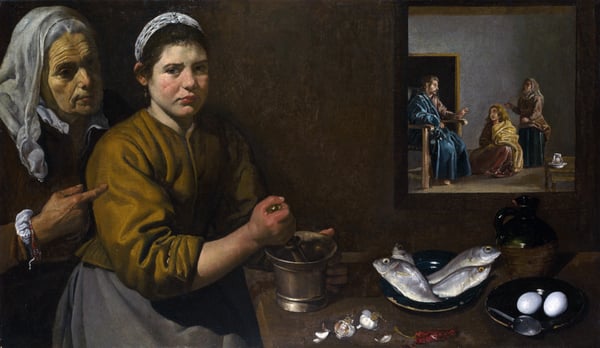
This work occupies a pivotal place within the Baroque period and Velázquez’s early career, exemplifying the Spanish master’s revolutionary synthesis of the sacred and the quotidian. While the title designates a religious subject—the biblical episode of Christ visiting the home of Mary and Martha (Luke 10:38–42)—Velázquez subverts traditional expectations by foregrounding a humble kitchen scene, relegating the holy narrative to a dimly lit background glimpsed through a serving hatch.
The painting’s significance lies in its blending of genre painting (the bodegón tradition of depicting everyday life) with religious iconography, a hallmark of Velázquez’s innovation. The foreground is dominated by a young kitchen maid, a mortar and pestle, garlic and eggs—ordinary, tactile objects rendered with astonishing naturalistic detail. This emphasis on the material world, typical of Spanish Baroque tenebrism, draws the viewer into the sensory reality of 17th-century Seville: the cool light from the left models forms with remarkable subtlety, while deep shadows envelop the space.
The true theological drama unfolds not in the background, but in the psychological tension between action and contemplation. The maid’s direct, confrontational gaze—breaking the fourth wall—forces the viewer to consider the moral equation: is she a stand-in for the distracted Martha, or an unwitting participant in the sacred story? Christ’s gesture in the background, gently rebuking Martha for her anxious labor, reinforces the counter-Reformation message of inner piety over worldly busyness.
Velázquez compresses space and time into a single canvas, using a picture-within-a-picture device that collapses the distance between the divine and the domestic. This layering—the sacred as a reflection seen through a window or mirror—was radical for its era. It anticipates modernist concerns with perception and reality, and cements Velázquez’s place as a pioneer of Baroque naturalism who refused to separate the spiritual from the everyday. In this work, the ordinary becomes the vessel for the extraordinary, a hallmark of the artist’s enduring significance.
Museum / Gallery
Visually similar
20 works with related composition and palette
Kitchen Scene with the Supper in Emmaus
Diego Velazquez
An Old Woman Cooking Eggs
Diego Velazquez
Four Figures at Table
Le Nain brothers
The happy family
Le Nain brothers
Baking of Flat Cakes
Bartolome Esteban Murillo
Woman Pouring Water into a Jar
Gerrit Dou
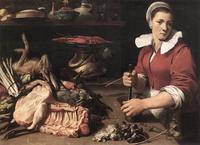
Cook With Food
Frans Snyders
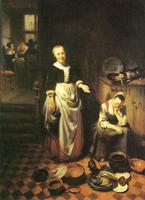
The idle servant
Nicolaes Maes
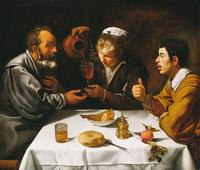
The Lunch
Diego Velazquez
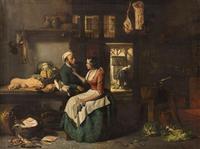
Lovers closely connected to each other painted in a kitchen interior surrounded by vegetables, salad, meat and fish, right beside is an open door which provides an insight into the next room
Hubertus van Hove
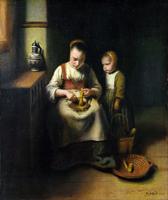
A Woman Scraping Parsnips, with a Child Standing by Her
Nicolaes Maes
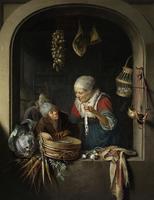
Herring Seller and Boy
Gerrit Dou
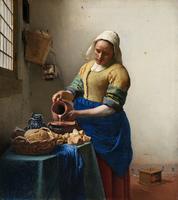
The Milkmaid
Johannes Vermeer
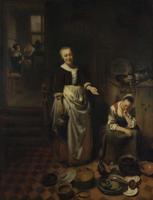
Interior with Sleeping Kitchen Maid - The Idle Servant
Nicolaes Maes
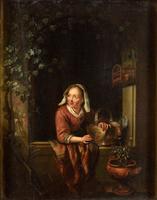
A Maid-Servant at a Window
Gerrit Dou
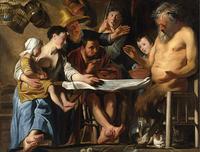
The Satyr and the Peasant Family
Jacob Jordaens
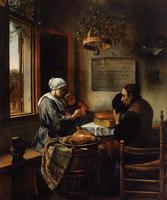
Prayer before Meal
Jan Steen
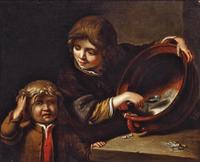
Zwei Kinder Bei Der Mahlzeit
Jan Miense Molenaer
Tavern Scene
David Teniers the Younger
Washerwoman
Gabriel Metsu