Description
Style: Baroque · Genre: genre painting
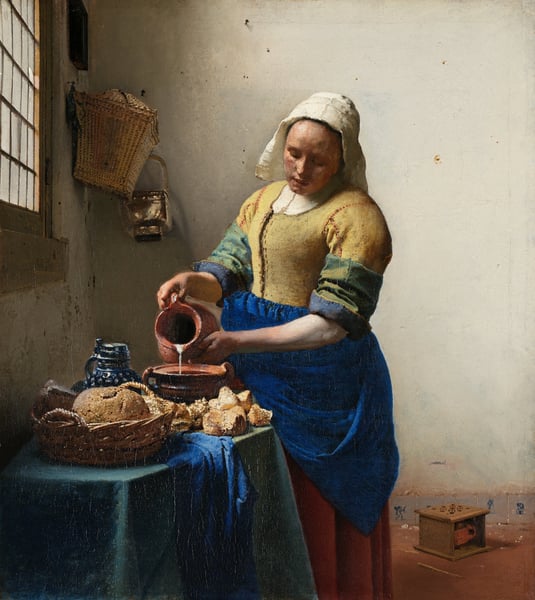
Even though servants and kitchen maids were recurring characters in 17th century Dutch genre paintings, Jan Vermeer’s The Milkmaid is a unique example, in which the kitchen maid is the subject of a single figure portrait. The milkmaid is fully absorbed in her activity, carefully pouring the milk. Even though the surrounding objects indicate that the milkmaid is in a kitchen, the indoor setting was kept relatively bare. X-ray studies of the painting show that Vermeer decided to eliminate a wall hanging, probably a map, from the back wall. Additionally, there was a basket of clothes in the right corner that the artist replaced with a footwarmer. By making these adjustments, the artist placed greater emphasis on the milkmaid and her activity.
This representation stands in contrast to other depictions of servants by his contemporaries, such as The idle servant (1655) by Dutch Golden Age painter Nicolaes Maes. In The idle servant, Maes constructs a narrative, the kitchen maid that fell asleep in front of a heap of dishes and then was found by her mistress. Like most genre paintings, this painting has a moral aspect: the mistress gestures towards the sleeping maid and the dishes, as a warning against idleness. In comparison, The Milkmaid does not present a story or anecdote, it simply describes a moment in time. For this reason, Vermeer’s composition displays only a limited space, directing the viewer’s attention to the milkmaid’s activity.
Vermeer’s milkmaid has a strong physical presence, created through expert use of light and shade. The light source is coming from the window and immersing the milkmaid in daylight. The artist created a light and dark contrast between the maid and the rear wall, in which the shaded parts of the wall correspond to where the light falls on the woman’s figure. Similarly, on the right side, the wall is lightest in order to enhance the shaded portion of the maid’s figure. Vermeer also emphasized her silhouette by painting a white contour line along her arm and shoulder. It was suggested that the pose of Vermeer’s milkmaid was inspired by Domenico Fiasella’s painting Queen Artemisia (ca. 1645). Generally speaking, it would be unusual for an artist to base a genre painting of a kitchen maid on a portrait of an ancient Greek queen. However, given Vermeer’s deviation from common depictions of servants in The Milkmaid, the connection to Fiasella’s Artemisia becomes more plausible. Vermeer depicted his milkmaid with empathy and dignity, and according to some the character also conveys morality. The portrayal of the maid concentrated on her work can relate to virtuosity and modesty, ideals of womanhood in Dutch 17th century society. The milkmaid displays her virtue through her diligent preparation of food. There are some elements in the painting that are indicative of romantic love, namely the footwarmer and the cupid tiles bordering the lower edge of the floor. However, because both of these are not prominent in the painting, it is unlikely that romantic love is the central theme. In this context, the footwarmer and the tiles symbolize human caring and the maid’s devotion toward others. In this way, these elements contribute to the central theme of the milkmaid pouring milk and providing nourishment.
Museum / Gallery
Visually similar
20 works with related composition and palette
Girl Reading a Letter at an Open Window
Johannes Vermeer
Maid at the Window
Gerrit Dou
Lady Writing a Letter with Her Maid
Johannes Vermeer
Woman Pouring Water into a Jar
Gerrit Dou
Woman hands over money to her servant
Pieter de Hooch
Market Scene with a Pick-pocket
Louise Moillon
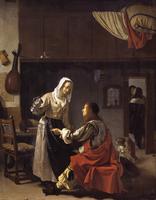
Brothel Scene
Frans van Mieris the Elder
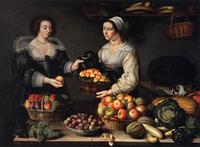
The Fruit and Vegetable Costermonger
Louise Moillon
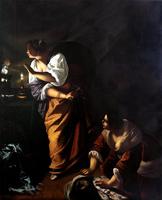
Judith and Her Maidservant with the Head of Holofernes Tapestry
Artemisia Gentileschi
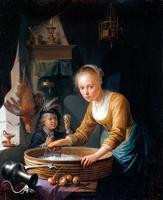
Girl Chopping Onions
Gerrit Dou
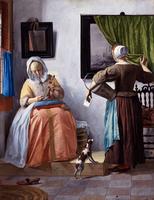
Woman Reading a Letter
Gabriel Metsu
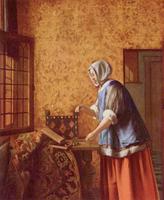
Woman weighing gold coins
Pieter de Hooch
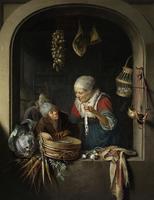
Herring Seller and Boy
Gerrit Dou
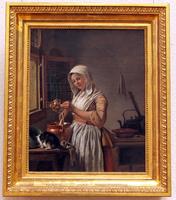
Milkmaid
Wybrand Hendriks
Martha and Mary Magdalene
Caravaggio
The cooker
Bartolome Esteban Murillo
Eating Oysters
Jacob Ochtervelt
A Woman Scraping Parsnips, with a Child Standing by Her
Nicolaes Maes
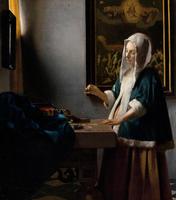
Woman Holding a Balance
Johannes Vermeer
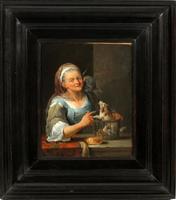
AN OLD LADY HOLDING A BASKET WITH A DOG AND PUPPIES
Jacob Toorenvliet