
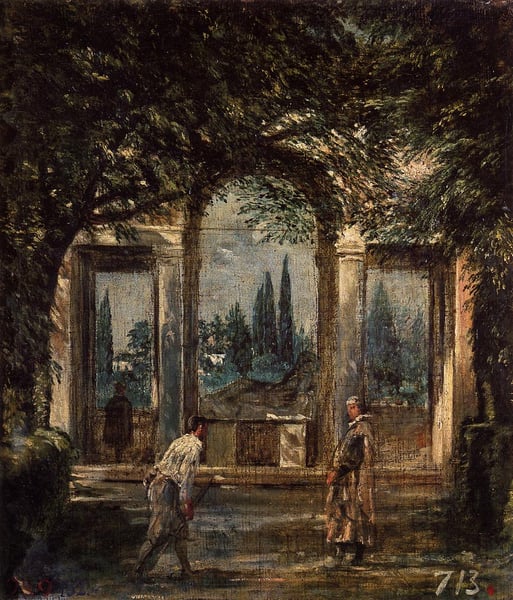
The Gardens of the Villa Medici in Rome
Подробности
Экспертный разбор работы «The Gardens of the Villa Medici in Rome» художника Diego Velazquez
Стиль: Baroque · Жанр: cityscape
Expert Analysis: "The Gardens of the Villa Medici in Rome" by Diego Velázquez
Velázquez’s The Gardens of the Villa Medici in Rome (c. 1630) stands as a remarkable outlier within both his own oeuvre and the broader Baroque tradition. While the Baroque is synonymous with dramatic chiaroscuro, religious fervor, and courtly grandeur, this small, intimate cityscape offers a quiet, almost modern sensibility that seems to anticipate Impressionism by two centuries.
Significance within Style and Period:
-
An Early Plein-Air Sketch: Painted during Velázquez’s first trip to Italy, this work is one of the earliest known examples of a painter working directly from nature (en plein air) to capture fleeting atmospheric effects. Unlike the studio-polished, allegorical landscapes of contemporaries like Claude Lorrain, Velázquez’s handling is loose and brushy, emphasizing the shimmer of sunlight filtering through foliage and the soft haze of the Roman afternoon. The dappled light on the villa’s arcade and the casual figures in the shadows create a snapshot of everyday life, not a staged classical ideal.
-
Departure from Velázquez’s Norm: Best known for his penetrating court portraits (e.g., Las Meninas) and religious works, Velázquez here turns his eye to a prosaic scene: a corner of the Medici gardens with a wall, arch, and figures. The composition is asymmetrical and seemingly spontaneous—a discarded statue lies in the foreground, a man urinates against a wall—blurring the line between high art and ordinary observation. This raw, unfiltered realism is a radical gesture for its time, privileging the artist’s immediate visual experience over symbolic or narrative content.
-
Proto-Modernist Sensibility: The sketchy, nearly unfinished quality of the painting—with visible brushstrokes and areas of bare canvas—was long dismissed as incomplete but is now celebrated as a deliberate exercise in optical truth. The work captures the effect of light and atmosphere rather than meticulous detail, foreshadowing the concerns of 19th-century Barbizon and Impressionist painters. It is a meditation on seeing itself, making it a crucial step toward modernism’s emphasis on perception over representation.
Conclusion: The Gardens of the Villa Medici in Rome is significant not for narrative drama or allegory, but for its radical directness. It reveals Velázquez as a painter of pure vision—a moment of quiet, sunlit observation that quietly challenges the theatricality of Baroque painting and lays a groundwork for the art of the next two centuries.
Museum / Gallery
Визуально похожие
20 работ с близкой композицией и палитрой
Villa Medici, pavilion with statue
Giorgio de Chirico
Villa Medici in Rome (Facade of the Grotto Logia)
Diego Velazquez
Aeneas and Dido in Carthage
Claude Lorrain
Arcaded Loggia by a River
Antonio de Pian
Classical Ruins
William Hamilton
View of Villa Ludovisi
Claude-Joseph Vernet
The Botanical Garden of Paseo del Prado
Luis Paret y Alcazar
A Study of Architecture, Florence
John Singer Sargent
the Arts Flourishing in Munich
Wilhelm von Kaulbach
Classical Ruins
William Hamilton
Capriccio with Classical Ruins and Buildings
Canaletto
Villa Papa Giulla
John Singer Sargent
Tavern in ancient Rome
Arnold Böcklin
Villa Falconieri
Giorgio de Chirico

Pompeii Street Scene
Ettore Forti
Spring morning in Villa Borghese
Aurelio Tiratelli
Bridge in Viko
Nikolai Ge
Villa by the Sea
Arnold Böcklin

The Small Park
Jean-Honore Fragonard
View from Capodimonte
Gabriele Smargiassi