Paper Dollar
Expert analysis of Andy Warhol’s Paper Dollar
Style: Pop Art · Genre: design
Expert Analysis: "Paper Dollar" by Andy Warhol
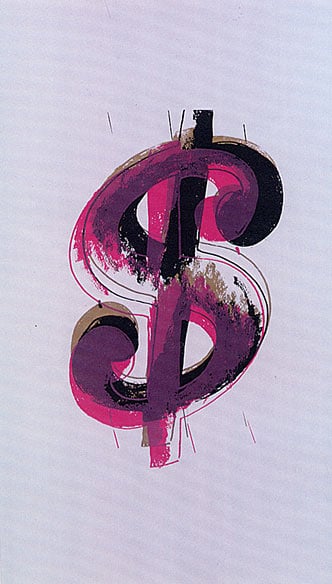
As a defining work of Pop Art, Andy Warhol's Paper Dollar transforms a ubiquitous piece of everyday currency into a potent symbol of the movement’s core concerns. Executed in the design genre, this piece functions as both a graphic object and a conceptual statement, leveraging the cold, mechanical look of commercial printing to question the very nature of value and originality in art.
Significance within Pop Art:
-
Elevation of the Banal: Warhol, like his Pop contemporaries, elevated mass-produced, low-culture imagery (soup cans, celebrities, dollar bills) to the status of fine art. Paper Dollar takes the most literal icon of commerce—the one-dollar bill—and strips it of its monetary function to reveal its essential quality as a designed, reproducible image. This democratization of subject matter challenges high-art hierarchies.
-
Critique of Commodification: The dollar bill is the ultimate symbol of exchange and value. By reproducing it on canvas, Warhol comments on the commodification of art itself. The artwork becomes a currency of its own—a tradable object whose value is dictated by name recognition and market speculation rather than inherent aesthetic merit. This is a meta-critique that resonates deeply with Pop Art’s fascination with consumer culture.
-
Mechanical Reproduction and Seriality: Warhol’s use of silkscreen printing (implied in the work’s flat, unmodulated surfaces) emphasizes the process of mass reproduction. A dollar bill is already mechanically produced in infinite editions; Warhol’s Paper Dollar further iterates this endless replication. The work’s significance lies in its embrace of the “non-art” look—the deadpan, depersonalized execution that mimics a bill’s graphic design rather than an artist’s hand.
-
Icon of the American Dream: The dollar bill carries the motifs of American identity—the Great Seal, eagles, portraits of founders. Warhol isolates and flattens these symbols, reducing them to abstract design elements. In doing so, he both celebrates and critiques the American myth of wealth and opportunity, exposing the disconnect between the ideal and the manufactured reality.
Conclusion: Paper Dollar is significant because it epitomizes Pop Art’s radical redefinition of what art can be. It treats a currency note as a pure visual sign, interrogates the relationship between art and money, and demonstrates Warhol’s genius for turning the most ordinary product into a provocative and enduring icon of its time.
Visually similar
20 works with related composition and palette
Dollar Sign
Andy Warhol
Bull Dreams in Green
Enrique Enn
Bull Dreams in Yellow
Enrique Enn
Dollar Sign
Andy Warhol
Dollar Sign
Andy Warhol
Bull Dreams in Fluor Red
Enrique Enn
God, Law
Jean-Michel Basquiat
Space constructions from Der Sturm portfolio
Peter Laszlo Peri
Solitude dans la Plaine
Pierre Tal-Coat
King Monopoly
Loutphi
Set design for the ballet 'Los Sacos Del Molinero'
Salvador Dali

Scheiber Hugó, Zsákhordó 1930
Scheiber Hugó
Lines-Force of Boccioni's Fist
Giacomo Balla
Richie Rich Yellow
Enrique Enn
Five Six and Four (77-654)
Ulfert Wilke

Brou de noix 65 x 50 cm, 1948
Pierre Soulages
Composition
Charles Lapicque
Green Column/Figure
Robert Mangold
Untitled (From a Laugh without Mouth)
Karl Otto Gotz

Study
Georges Vantongerloo