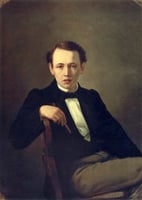
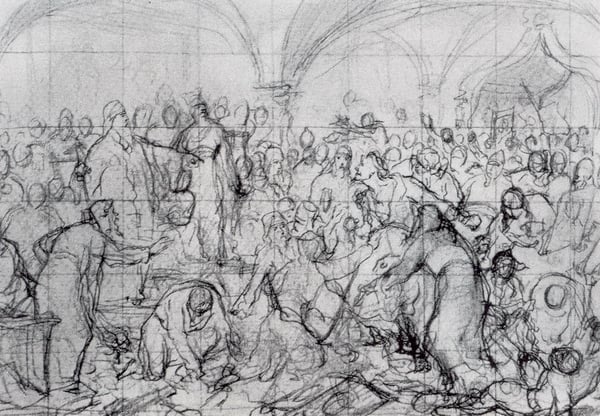
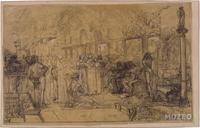
Expertenanalyse zu Vasily Perovs Nikita Pustosvyat. The dispute about the faith
Stil: Realism · Genre: sketch and study
Expert Analysis of "Nikita Pustosvyat. The dispute about the faith" by Vasily Perov
Context and Style
Vasily Perov was a leading figure of the Russian Realist movement, particularly associated with the critical, socially conscious branch that flourished in the 1860s–1870s. This work, a sketch and study for a larger historical composition, exemplifies Perov’s commitment to capturing authentic, unvarnished moments from Russian life—both contemporary and historical. Realism in Russia (often called the peredvizhniki or Wanderers’ tradition) demanded fidelity to truth over idealization, and Perov’s preparatory studies were celebrated for their raw, unposed energy.
Subject Matter
The title refers to Nikita Pustosvyat (a nickname meaning "Nikita the Empty-Saint"), a 17th-century leader of the Old Believers who defied Tsar Alexei Mikhailovich’s church reforms. In 1682, he famously debated the Patriarch and court officials, arguing for the preservation of ancient Orthodox rites. The dispute ended with Pustosvyat’s execution—a martyrdom for the Old Believer cause. Perov’s sketch focuses on the tense, dramatic climax of that debate, capturing the charged atmosphere of religious defiance and intellectual conviction.
Significance within Realism and Perov’s Oeuvre
As a study, this artwork holds exceptional value for understanding Perov’s method. Rather than polishing a finished scene, he zeroes in on psychological truth: the anguish, fervor, and stubborn piety of a man willing to die for his faith. The loose, spontaneous brushwork and stark chiaroscuro (typical of preparatory works) heighten the immediacy, making the viewer feel present at the confrontation. This approach aligns with Realism’s core principle—eschewing grand historical allegories in favor of gritty, human-scale drama.
Moreover, the choice of subject is deeply significant for the period. In the 1860s–70s, Russian artists increasingly turned to episodes of popular resistance and religious dissent as metaphors for contemporary social struggles against autocracy and orthodoxy. Pustosvyat represented the voice of the common people against state power—a resonant theme for Perov, who had earlier painted biting critiques of clergy corruption (e.g., Easter Procession in the Country) and peasant suffering. This sketch, therefore, is not merely a historical anecdote but a political statement, reflecting Realism’s role as a vehicle for social critique.
Artistic Execution
Even in its unfinished state, the study demonstrates Perov’s mastery of expressive gesture and facial expression. The figure of Pustosvyat is likely rendered with a wild, intense gaze and a defensive, argumentative posture, while the opposing figures (the patriarch, courtiers) would be implied through contrasts in lighting and mass. The loose handling of the medium—probably oil on canvas or paper—preserves the artist’s initial rush of inspiration, making this sketch a vital record of his creative process. It bridges the gap between academic historical painting and the raw immediacy of reportage, a hallmark of mature Russian Realism.
Conclusion
“Nikita Pustosvyat. The dispute about the faith” is significant as a rare surviving study that reveals Perov’s working method, his engagement with critical historical narratives, and his contribution to Realist art as a tool for social and political reflection. It stands as a testament to the movement’s insistence on truth—whether in the streets of contemporary Russia or the contentious history of its religious dissenters.
Visuell ähnlich
20 Werke mit ähnlicher Komposition und Farbpalette
Boyarynya Morozova (study)
Vasily Surikov
Khlysty zeal. Sketch
Vasily Perov
Joseph Recounting His Dreams
Rembrandt
Jacob shown the Bloodstained Coat of Joseph
Rembrandt
Studies of a Calvary
Albrecht Durer
Penitent Woman Anointing the Feet of Christ at the Table of Simon the Pharisee
Palma il Giovane
The Marriage Feast at Cana
Luca Giordano
The Elders Accuse Susanna Falsely of Adultery
Maarten de Vos
Various Figure Groups
Palma il Giovane
Study to "Boyarynya Morozova"
Vasily Surikov
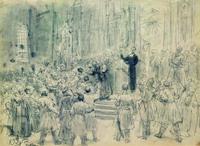
Sermon of Josaphat Kuntsevich in Belarus
Ilya Repin
Christ appearing to the apostles
Rembrandt
Study for the Adoration of the Magi
Leonardo da Vinci
Christ Blessing the Children
Nicolaes Maes
Christ disputing with the doctors
Rembrandt
Jesus and the adulteress by Rembrandt
Rembrandt
Adoration of the Magi
Albrecht Durer
Harbour in Constantinople
Karl Bryullov
Men and women singing and playing music
Luc-Olivier Merson
Holy Family
Albrecht Durer