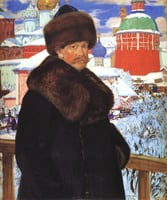
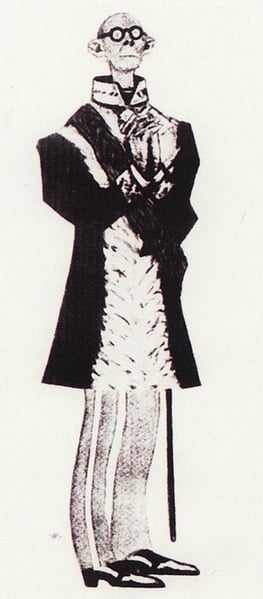
Analisi esperta di Chief Procurator of the Synod K. Pobedonostsev di Boris Kustodiev
Stile: Realism · Genere: caricature
Although the provided facts identify the style as "Realism" and the genre as "caricature," the true significance of Boris Kustodiev’s Chief Procurator of the Synod K. Pobedonostsev lies in its masterful fusion of these two seemingly divergent approaches. The work stands as a landmark of political satire within the Russian Realist tradition, using the visual language of objective representation to deliver a devastatingly subjective critique.
Significance within Realism and Caricature:
-
Undermining the Prestige of Power: Realism in the late 19th and early 20th centuries often sought to depict life "as it is." Kustodiev hijacks this earnestness. By rendering Pobedonostsev with meticulous, almost photographic detail—the precise folds of his ministerial uniform, the hollows of his gaunt face—he gives the figure a shocking, tangible presence. Yet this very realism becomes the tool of caricature. The exaggerated elongation of the procurator’s frame, the bird-like, predatory tilt of his head, and the cold, fanatical gleam in his eye are subtle distortions that transform a state portrait into an indictment. The viewer is forced to confront this powerful official not as a man, but as a menacing, inhuman force of reaction.
-
Social Critique as Artistic Duty: Kustodiev was working in a period of intense social ferment in Russia. Pobedonostsev, the Ober-Procurator of the Holy Synod under Alexander III and Nicholas II, was the arch-conservative architect of Russification and censorship. Kustodiev’s caricature is not mere jest; it is a weapon. By placing a Realist frame around a grotesque, skeletal figure, he exposes the spiritual decay behind the pomp of the autocracy and the Orthodox Church. The painting functions as a historical document of dissent, showing how Realist artists could use their fidelity to observation to unmask power, rather than simply document its surface glory.
-
A Pioneering Hybrid: While caricature often abandons naturalism for the sake of a joke, and Realism often avoids overt editorializing, Kustodiev creates a potent third thing. This work is significant because it proves that Realism can be the perfect vehicle for caricature. The exaggerated, gnarled hands, the rabbity incisors, the hunched posture—every element is based in observable human anatomy, yet selected and emphasized to produce a feeling of moral revulsion. It is a virtuosic performance: the artist never breaks the rules of visual truth, yet the resulting image is a merciless lie about how this man appears to the conscience of the nation.
In summary, Kustodiev’s portrait is significant because it wields the authority of Realist style to authenticate a caricaturist’s truth. It is a masterpiece of disguised critique, where the very precision of observation becomes the sharpest satire, capturing the cold, implacable spirit of a reactionary era.
Visivamente simili
20 opere con composizione e palette affini
Finance Minister Sergei Witte
Boris Kustodiev
F.V. Dubasov
Boris Kustodiev
Costume Design
Vadym Meller
Portrait of S. Somov
Boris Kustodiev
Saluons Les
Theophile Steinlen
Portrait of Count V.N. Kokovtsev
Boris Kustodiev
Franz II
Josef Kriehuber
Pergolesi
Pier Leone Ghezzi
Part of a Series Chronicling the Uniforms of Napoleon's Grande Armée.
Carle Vernet
Joseph II
Josef Kriehuber
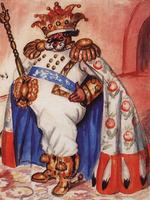
King wearing a crown and purple
Boris Kustodiev
The African King
Josef Capek
Retrato De Joaquín José Melgarejo Y Saurín
Rosario Weiss Zorrilla
Leopold II
Josef Kriehuber
Fifth Avenue
Richard Lindner
Kiselvrode
Boris Kustodiev
Charles Whitworth, 1st Earl Whitworth
Charles Turner
Adam Graf Reviczky von Revisnye
Johann Baptist Clarot
Manuel Inácio Martins Pamplona Corte Real, count of Subserra
Domingos Sequeira
On the grand staircase
Vladimir Makovsky