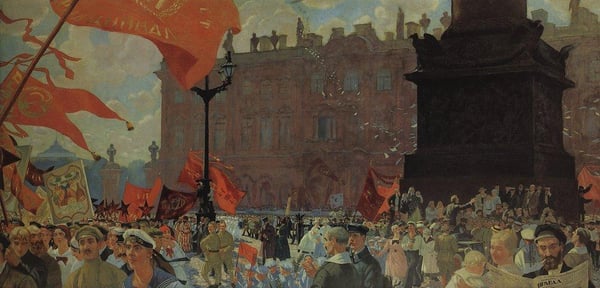
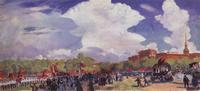
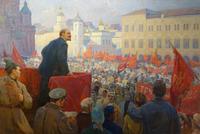
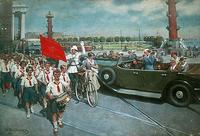
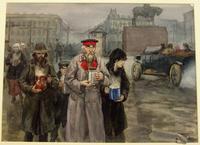
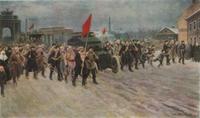
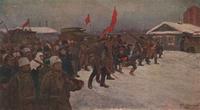
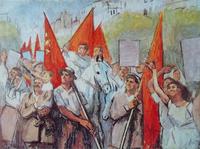
This work by Boris Kustodiev captures a pivotal moment in the early Soviet state: the celebratory demonstration on Uritsky (now Palace) Square in Petrograd on July 19, 1920, marking the opening of the Second Congress of the Communist International (Comintern). It is significant as a luminous, historically anchored document of revolutionary pageantry.
Historical and Political Resonance: The painting is a vivid piece of visual propaganda that immortalizes a key international gathering of communist parties. The Comintern Congress was intended to coordinate global revolutionary movements, and Kustodiev transforms the square into a stage for mass solidarity and the triumphant consolidation of Bolshevik power.
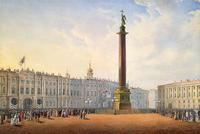
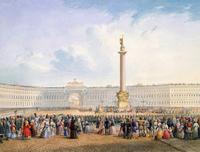
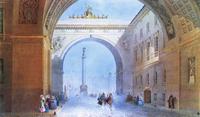
Artistic Synthesis: Despite Kustodiev’s Realist style—which typically focused on scenes of traditional Russian life, fairs, and merchants—he here applies his gift for festive, crowded compositions to a revolutionary subject. The result is a seamless blend of official celebration and accessible genre painting. The square is filled with banners, red flags, and a dense, energetic crowd, while the grand neoclassical architecture of the General Staff Building and the Alexander Column frames the scene, lending an air of historical majesty.
Significance within Art History: Kustodiev painted this while suffering from a debilitating spinal condition that confined him to a wheelchair. His ability to render such a sweeping, jubilant panorama from memory and imagination underscores his profound sympathy for the Bolshevik cause—or at least his commitment to portraying it as a people’s festival. The work exemplifies how Russian Realism was adapted to serve the new state’s need for heroic yet accessible depictions of its achievements. By foregrounding the masses rather than individual leaders, Kustodiev emphasizes collective participation over cult of personality, making the painting a unique fusion of traditional genre celebration (the fair, the feast) and modern political ritual. It remains a key artifact of early Soviet visual culture, capturing the brief moment when revolutionary fervor and artistic vigor aligned in public spectacle.