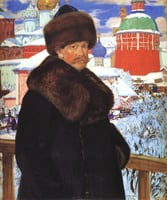
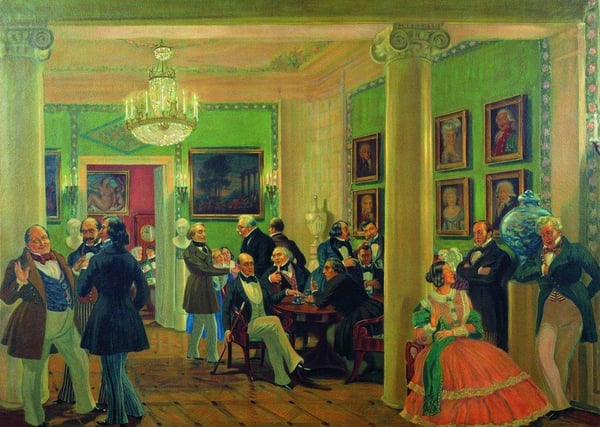
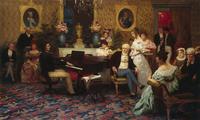
Expertenanalyse zu Boris Kustodievs In the living room in Moscow in 1840's
Stil: Art Nouveau (Modern) · Genre: genre painting
Expert Analysis: "In the Living Room in Moscow in the 1840s" by Boris Kustodiev
This work stands as a fascinating intersection of historical nostalgia and stylistic modernity. Although its subject—a bourgeois Moscow interior from the mid-19th century—is firmly rooted in genre painting’s tradition of everyday life, Kustodiev’s treatment elevates it through the lens of Art Nouveau (known in Russia as Modern). The painting is significant for how it synthesizes two seemingly incompatible impulses: a romantic, almost ethnographic recollection of the Russian merchant class and the sinuous, decorative aesthetic of turn-of-the-century international Art Nouveau.
Stylistic Significance within Art Nouveau
Art Nouveau prized organic forms, flowing lines, and a flattened pictorial space that emphasized pattern over depth. Kustodiev applies these principles to a scene that might otherwise be a straightforward historical document. The living room is not rendered with strict realism; instead, furniture, carpets, wallpaper, and the sitters’ costumes are treated as interlocking decorative zones. Curves echo through the armchair arms, the samovar, and the women’s shawls, creating a cohesive rhythm that feels both modern and deliberately stylized. The artist uses a rich, somewhat muted palette (golds, browns, deep greens) typical of Russian Art Nouveau’s preference for warmth and opulence, but he flattens shadows to emphasize pattern—a hallmark of the style’s rejection of academic perspective.
Genre Painting as Cultural Memory
As a genre painting, the work is not merely a snapshot of domestic life but a constructed memory. Kustodiev, working in the early 20th century, was looking back at the pre-reform Russia of the 1840s—a period of rising merchant power and traditional domesticity. By framing this scene within the modern style, he transforms it into a symbol of a vanished world. The figures (likely a family group) are absorbed in quiet activities: reading, sewing, or taking tea. Their poses are slightly stiff, echoing the decorative quality of the room. This is not documentary reportage but a poetic reconstruction, where Art Nouveau’s love for the ornamental becomes a vehicle for nostalgia.
What Makes It Significant
The painting’s significance lies in its fusion of Russianness with a pan-European style. Kustodiev was a master of this synthesis: he applied the linear grace and decorative richness of Art Nouveau to quintessentially Russian subject matter—the merchant-class interior, the samovar, the traditional icon corner (likely present, though not detailed in the prompt). This allowed him to celebrate national identity through a contemporary visual language. At the same time, the work challenges the standard Art Nouveau focus on the cosmopolitan and the exotic; here, the “exotic” is Russia’s own recent past, rendered with affectionate precision.
Ultimately, "In the Living Room in Moscow in the 1840s" exemplifies how genre painting, when executed by an artist of Kustodiev’s caliber, can transcend mere anecdote. It becomes a cultural artifact that tells us not only about 1840s Moscow but about the values and aesthetic sensibilities of early 20th-century Russia—a nation looking back at its traditions through a modern, decorative lens.
Visuell ähnlich
20 Werke mit ähnlicher Komposition und Farbpalette
Riksforsamlingen at Eidsvoll
Oscar Wergeland
Sessão do Conselho de Estado
Georgina de Albuquerque
Pushkin and his friends listen to Mickiewicz in the salon of Princess Zinaida Volkonskaya
Grigoriy Myasoyedov
Slavic composers
Ilya Repin
Literary reading
Vladimir Makovsky
Sketch for 'Vielgeschrey's Difficulties', scene from L. Holberg's "The Timeless", 1st act, 6th scene
Wilhelm Marstrand
Meeting at the Museum
Peder Severin Kroyer
A. Pushkin on the act in the Lyceum on Jan. 8, 1815
Ilya Repin
Mozart Giving A Concert In The 'Salon Des Quatre-Glaces Au Palais Dutemple' In The Court Of The Prince De Conti
Michel-Barthelemy Ollivier
Sketch for 'Philemon and his prosecutors'. Scene from Det lykkelige skibbrud by Holberg, Act 5, Scene 9
Wilhelm Marstrand
Schubertiade
Julius Schmid
Scene
Walter Sadler
The Daddies
Kent Monkman
Chess Game
Johann Erdmann Hummel
A Soiree
Henry Bunbury

General George Washington Resigning his Commission
John Trumbull
Himno Nacional Argentino
Pedro Subercaseaux
Painters in the hall of a rich man
Fyodor Bronnikov
Red Coat Soldiers Toasting the Ladies of the House
Howard Pyle
Chopin Playing the Piano in Prince Radziwill's Salon
Henryk Siemiradzki