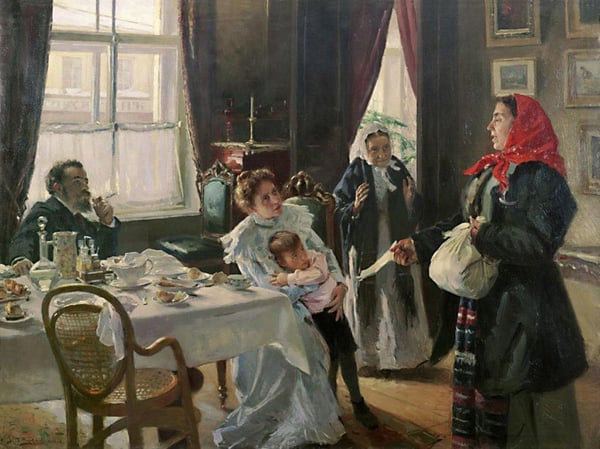
Two mothers. Native mother and stepmother.
Подробности
Экспертный разбор работы «Two mothers. Native mother and stepmother.» художника Vladimir Makovsky
Стиль: Realism · Жанр: genre painting
Vladimir Makovsky’s Two Mothers. Native Mother and Stepmother (c. 1880s) is a compelling example of Russian Realism, a movement dedicated to depicting everyday life with unflinching honesty and social awareness. As a genre painting, it focuses on a domestic scene that carries profound emotional and moral weight.
Significance within Realism and Its Period:
Makovsky, a leading figure in the realist circle known as the Peredvizhniki (The Wanderers), specialized in scenes that exposed the psychological and social undercurrents of 19th-century Russian life. This painting is significant for its psychological realism — it does not merely show a moment, but a loaded tension between two women bound by a single child. The title itself, contrasting “native mother” and “stepmother,” immediately evokes the archetypal conflict of the fairy-tale “wicked stepmother,” yet Makovsky’s treatment is far from sensational. Instead, he uses the conventions of genre painting to create a quiet, almost domestic drama.
The work’s importance lies in its empathetic social commentary. Makovsky often championed the vulnerable — the poor, orphans, and women. Here, he refrains from demonizing either figure. The “native mother” is typically seen as a peasant or destitute woman, perhaps forced to give up her child, while the “stepmother” stands as the woman who now raises it. By bringing them together, Makovsky asks the viewer to consider the painful choices imposed by poverty, the nature of maternal love, and the emotional cost of societal structures. The lack of melodrama is key: the stark, realistic detail of their clothing, posture, and expression conveys a profound, stoic sorrow.
Significance within Genre Painting:
Makovsky elevates genre painting from mere anecdote to a vehicle for moral inquiry. Unlike earlier, more idealized or humorous genre scenes, this work uses the format to probe complex family dynamics. The dual figure of “mother” challenges the simple dichotomy of biological versus adoptive care. The painting’s power comes from making the viewer an unseen witness to a private, painful reckoning — a hallmark of the best realist genre work. It stands as a masterful illustration of how Russian Realism could use a domestic moment to reflect on universal themes of loss, duty, and the often-difficult bonds of family.
Museum / Gallery
Визуально похожие
20 работ с близкой композицией и палитрой
Grandma Holiday
Alexei Korzukhin
Unexpected Visitors
Ilya Repin
The Children of Francois van Rysselberghe
Theo van Rysselberghe
The Luncheon
Claude Monet
Congratulation of betrothed in landlord's house
Grigoriy Myasoyedov
A Vaccination
Anna Ancher
Thoughts
Wenzel Tornøe
In the Monastery Hotel
Alexei Korzukhin
The violinist in love
Carl Zewy
Morning tea
Vladimir Makovsky
Morning of the Landlady
Alexey Venetsianov
In the Kitchen
Vladimir Makovsky
Exciting reading
Carl Zewy
Christmas Time (also known as The Blodgett Family)
Eastman Johnson
Grandma's lesson
Silvestro Lega
Landlady
Konstantin Makovsky
Waiting for Bridal Couple's Return from a Church in Novgorod Province
Andrei Ryabushkin
Music in the family
Giacomo Favretto
Laying the table
Victor Gabriel Gilbert
Breakfast for Three
Charles Courtney Curran