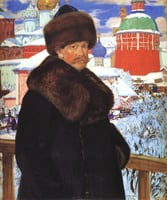
Analisi esperta di Paris at Night di Boris Kustodiev
Stile: Realism · Genere: cityscape
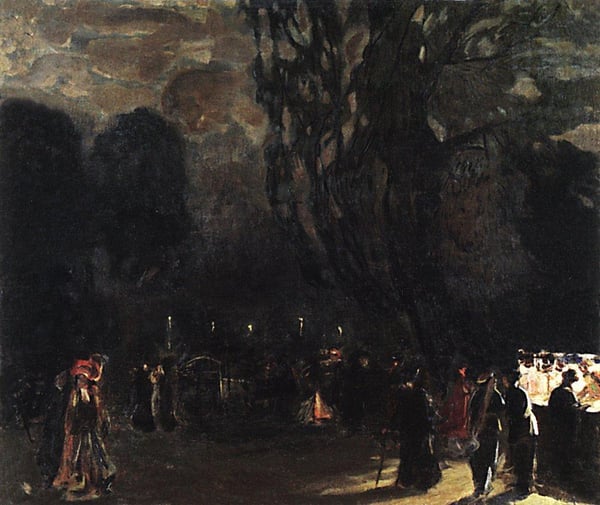
Expert Analysis: "Paris at Night" by Boris Kustodiev
Boris Kustodiev (1878–1927) is primarily celebrated for his exuberant, richly colored depictions of Russian provincial life, festivals, and the merchant class. Yet his Paris at Night demonstrates a remarkable versatility within the Realist tradition, applying its observational rigor to an iconic urban subject.
Significance within the Realist Cityscape Genre
As a cityscape rooted in Realism, this work does not romanticize Paris with Impressionist hazes or Symbolist mystery. Instead, Kustodiev captures the tangible, lived-in texture of the nocturnal metropolis. Realist cityscapes of the late 19th and early 20th centuries often prioritized the interplay of artificial light—gas lamps, shop windows, carriage lamps—against the dark sky, and Paris at Night would align with that tradition. The significance lies in its documentary clarity: the artist’s eye selects ordinary street details (a café terrace, a passing fiacre, the glow of a boulevard) and presents them with the same unflinching directness he brought to Russian market scenes.
Contrast with Kustodiev’s Oeuvre
What makes Paris at Night notable is how Kustodiev adapts his signature style to a foreign locale. His Russian works are often drenched in primary hues and folk-inflected patterns. In this Parisian night scene, one would expect a more muted, tonal palette—deep blues, amber yellows, soft greys—yet still rendered with his characteristic solidity of form. The painting becomes a dialogue between the artist’s native Realist training (acquired at the Imperial Academy of Arts under Ilya Repin) and the modern urban environment of the French capital. It bridges the gap between Old World winter fairs and the cosmopolitan nightlife of the Belle Époque.
Atmospheric and Social Observation
In keeping with Realist priorities, Paris at Night likely emphasizes the social fabric of the city after dark—the anonymous figures, the contrast between lit interiors and dark streets, the transient quality of night life. The work’s significance also derives from its historical moment: painted in the early 20th century (Kustodiev visited Western Europe around 1909–1910), it captures Paris before the upheavals of World War I. As a Realist cityscape, it functions as a visual record of that fleeting era, suffused with the quiet drama of everyday urban existence.
Conclusion
Paris at Night is significant as a testament to Boris Kustodiev’s ability to transcend his native subject matter while retaining the realist’s commitment to truthful, unidealized representation. It enriches his legacy by showing that his masterful handling of light, mood, and street life was not limited to Russian scenes but could illuminate even the most famous of world cities with fresh, objective clarity.
Visivamente simili
20 opere con composizione e palette affini
Cremorne Gardens, No. 2
James McNeill Whistler
The Overseer on the Plantation
Eastman Johnson
In St Cloud Park
Pierre-Auguste Renoir
Nocturne: Black and Gold – The Fire Wheel
James McNeill Whistler
Garden Party
Adolphe Joseph Thomas Monticelli
Under the Trees, Luxembourg Gardens
William James Glackens
A Cow and its Keeper
Camille Corot
Study for the Cercle de l'île de Puteaux
Henri Gervex
Night Scene
Istvan Farkas
Cows Returning from the Mountainside
Theodore Rousseau
Jesus Christ in the Garden of Gethsemane
Ilya Repin
Evening in Parc Monceau
Mihaly Munkacsy
Souvenir of Ville d'Avray
Camille Corot
The Manet Family picnicking
Eugene Boudin
The upper Thames
Albert Chevallier Tayler
On The Farm
Constant Troyon
Bretons on the way
Maxime Maufra
Montparnasse
Robert Henri
Fruit Stand, Coney Island
William James Glackens
La Grenouillere
Pierre-Auguste Renoir