
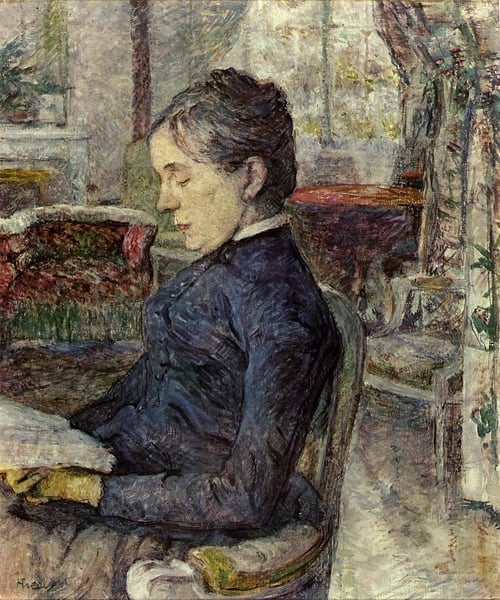
Análisis experto de Comtesse de Henri de Toulouse-Lautrec
Estilo: Post-Impressionism · Género: portrait
Expert Analysis: Comtesse by Henri de Toulouse-Lautrec
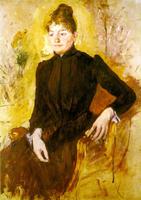
In this striking portrait, Toulouse-Lautrec transcends the conventions of traditional aristocratic representation. Painted in the Post-Impressionist idiom, Comtesse exemplifies his signature ability to merge psychological acuity with a radical, almost graphic formal language.
Significance within the Style and Period:
-
Subversion of the Noble Portrait: Unlike the flattering, idealized portraits of the upper classes common in academic art, Toulouse-Lautrec captures the countess with an unflinching, almost candid realism. The composition—often characterized by a slightly elevated or oblique viewpoint—strips away pomp, focusing instead on the subject’s inner world, be it ennui, strength, or melancholy. This reflects the Post-Impressionist shift away from mere visual likeness toward emotional and psychological truth.
-
Influence of Japanese Prints and Modern Line: Toulouse-Lautrec’s bold, sinuous contours and flattened planes of color (a hallmark of his Post-Impressionist style) owe a debt to ukiyo-e woodblock prints. In Comtesse, this manifests in the way the sitter’s silhouette is defined by decisive, rhythmic lines, while areas of pure, unmodulated color—deep blacks, ochres, or crimsons—create a sense of immediate presence rather than sculptural volume. This treatment elevates the portrait from a simple likeness to a modern, graphic statement.
-
Capturing the Zeitgeist of Fin-de-Siècle Paris: Though the subject is a countess, Toulouse-Lautrec’s approach equally reflects his lifelong fascination with the performers, prostitutes, and bohemians of Montmartre. By applying the same direct, unsentimental eye to an aristocrat, he collapses social hierarchies, treating all his sitters as complex individuals. The portrait thus becomes a document of a society in flux, where traditional roles are scrutinized through the lens of modern, urban consciousness.
-
Technical Innovation in a Traditional Genre: Where Impressionists dissolved form in light, Toulouse-Lautrec reasserts structure through strong outlines and strategic exaggeration—elongated necks, sharp angles, or asymmetrical poses. In Comtesse, such distortions are not decorative but expressive, conveying the subject’s character or mood. This anticipates the Expressionist portraiture of the early 20th century and marks the work as a pivotal bridge between 19th-century naturalism and modernist subjectivity.
Ultimately, Comtesse is significant not because it idealizes nobility, but because it humanizes it—filtered through Toulouse-Lautrec’s unsparing, empathetic, and radically modern eye.
Museum / Gallery
Visualmente similares
20 obras con composición y paleta relacionadas
Portrait of Countess A. de Toulouse Lautrec
Henri de Toulouse-Lautrec
Young woman with a book
Edouard Manet
Madame Aline Gibert
Henri de Toulouse-Lautrec
The Reader
Pierre-Auguste Renoir
Woman in a wheelchair
Louis Valtat
Self-Portrait with Julie (study)
Berthe Morisot
Pensive (Listening to the piano)
Giuseppe De Nittis
Woman Sitting by a Cradle
Vincent van Gogh
Interior, Woman Reading
Gustave Caillebotte
The Cup of Chocolate
Pierre-Auguste Renoir
Woman in a Black Hat, Berthe la Sourde
Henri de Toulouse-Lautrec
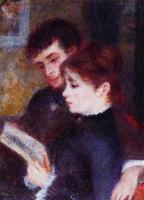
Reading Couple (Edmond Renoir and Marguerite Legrand)
Pierre-Auguste Renoir
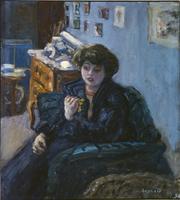
Young Womwn in an Interior
Pierre Bonnard
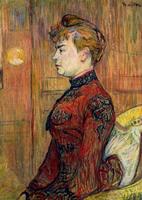
The Policeman s Daughter
Henri de Toulouse-Lautrec
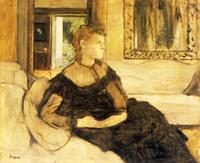
Madame Gobillard, Yves Morisot
Edgar Degas
By the Fireside
Pierre-Auguste Renoir
Madame Juliette Pascal
Henri de Toulouse-Lautrec
Miss Reynolds
Berthe Morisot
Ingeborg Thaulow
Paul Gauguin
Woman in Black
Mary Cassatt