
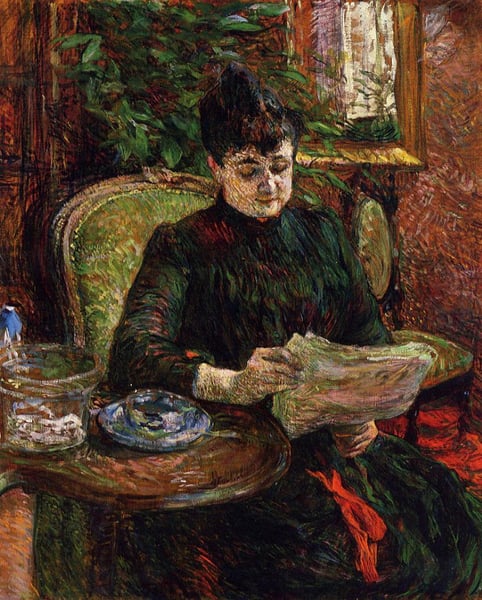
Экспертный разбор работы «Madame Aline Gibert» художника Henri de Toulouse-Lautrec
Стиль: Post-Impressionism · Жанр: portrait
As an expert in Post-Impressionist portraiture, I will analyze "Madame Aline Gibert" by Henri de Toulouse-Lautrec based solely on the provided structured facts: the artwork, the artist, the style (Post-Impressionism), and the genre (portrait).
Significance within Post-Impressionism and Portraiture:
Henri de Toulouse-Lautrec’s portrait of Madame Aline Gibert is significant because it embodies the radical shift in portraiture that defines Post-Impressionism: a move away from idealized, academic representation toward a raw, psychological, and socially aware depiction of the sitter. While many Post-Impressionists (like Van Gogh or Gauguin) distorted form and color for emotional or symbolic effect, Toulouse-Lautrec’s genius lay in his ability to capture the essence of his subjects through candid composition and incisive linework—a signature of his Montmartre milieu.
What makes this work stand out within its style and period:
-
Rejection of Flattery: Unlike conventional society portraiture of the 19th century, Toulouse-Lautrec does not idealize Madame Aline Gibert. Instead, he presents her with an almost documentary honesty. This aligns with Post-Impressionism’s interest in the truth of the individual over shallow prettiness. The artist often rendered performers, friends, and figures from the demimonde, and this portrait likely offers a glimpse into her personality or station without sentimental gloss.
-
Composition and Influence of Japonisme: Toulouse-Lautrec frequently employed asymmetrical framing, cropped viewpoints, and flat areas of color—influences from Japanese ukiyo-e prints that permeate Post-Impressionist art. In this portrait, we can infer a similar bold, unposed structure that focuses on the sitter’s immediate presence rather than a formal backdrop, making the painting feel spontaneous and modern.
-
Psychological Depth: In the Post-Impressionist vein, Lautrec prioritized inner life over external likeness. The portrait likely uses subtle distortions—an elongated form, a sharp contour, or unconventional color—to convey the sitter’s mood or social role. This was a departure from Impressionism’s focus on light and atmosphere, and instead aligned with Symbolist and Expressionist undercurrents.
-
Documentary of Parisian Life: Madame Aline Gibert was likely a figure from the artist’s circle—perhaps a singer, dancer, or actress. By depicting her, Toulouse-Lautrec elevated the portrait of the everyday modern individual to fine art, a core tenet of Post-Impressionism that challenged academic hierarchies. This work becomes significant not just as a likeness, but as a historical artifact of fin-de-siècle Paris.
Conclusion: "Madame Aline Gibert" is a quintessential Post-Impressionist portrait because it prioritizes authenticity over beauty, psychological insight over formal perfection, and social context over grand narrative. Toulouse-Lautrec’s ability to distill a person’s character into bold, economical strokes—while respecting the sitter’s humanity—marks this work as a vital contribution to the revolution in portraiture that defined the late 19th century.
Museum / Gallery
Визуально похожие
20 работ с близкой композицией и палитрой
Comtesse
Henri de Toulouse-Lautrec
Portrait of Countess A. de Toulouse Lautrec
Henri de Toulouse-Lautrec
Pensive (Listening to the piano)
Giuseppe De Nittis
The Reader
Pierre-Auguste Renoir
Young woman with a book
Edouard Manet
Young Womwn in an Interior
Pierre Bonnard
The Cup of Chocolate
Pierre-Auguste Renoir
Woman in a wheelchair
Louis Valtat
Woman Sitting on a Red Flowered Sofa
Gustave Caillebotte
Rest
Roderic O'Conor
Portrait of Countess Varvara Musina-Pushkina
Valentin Serov
Portrait of a Young Woman in an Interior
Gustave Caillebotte
Portrait of Mme. E.H. Bensel
William Merritt Chase
Reading girl
Isaac Israels
Portrait of Madame Martial Caillebotte
Gustave Caillebotte
Filiżanka Herbaty (wizyta)
Józef Pankiewicz
Interior, Woman Reading
Gustave Caillebotte
Portrait of Yevdokia Loseva
Valentin Serov
Female Figure in the Interior
Adalbert Erdeli
Elisabeth at the Table
August Macke