
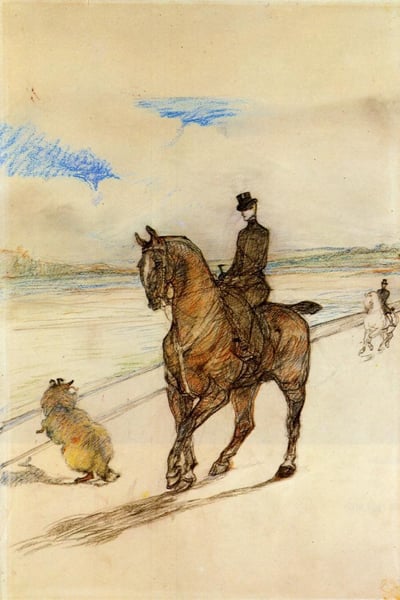
Expertenanalyse zu Henri de Toulouse-Lautrecs Horsewoman
Stil: Art Nouveau (Modern) · Genre: genre painting
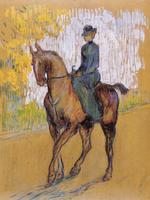
The Horsewoman by Henri de Toulouse-Lautrec is a masterful example of the artist’s ability to distill modern Parisian life into a compelling, Art Nouveau-infused genre scene. Though Lautrec is best known for his cabaret posters and portraits of Montmartre’s entertainers, this painting reveals his keen observation of leisure-class activity—here, a female equestrian—with the same psychological depth and stylistic flair he applied to dancers and singers.
Stylistic Significance within Art Nouveau: Lautrec’s approach to Art Nouveau is less about sinuous floral ornament and more about a bold flattening of space and dynamic contour lines. In Horsewoman, the rider and horse are defined by sweeping, calligraphic outlines that echo Japanese ukiyo-e prints—a major influence on the artist. The composition privileges asymmetry and cropping, as if the viewer has caught a fleeting moment. The ground is suggested by broad, unmodulated strokes of color, while the horse’s musculature is rendered with economical, rhythmic dashes. This synthesis of line and pattern is quintessential Lautrec: it pushes decorative Art Nouveau elegance toward a raw, modern immediacy.
Genre Painting as Social Documentation: As a genre painting, Horsewoman captures a specific moment in late 19th-century leisure culture. The subject—a woman confidently astride a horse—was relatively modern, reflecting the era’s shifting gender roles and the popularity of equestrian sports among the bourgeoisie. Lautrec does not idealize the scene; instead, he emphasizes the tension between the rider’s poise and the animal’s energy. The horse’s lowered head and tensed neck suggest motion restrained, while the rider’s upright posture and focused expression hint at control and determination. This psychological undercurrent is typical of Lautrec’s ability to find narrative in everyday action.
Technical Innovation: Lautrec often worked on unprimed cardboard or with thinned oil paint to achieve a matte, poster-like finish. Horsewoman likely exhibits this technique: the paint is applied in swift, overlapping strokes, with areas of raw support left visible to enhance spontaneity. The palette is restricted to ochers, blacks, and a muted green—colors that avoid sentimentality and anchor the scene in the gritty, authentic Paris that Lautrec adored.
Legacy: Horsewoman stands at the crossroads of Post-Impressionism and Art Nouveau. It anticipates the flat, graphic power of later poster art while retaining the painterly observation of Degas (another lover of horse racing scenes). For Lautrec, the horse and rider become a vehicle for exploring motion, social performance, and the artist’s unsentimental eye. This work proves that even a “genre” subject could be transformed into a stunningly modern, psychologically charged vision.
Museum / Gallery
Visuell ähnlich
20 Werke mit ähnlicher Komposition und Farbpalette
King Christian IX on Horseback. Study.
Otto Bache
The amazon (Alice Regnault)
Giovanni Boldini
Horsewoman and Dog
Henri de Toulouse-Lautrec
Amazone
Henri de Toulouse-Lautrec
In the Bois de Boulogne
Oleg Holosiy
Pleasant Company
Heywood Hardy
Amazon
Stefan Luchian
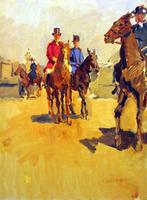
The Hunt's Return
Isaac Israels
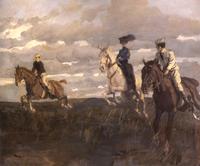
Horseback riding (Return, Hunting)
Ettore Tito
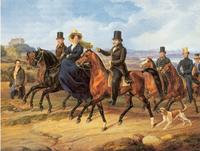
Cavalcade in front of Heiligenberg Castle Prince Karl Egon II of Fürstenberg and Amalie, b. Princess of Baden
Albrecht Adam
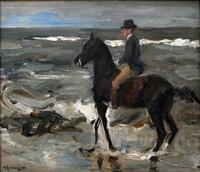
Rider on the Beach
Max Liebermann
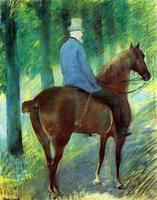
Mr. Robert S. Cassatt on Horseback
Mary Cassatt
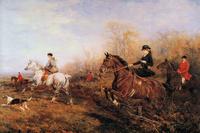
Out for a Scamper
Heywood Hardy
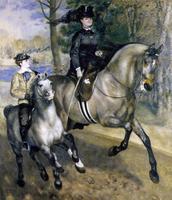
Riding in the Bois de Boulogne (Madame Henriette Darras or The Ride)
Pierre-Auguste Renoir
Cheval Arrivant De La Chasse
Carle Vernet
Boy on Pony (unfinished)
Algernon Talmage
Portrait équestre de François Adolphe Akermann
Franz Xaver Winterhalter
Amazone
Edmond-Georges Grandjean
The Trainers
Edgar Degas
Horse carriage
Théodore Géricault